Skip to content
Epomedicine

Mnemonics, Simplified Concepts & Thoughts

Epomedicine

Mnemonics, Simplified Concepts & Thoughts

Bronchopulmonary segments : Mnemonic

Epomedicine, Jun 12, 2023May 19, 2024

Features of Bronchopulmonary segments:

  1. Subdivision of the lobe of lung
  2. Pyramidal in shape – apex towards hilum and base towards lung surface
  3. Surrounded by connective tissue
  4. Aerated by segmental (tertiary) bronchus
  5. Each segment has it’s own artery (segmental branch of pulmonary artery)
  6. Drained by intersegmental veins (tributaries of pulmonary veins)
  7. Surgically resectable

Right Lung

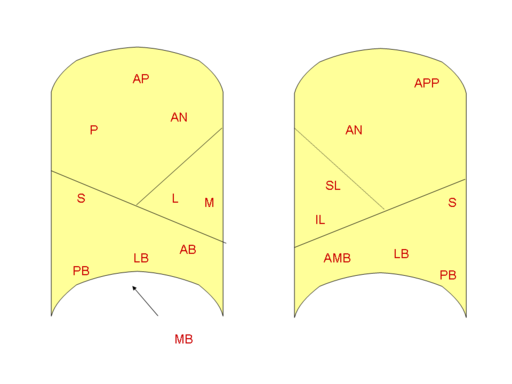
Mnemonic: A PALM Seed Makes Another Little Palm (from top to bottom)

1. Superior lobe:

  • Apical
  • Posterior
  • Anterior

2. Middle lobe:

  • Lateral
  • Medial

3. Inferior lobe:

  • Superior
  • Medial basal
  • Anterior basal
  • Lateral basal
  • Posterior basal
bronchopulmonary segments schematic
No machine-readable author provided. Arcadian assumed (based on copyright claims)., Public domain, via Wikimedia Commons

Left Lung

Instead of lateral and medial segment as described in middle lobe of right lung, the left lung lingula has:

  1. Superior lingular bronchopulmonary segment
  2. Inferior lingular bronchopulmonary segment

Some books mention 8 bronchopulmonary segments in left lung, and in these situations, it is due to merging of:

  1. Apical + Posterior segment in upper lobe = Apicoposterior
  2. Anterior + Medial basal segments in lower lobe = Anteromedial

  • Facebook
  • Twitter
PGMEE, MRCS, USMLE, MBBS, MD/MS AnatomyRespiratory system

Post navigation

Previous post
Next post

Related Posts

PGMEE, MRCS, USMLE, MBBS, MD/MS

Pharmacokinetics Mnemonics

Aug 12, 2019Aug 18, 2024

ADME is the 4-letter acronym used to describe pharmacokinetics: ABCD is another 4-letter acronym used to describe pharmacokinetics: The most important pharmacokinetic parameters from a dosing point of view are: Vd = Volume of distributionD = DoseCo = Concentration in plasmaCL = ClearancekE = Elimination constantt1/2 = Half life In…

Read More
PGMEE, MRCS, USMLE, MBBS, MD/MS coombs test

Coomb’s test : Mnemonic

May 23, 2019May 23, 2019

Components of Coomb’s test: Mnemonic: ABCD A: Antibody (to be detected) B: Blood antigen (RBC) C: Coomb’s reagent (Anti-antibody) D: Detect agglutination Direct Coomb’s/Antiglobulin test (DAT or DCT): Mnemonic: In DAT/DCT we take A+B from patient and add C [(A+B) + C] Another Mnemonic: DCBA (Direct Coomb’s detect Blood Bound…

Read More
PGMEE, MRCS, USMLE, MBBS, MD/MS branchial apparatus embryology

Branchial Apparatus (Pharyngeal arches and pouches) : Mnemonics

Aug 6, 2015May 18, 2024

Synonym: Pharyngeal apparatus Mnemonic: CAP covers from out to in Pharyngeal arches are equivalent of gill arches in fish that develop in a cranio-caudal sequence. Derivatives of Pharyngeal or Branchial Apparatus   Pharyngeal cleft Pharyngeal arch Pharyngeal pouch   Ectoderm Mesoderm Neural crest Cranial Nerves Arteries Endoderm 1st External Auditory Meatus…

Read More

Leave a Reply Cancel reply

Your email address will not be published. Required fields are marked *

This site uses Akismet to reduce spam. Learn how your comment data is processed.

Pre-clinical (Basic Sciences)

Anatomy

Biochemistry

Community medicine (PSM)

Embryology

Microbiology

Pathology

Pharmacology

Physiology

Clinical Sciences

Anesthesia

Dermatology

Emergency medicine

Forensic

Internal medicine

Gynecology & Obstetrics

Oncology

Ophthalmology

Orthopedics

Otorhinolaryngology (ENT)

Pediatrics

Psychiatry

Radiology

Surgery

RSS Ask Epomedicine

  • What to study for Clinical examination in Orthopedics?
  • What is the mechanism of AVNRT?

Epomedicine weekly

  • About Epomedicine
  • Contact Us
  • Author Guidelines
  • Submit Article
  • Editorial Board
  • USMLE
  • MRCS
  • Thesis
©2026 Epomedicine | WordPress Theme by SuperbThemes