Skip to content
Epomedicine

Mnemonics, Simplified Concepts & Thoughts

Epomedicine

Mnemonics, Simplified Concepts & Thoughts

Branches of Celiac trunk, Superior and Inferior mesenteric arteries and veins

Epomedicine, May 13, 2024May 13, 2024

Celiac trunk (T12)

Mnemonic: LHS (Left Hand Side)
Supplies Foregut (Upto opening of bile duct in 2nd part of duodenum)

1. Left gastric artery

  • Esophageal branches
  • Gastric branches

2. Hepatic artery (common)

  • Gastroduodenal artery
    • Supraduodenal artery
    • Superior pancreaticoduodenal artery
    • Right gastro-epiploic artery
  • Hepatic artery proper
    • Right gastric artery
    • Left hepatic artery
    • Right hepatic artery
      • Cystic artery

3. Splenic artery

  • Splenic branches
  • Pancreatic branches (body and tail)
  • Short gastric branches
  • Left gastro-epiploic artery

Superior Mesenteric Artery (L1)

Mnemonic: IMRIS
Supplies Midgut (Upto proximal 2/3 of transverse colon)

1. Inferior pancreaticoduodenal artery

2. Middle colic artery

3. Right colic artery

4. Ileo-colic artery

5. Small intestinal branches (Ileal and Jejunal)

Inferior Mesenteric Artery (L3)

Mnemonic: LeSS
Supplies Hindgut (Upto anal canal above pectinate line)

1. Left colic artery

2. Sigmoidal artery

3. Superior rectal artery
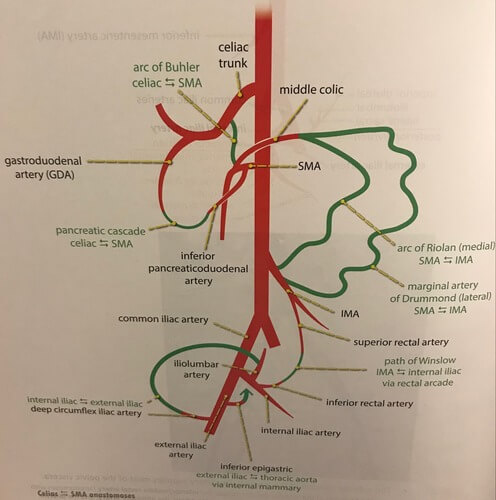
celiac trunk SMA IMA

Collateral pathways:

The collateral pathways of the mesenteric arterial circulation include the pancreatico–duodenal arcade, arc of Riolan, arc of Buhler, arc of Barkow, and the marginal artery of Drummond.

  1. Kirk’s arcade: Dorsal pancreatic artery + Inferior pancreatico-duodenal arteries
  2. Arc of Buhler: Celiac artery + Superior mesenteric artery
  3. Arc of Barkow: Left gastroepiploic artery + Right gastroepiploic artery
  4. Arc of Riolan: Superior mesenteric artery (middle colic artery) + Inferior mesenteric artery
  5. Marginal artery of Drummond: Terminal branches of SMA + Terminal branches of IMA

Critical points:

  1. Sudeck’s critical point (rectosigmoid junction): At the point of origin of last sigmoidal arterial branch from IMA
  2. Griffith’s critical point (splenic flexure): At the site of watershed anastomosis between ascending left colic artery and marginal artery of Drummond

Venous counterparts

ArteriesVenous counterpartTributariesDrains into
Celiac arterySplenic veinShort gastric vein
Left gastro-epiploic vein
Pancreatic vein
Inferior mesenteric vein
Portal vein
Superior mesenteric arterySuperior mesenteric veinRight gastro-epiploic vein
Inferior pancreaticoduodenal veins
Jejunal vein
Ileal vein
Ileocolic vein
Right colic vein
Middle colic vein
Portal vein
Inferior mesenteric arteryInferior mesenteric veinSuperior rectal vein
Sigmoidal vein
Left colic vein
Splenic vein
Portal Vein : Tributaries and Portocaval Anastomoses
  • Facebook
  • Twitter
PGMEE, MRCS, USMLE, MBBS, MD/MS AnatomyCardiovascular systemGastrointestinal system

Post navigation

Previous post
Next post

Related Posts

PGMEE, MRCS, USMLE, MBBS, MD/MS glass prescription slip

Understanding Eye Glass Prescription Slip

Aug 12, 2015Aug 17, 2015

A phoropter/refractor is an instrument commonly used by eye care professionals during an eye examination, containing different lenses used for refraction of the eye during sight testing, to measure an individual’s refractive error and determine his or her eyeglass prescription. Retinoscopy is done instead in children who are unable to…

Read More
PGMEE, MRCS, USMLE, MBBS, MD/MS tnm breast cancer

TNM and Staging of Breast Cancer Simplified

Aug 14, 2016Aug 14, 2016

TNM Classification for Breast Cancer Primary Tumor (T) T1: ≤2 cm (20 mm) mi: ≤1 mm a: 1-5 mm b: 5-10 mm c: 10-20 mm T2: 2-5 cm T3: >5 cm T4: Direct extension to chest wall and/or skin a: Chest wall (exclude only pectoralis muscle adherence/invasion) b: Ipsilateral ulceration, satellite nodules…

Read More
PGMEE, MRCS, USMLE, MBBS, MD/MS

4 Box Model for Clinical Decision Making

Oct 23, 2020Oct 23, 2020

Remember the 4 Cs: Clinical indication (Principle of Benevolence and Non-maleficence) Choice of patient (Principle of respect for Autonomy) Contextual features (Principle of Loyalty and Fairness) Condition (quality) of life (Principle of Benevolence, Non-maleficence and respect for Autonomy) A 5th box can be added: Catholic perspective Example: Clinical indications 18…

Read More

Leave a Reply Cancel reply

Your email address will not be published. Required fields are marked *

This site uses Akismet to reduce spam. Learn how your comment data is processed.

Pre-clinical (Basic Sciences)

Anatomy

Biochemistry

Community medicine (PSM)

Embryology

Microbiology

Pathology

Pharmacology

Physiology

Clinical Sciences

Anesthesia

Dermatology

Emergency medicine

Forensic

Internal medicine

Gynecology & Obstetrics

Oncology

Ophthalmology

Orthopedics

Otorhinolaryngology (ENT)

Pediatrics

Psychiatry

Radiology

Surgery

RSS Ask Epomedicine

  • What to study for Clinical examination in Orthopedics?
  • What is the mechanism of AVNRT?

Epomedicine weekly

  • About Epomedicine
  • Contact Us
  • Author Guidelines
  • Submit Article
  • Editorial Board
  • USMLE
  • MRCS
  • Thesis
©2026 Epomedicine | WordPress Theme by SuperbThemes