Skip to content
Epomedicine

Mnemonics, Simplified Concepts & Thoughts

Epomedicine

Mnemonics, Simplified Concepts & Thoughts

renal papillary necrosis patterns

Ball-on-Tee, Lobster Claw and Signet Ring Sign – Renal papillary necrosis

Epomedicine, Oct 27, 2016

Synonym: Necrotizing papillitis

In renal papillary necrosis, part or all of necrotic renal papilla sloughs and may fall into the pelvicalyceal system, which may remain there (and get calcified) or may be voided down the ureter (often causing obstruction). The renal medulla and papillae are vulnerable to ischemic necrosis because of peculiar arrangement of their blood supply and hypertonic environment.

Common causes of papillary necrosis

Remember the mnemonic: POSTCARDS

  • Pyelonephritis
  • Obstruction of the urinary tract
  • Sickle cell hemoglobinopathies, including sickle cell trait
  • Tuberculosis
  • Cirrhosis of the liver, Chronic alcoholism
  • Analgesic abuse
  • Renal transplant rejection, Radiation
  • Diabetes mellitus (commonest – accounts for more than 50% of the cases of renal papillary necrosis 1Radiology Illustrated: Uroradiology edited by Seung Hyup Kim)
  • Systemic vasculitis

Best modality of evaluation of papillary necrosis

IVU or retrograde pyelography

Radiological signs of papillary necrosis

If the papillary sloughing is:

  1. Partial: Contrast tracks around or onto it
  2. Complete: Calyx appears spherical (with loss of papillaryindentation) and as filling defect
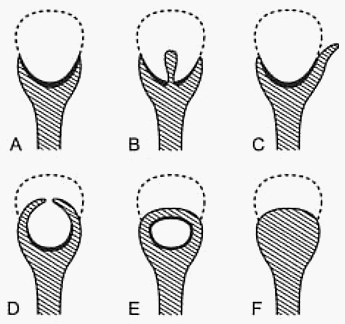
necrotizing papillitis signs
Normal (A), Central excavation with ball-on-tee
appearance (B), Forniceal excavation (C), Lobster
claw appearance (D), Signet ring appearance (E),
and sloughed papilla with clubbed calix (F)

Ball-on-tee appearance: Contrast material filling central excavations in the papilla of the interpolar region gives ball-on-tee appearance.

Lobster claw sign: Excavation extending from the caliceal fornices produces the lobster claw deformity.

Signet ring sign: The necrotic papillary tip may remain within the excavated calyx, producing the signet ring sign when the calyx is filled with contrast material.

Club shaped saccular calyx: Due to sloughed papilla
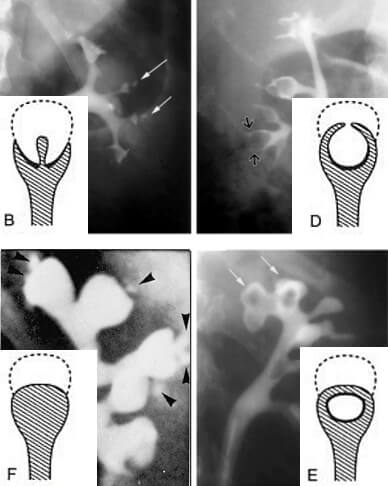
renal papillary necrosis patterns

37 shares
  • Facebook17
  • Twitter
PGMEE, MRCS, USMLE, MBBS, MD/MS Internal medicineRadiologyRenal and Electroloyte

Post navigation

Previous post
Next post

Related Posts

PGMEE, MRCS, USMLE, MBBS, MD/MS

Spondylolisthesis : Summary

Aug 31, 2024Aug 31, 2024

Indications for surgery Age group Spondylolisthesis Indications Pediatric Low grade Failure to respond to conservative treatment (9-12 months)Progressive slippageIntractable low back or radicular painNeurological deficit and deterioration High grade Neurological symptomsSevere sagittal plane spinal deformity Adult Low grade Failure of non-operative treatmentProgressive slippageSymptomatic and radiographically unstable isthmic spondylolisthesis High grade…

Read More
PGMEE, MRCS, USMLE, MBBS, MD/MS

Wrist Ligaments

Jan 7, 2021Jan 7, 2021

a. Interosseous: Extend deeply, directly between two bones Radioscapholunate (RSL) aka Ligament of Testut (neurovascular conduit to SL ligament) Scapholunate (SL) and Lunotriquetral (UL) – volar, dorsal and proximal fibrocartilaginous membrane components Capitohamate (CH) b. Palmar-proximal V: Converge as an “upside-down V” from the radius/ulna to lunate Radio-luno-triquetral (RLT) –…

Read More
PGMEE, MRCS, USMLE, MBBS, MD/MS

Thyroid Gland Blood Supply : Mnemonics

Apr 29, 2024Apr 29, 2024

Arterial supply Arterial anastomosis Venous drainage The venous plexus lies beneath the true capsule (peripheral condensation of fibrous stroma of gland). Hence, during thyroidectomy, thyroid gland is removed along with the true capsule to avert the hemorrhage. False capsule (pre-tracheal fascia) is left intact. Thyroid Arteries and Laryngeal Nerves Mnemonic:…

Read More

Comment

  1. Manal says:
    Jan 17, 2022 at 6:27 am

    Really very informative and consize

    Reply

Leave a Reply Cancel reply

Your email address will not be published. Required fields are marked *

This site uses Akismet to reduce spam. Learn how your comment data is processed.

Pre-clinical (Basic Sciences)

Anatomy

Biochemistry

Community medicine (PSM)

Embryology

Microbiology

Pathology

Pharmacology

Physiology

Clinical Sciences

Anesthesia

Dermatology

Emergency medicine

Forensic

Internal medicine

Gynecology & Obstetrics

Oncology

Ophthalmology

Orthopedics

Otorhinolaryngology (ENT)

Pediatrics

Psychiatry

Radiology

Surgery

RSS Ask Epomedicine

  • What to study for Clinical examination in Orthopedics?
  • What is the mechanism of AVNRT?

Epomedicine weekly

  • About Epomedicine
  • Contact Us
  • Author Guidelines
  • Submit Article
  • Editorial Board
  • USMLE
  • MRCS
  • Thesis
©2026 Epomedicine | WordPress Theme by SuperbThemes