Skip to content
Epomedicine

Mnemonics, Simplified Concepts & Thoughts

Epomedicine

Mnemonics, Simplified Concepts & Thoughts

Approach to Rheumatoid Factor Positive test

Epomedicine, Feb 21, 2023Feb 21, 2023

Rheumatoid factor (RF; also mistakenly called RA factor) is an auto-antibody (commonly IgM and rarely IgG or IgA) directed against the Fc portion of IgG. Increase in both IgM and IgA RFs is almost exclusively observed in patients with RA (Rheumatoid Arthritis).

Clinical Significance of Rheumatoid Factor

1. A positive rheumatoid factor can be found in rheumatic disorders, non-rheumatic disorders, and healthy subjects:

  • Rheumatic disorders: Rheumatoid arthritis (26-90%), Sjogren’s syndrome (75-95%), Mixed connective tissue disease (50-60%), Mixed cryoglobulinemia (40-100%), SLE (15-35%), Polymyositis/dermatomyositis (5-10%), Juvenile RA (5%)
  • Non-rheumatic disorders: Subacute bacterial endocarditis/SBE (40%), Hepatitis B (25%) or C (40-76%), Malignancy (5-25%), Primary biliary cirrhosis (25%)
  • Healthy individuals: Young (upto 4%), Elderly (3-25%)

The negative predictive value for RA and for any rheumatic disease was 89 and 85 percent, respectively.

2. RF titer and value:

  • Normal titer is <1:80. Higher the titer, higher is the sensitivity and specificity for rheumatic diseases.
  • Normal value of RF is <15 IU/ml (defer according to lab). Low positive means >ULN; high positive means >3× ULN.

3. Prognostic value:

RF-positive (seropositive) patients with RA may experience more aggressive and erosive joint disease and extra-articular manifestations than those who are RF-negative (seronegative).

Approach to Rheumatoid Factor Positive test
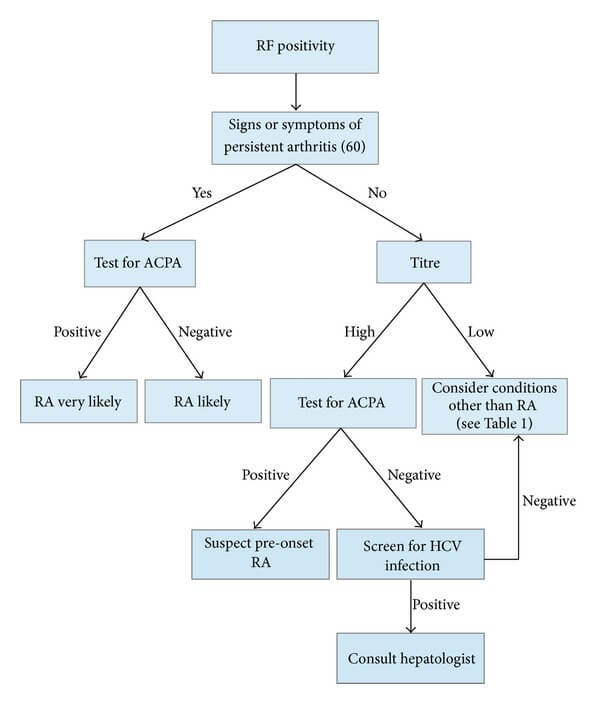
rheumatoid factor positive approach
Source: Ingegnoli F, Castelli R, Gualtierotti R. Rheumatoid factors: clinical applications. Dis Markers. 2013;35(6):727-34. doi: 10.1155/2013/726598. Epub 2013 Nov 13. PMID: 24324289; PMCID: PMC3845430.
  1. High titer RF or Low titer RF with Clinical features of RA = Test for ACPA
  2. High titer RF without clinical features of RA + Negative ACPA = Screen for HCV infection
  3. Low titer RF without clinical features of RA = Consider other conditions where RF is positive

References:

  1. Ingegnoli F, Castelli R, Gualtierotti R. Rheumatoid factors: clinical applications. Dis Markers. 2013;35(6):727-34. doi: 10.1155/2013/726598. Epub 2013 Nov 13. PMID: 24324289; PMCID: PMC3845430.
  2. Khan F. The role of rheumatoid factor in the diagnosis of rheumatoid arthritis.
  3. Tiwari V, Jandu JS, Bergman MJ. Rheumatoid Factor. [Updated 2022 Jul 25]. In: StatPearls [Internet]. Treasure Island (FL): StatPearls Publishing; 2022 Jan-. Available from: https://www.ncbi.nlm.nih.gov/books/NBK532898/
  • Facebook
  • Twitter
PGMEE, MRCS, USMLE, MBBS, MD/MS ImmunologyInternal medicineMusculoskeletal systemOrthopedicsRheumatology

Post navigation

Previous post
Next post

Related Posts

PGMEE, MRCS, USMLE, MBBS, MD/MS

Sarcomere Structure : Mnemonic

Feb 2, 2019Sep 10, 2020

Remember the sequence: Zahir Is A Hungry Man Z line (Zwischen = between [German]) I band A band H zone M line Z is the final alphabet: Z lines represents the end of sarcomere M for middle: M line represents the midline of sarcomere I is a thin letter: I…

Read More
PGMEE, MRCS, USMLE, MBBS, MD/MS

Dermatomes : Mnemonic

Sep 18, 2021Sep 18, 2021

Note: C1 doesn’t have a sensory branch For the purpose of making learning easier, we divide the remaining dermatomal segments into 4 groups which will be accompanied by analogies and mnemonics. C2-C4 These supply the “hooded cape” region. C2: hood region abutting the trigeminal distribution C3: upper neck C4: lower…

Read More
PGMEE, MRCS, USMLE, MBBS, MD/MS

Laryngeal Muscles : Mnemonics

Apr 29, 2024Apr 29, 2024

Extrinsic muscles Nerve supply: Ansa cervicalis (CN XII + C1, C2, C3) Infrahyoid muscles (Depressors of larynx): Mnemonic: TOSS Suprahyoid muscles (Elevators of larynx): Mnemonic: MDGS Intrinsic muscles Muscles Origin Insertion Function Thyroepiglotticus Thyroaryetenoid muscle Epiglottis (lateral surface) Opens laryngeal inlet Aryepiglotticus Oblique arytenoid muscle Epiglottis Closes laryngeal inlet Posterior…

Read More

Leave a Reply Cancel reply

Your email address will not be published. Required fields are marked *

This site uses Akismet to reduce spam. Learn how your comment data is processed.

Pre-clinical (Basic Sciences)

Anatomy

Biochemistry

Community medicine (PSM)

Embryology

Microbiology

Pathology

Pharmacology

Physiology

Clinical Sciences

Anesthesia

Dermatology

Emergency medicine

Forensic

Internal medicine

Gynecology & Obstetrics

Oncology

Ophthalmology

Orthopedics

Otorhinolaryngology (ENT)

Pediatrics

Psychiatry

Radiology

Surgery

RSS Ask Epomedicine

  • What to study for Clinical examination in Orthopedics?
  • What is the mechanism of AVNRT?

Epomedicine weekly

  • About Epomedicine
  • Contact Us
  • Author Guidelines
  • Submit Article
  • Editorial Board
  • USMLE
  • MRCS
  • Thesis
©2026 Epomedicine | WordPress Theme by SuperbThemes