Skip to content
Epomedicine

Mnemonics, Simplified Concepts & Thoughts

Epomedicine

Mnemonics, Simplified Concepts & Thoughts

APGAR score in practice and its implications

Dr. Pedchrome, Sep 2, 2020Sep 2, 2020

A baby is born. Pediatrician receives the delivery, fetal bradycardia with maternal hypertension is the scenario. Baby is efficiently resuscitated. By the time everything is settled its around 7-8 minutes of babies life. In such a rush scenario, APGAR now has to be awarded retrospectively. A skilled pediatrician or neonatologist can do good but still it has a drawback. 

The Apgar scoring system was intended as an evaluative measure of a newborn’s condition at birth and of the need for immediate attention.

In practice

We often use mnemonic form APGAR, for our convenience. But in fact, the mnemonic does not represent the initials for true parameters we use for evaluation.

Example Pulse is not used in newborn for assessment, instead Heart rate is used, but P in APGAR stands for pulse rate.

The real parameters are given below:
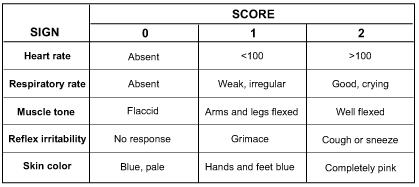
Apgar score

What we use in practice for convenience:
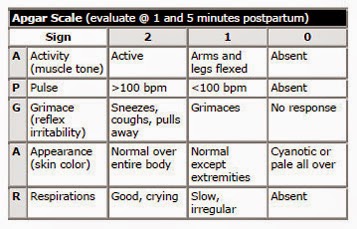
Apgar mnemonic

Though the assessment may not be much different in practice, it makes a big difference when using such parameters in exams.

Importance of APGAR:

1. Despite the advent of modern technology, the Apgar score remains the best tool for the identification of newly born infants in need for cardiopulmonary resuscitation.

2. Data suggest that serial APGAR ratings in infants with early low scores detect clinically important recovery of lack thereof. 

Drawbacks of APGAR:

1. Subjective assessment

2. Retrospective assessment – usually done after resuscitation so health workers usually recall after the event.

Few Interesting Readings: The Apgar scoring system was intended as an evaluative measure of a newborn’s condition at birth and of the need for immediate attention. In the most recent past, individuals have unsuccessfully attempted to link Apgar scores with long-term developmental outcomes. This practice is not appropriate, as the Apgar score is currently defined. Expectant parents need to be aware of the limitations of the Apgar score and its appropriate uses.

J Perinat Educ. 2000 Summer; 9(3): 5 Apgar Scores: Examining the Long-term Significance Kristen S. Montgomery, PhD, RNC, IBCLC

Here is one article on Correct use of the Apgar score for resuscitated and intubated newborn babies 

Pediatric doctor
Dr. Pedchrome

MD Pediatrics and Fellowship Neonatology, he chooses to stay anonymous. He often writes his views online as well as share few important topics for medical students, doctors and specially parents. He does research in pediatrics.

40 shares
  • Facebook40
  • Twitter
PGMEE, MRCS, USMLE, MBBS, MD/MS

Post navigation

Previous post
Next post

Related Posts

PGMEE, MRCS, USMLE, MBBS, MD/MS wound

Wound – It’s types

Aug 13, 2020Aug 17, 2020

A wound is typically described as a break in the surface tissue (such as skin or mucous membrane) or any tissue under the surface. It may involve the superficial planes alone or the deep planes and deep tissue of the body alone or both. Superficial Tissue include: Skin, Superficial Fascia,…

Read More
PGMEE, MRCS, USMLE, MBBS, MD/MS pcr

Polymerase Chain Reaction (PCR) Made Easy

Jun 28, 2016Jan 25, 2017

What is Polymerase Chain Reaction ? It is a process of artificial DNA replication (amplification of a selected part of DNA). As the name suggests: Polymerase: It requires DNA polymerase for extending the added primers to complete DNA replication. Chain Reaction: PCR is run in cycles. The number of molecules…

Read More
PGMEE, MRCS, USMLE, MBBS, MD/MS hla

HLA association mnemonics

Jun 1, 2019Jan 20, 2022

The genes that encode HLA (Human Leukocyte Antigen) are on chromosome 6. MHC class Type Location Function I HLA-A, -B, -C All cells Recognized by CD8+ lymphocytes II HLA-DP, -DQ, -DR Antigen presenting cells Recognized by CD4+ lymphocytes III Complement components Plasma Chemotaxis, opsonization, lysis of bacteria and cells The…

Read More

Leave a Reply Cancel reply

Your email address will not be published. Required fields are marked *

This site uses Akismet to reduce spam. Learn how your comment data is processed.

Pre-clinical (Basic Sciences)

Anatomy

Biochemistry

Community medicine (PSM)

Embryology

Microbiology

Pathology

Pharmacology

Physiology

Clinical Sciences

Anesthesia

Dermatology

Emergency medicine

Forensic

Internal medicine

Gynecology & Obstetrics

Oncology

Ophthalmology

Orthopedics

Otorhinolaryngology (ENT)

Pediatrics

Psychiatry

Radiology

Surgery

RSS Ask Epomedicine

  • What to study for Clinical examination in Orthopedics?
  • What is the mechanism of AVNRT?

Epomedicine weekly

  • About Epomedicine
  • Contact Us
  • Author Guidelines
  • Submit Article
  • Editorial Board
  • USMLE
  • MRCS
  • Thesis
©2026 Epomedicine | WordPress Theme by SuperbThemes