Skip to content
Epomedicine

Mnemonics, Simplified Concepts & Thoughts

Epomedicine

Mnemonics, Simplified Concepts & Thoughts

AKI RIFLE Criteria Mnemonic

Epomedicine, Aug 6, 2024Aug 6, 2024
rifle criteria
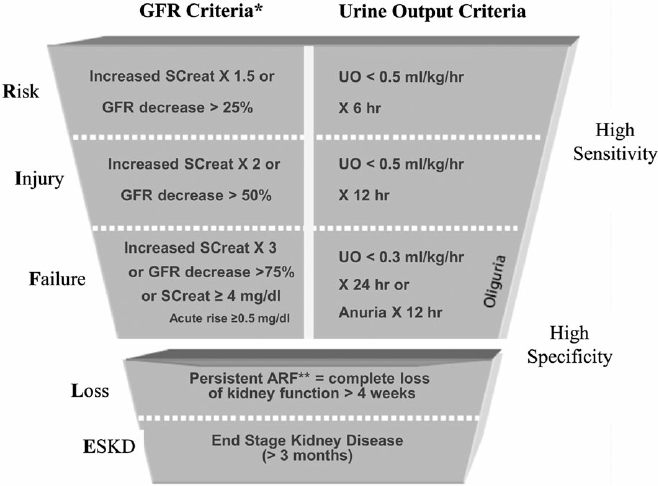
StageGFR criteriaUrine output criteria
Mnemonic1, 2, 3, 41, 2, 3
1. RiskCr ↑ 1.5-2 X
GFR ↓ 25-50% (>1/4)
<0.5 ml/kg/hr X 6-12 (>1/4 day)
2. InjuryCr ↑ 2-3 X
GFR ↓ >50-75% (>2/4)
<0.5 ml/kg/hr X >12-24 hrs (>2/4 day)
3. FailureCr ↑ >3 X
Cr ↑ 0.5 mg/dl to >4 mg/dl
GFR ↓ >75% (>3/4)
<0.3 ml/kg/hr X >/= 24 hrs
Anuria >12 hrs
4. LossNeed for dialysis >4 weeks
5. ESRDNeed for dialysis >3 months

This system has a separate criteria for creatinine and urine output. If the patient’s condition falls under two different levels, then the worse classification should be used.

RIFLE-FC = denotes ‘acute-on-chronic’ disease.

RIFLE-FO = when RIFLE-F classification is reached by urine output criteria only

  • Facebook
  • Twitter
PGMEE, MRCS, USMLE, MBBS, MD/MS Internal medicinePediatricsRenal and Electroloyte

Post navigation

Previous post
Next post

Related Posts

PGMEE, MRCS, USMLE, MBBS, MD/MS

Scheurmann’s Disease : Mnemonic

Mar 27, 2021Oct 20, 2022

Mnemonic: Remember “S” for Scheurmann Structural kyphosis (sagittal deformity) of thoracic or thoracolumbar spine Skeletally immature sons (0.4-10% of adolescents between 10-14 years; onset with prepubertal growth spurt; M:F = 2-7:1) Strong hereditary (genetic) predisposition and Several theories: Scheurmann’s vertebral epiphyseal disturbance theory Schmorl’s nodes (herniation of disc material into…

Read More
PGMEE, MRCS, USMLE, MBBS, MD/MS

Swan neck deformity vs Boutonniere deformity

Jun 5, 2022Jun 5, 2022

Alterations in the relationships between the balanced extrinsic and intrinsic musculature of the hand due to trauma or secondary to the effects of systemic disease may cause the development of functional deformities such as a boutonnière or swan-neck deformity. Swan-neck deformity Boutonniere deformity Deformity PIPJ Hyperextension PIPJ Flexion DIPJ Flexion…

Read More

Anatomy and Physiology of Sebaceous glands

Nov 11, 2013

Definition: Sebaceous glands are numerous microscopic glands in the dermis that usually open into the hair follicles and secrete sebum. They are holocrine glands, i.e., the sebum consists of the entire secreting cells. Location: Found everywhere on the skin apart from the palms and soles Types of Sebaceous glands: 1….

Read More

Leave a Reply Cancel reply

Your email address will not be published. Required fields are marked *

This site uses Akismet to reduce spam. Learn how your comment data is processed.

Pre-clinical (Basic Sciences)

Anatomy

Biochemistry

Community medicine (PSM)

Embryology

Microbiology

Pathology

Pharmacology

Physiology

Clinical Sciences

Anesthesia

Dermatology

Emergency medicine

Forensic

Internal medicine

Gynecology & Obstetrics

Oncology

Ophthalmology

Orthopedics

Otorhinolaryngology (ENT)

Pediatrics

Psychiatry

Radiology

Surgery

RSS Ask Epomedicine

  • What to study for Clinical examination in Orthopedics?
  • What is the mechanism of AVNRT?

Epomedicine weekly

  • About Epomedicine
  • Contact Us
  • Author Guidelines
  • Submit Article
  • Editorial Board
  • USMLE
  • MRCS
  • Thesis
©2026 Epomedicine | WordPress Theme by SuperbThemes