Introduction
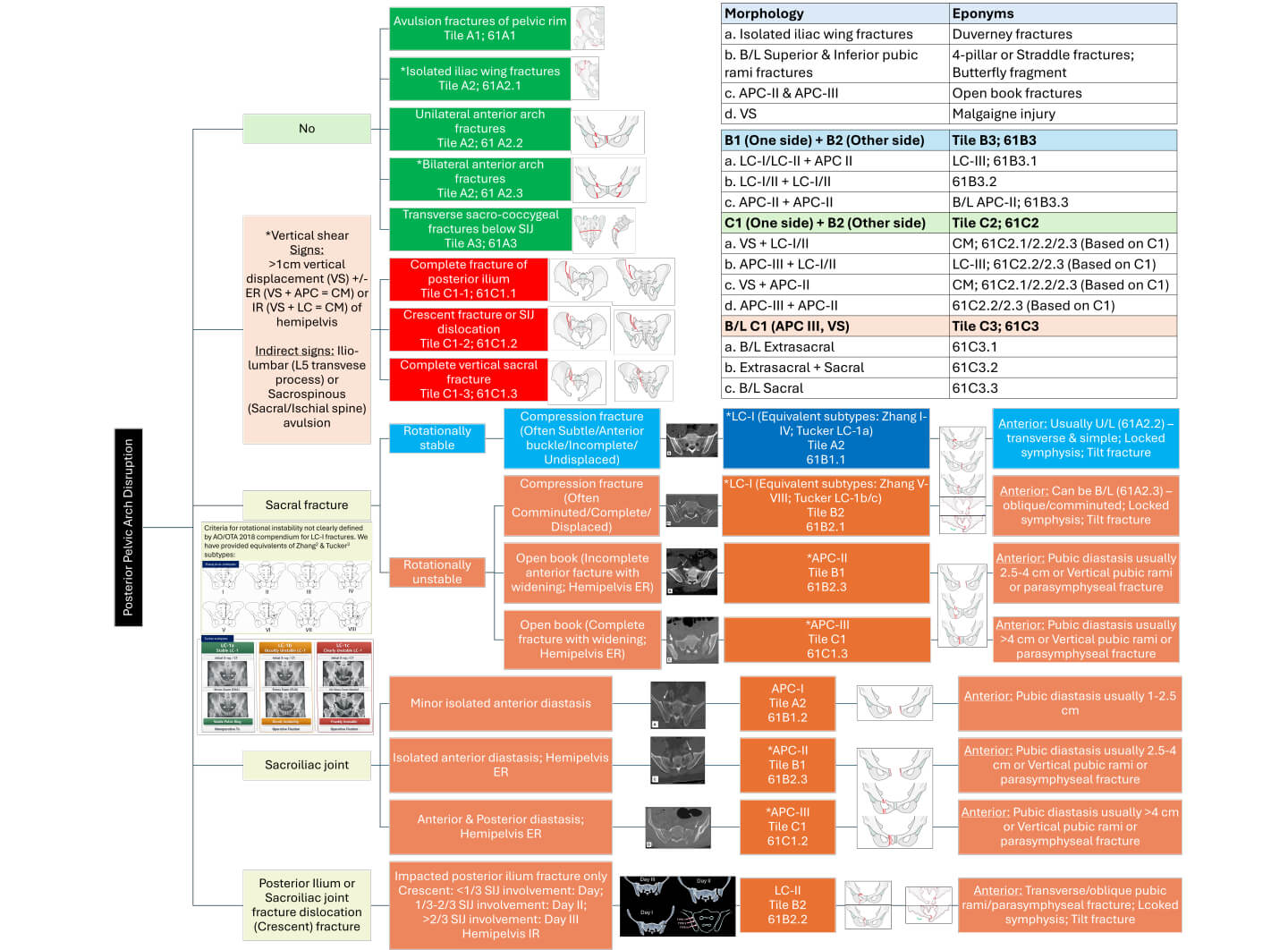
Existing Young-Burgess (YB), Tile & AO/OTA classification systems for pelvic ring fractures demonstrate inconsistent and often only fair-to-moderate inter-observer reliability (kappa = 0.30–0.79), creating diagnostic variability that can impact treatment planning and communication among orthopedicians.1 A clear, stepwise, unified algorithm could improve trainee education, standardize radiographic interpretation, and aid in clinical communication. The objective was to develop an algorithmic, morphology-driven approach that integrates YB mechanisms, Tile comprehensive classification, & AO/OTA 20183, & to present it as an educational decision-support tool.
Methods:
A stepwise flowchart was constructed based on anatomical fracture morphology identifiable on AP, inlet, outlet radiographs and CT. Each morphological endpoint was mapped to: YB mechanism (LC, APC, VS, CM), Tile classification (A, B, C) & AO/OTA 2018 pelvic ring classification (61 A–C). An interactive online decision-support tool was created using the same logic. The algorithm was applied to representative pelvic fracture patterns derived from standard trauma textbooks.
Discussion:
This tool: a) simplifies education for residents and medical students, b) standardizes reporting between emergency medicine, radiology, and orthopedics, c) aids in rapid assessment by focusing on key radiographic findings & d) bridges three major classification systems through a unified flowchart and an interactive online decision-support tool.
This is a conceptual tool. The next step is validation through a study assessing its impact on classification accuracy and inter-observer agreement. An AI tool that automatically detects fracture pattern and classification from radiographs and CT could be developed.
Conclusion:
A morphology-based algorithm integrating Young-Burgess, Tile and AO/OTA 2018 classifications provides a practical and educational framework for understanding pelvic ring fractures. This approach bridges mechanism, stability, and anatomy, improving clarity and reproducibility in classification.
Digital Classification Tool
References:
- Surakanti AR, Lampasona N, Choudhari J, et al.
Accuracy of AO-Tile and Young–Burgess pelvic ring classifications: a systematic review. Int J Orthop Rehabil. 2024;10:1–9. - Zhang BF, Wang J, Zhang YM, et al.
Morphological mapping of LC-1 pelvic fractures and pelvic ring stability. J Orthop Surg Res. 2021;16:675.Meinberg EG, Agel J, Roberts CS, et al. - Fracture and dislocation classification compendium – 2018. J Orthop Trauma. 2018;32(Suppl 1):S1–S170.

He is the section editor of Orthopedics in Epomedicine. He searches for and share simpler ways to make complicated medical topics simple. He also loves writing poetry, listening and playing music. He is currently pursuing Fellowship in Hip, Pelvi-acetabulum and Arthroplasty at B&B Hospital.