Today was one of those surgeries that stays with you not just for the technical challenge, but for what it teaches you as a growing orthopedic surgeon.
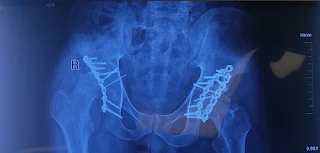
Our patient was a 30-year-old male with painful AVN of the femoral head, years after an acetabular fracture that had been treated with ORIF and a posterior wall reconstruction plate. He had a pre-existing foot drop.
We performed a metal-on-poly Total Hip Replacement (THR) via the posterior approach to reduce the patient cost. The plan was to retain the posterior plate, but as is often the case, bones have their own plans. The plate obstructed the optimal placement of the acetabular cup, so we had to remove it.
Implants used:
- 54 mm acetabular cup
- 54 mm elevated polyethylene liner
- 36 mm (+offset) femoral head
- Size 7 femoral stem
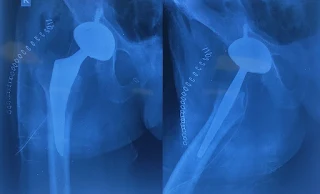
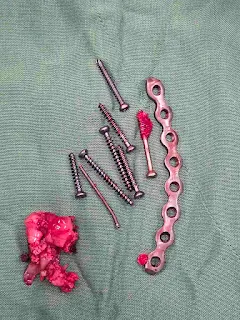
While the technical details are important, today I want to focus on the learnings that stood out – the kind you don’t always find in textbooks.
1. Positioning of patient for posterior approach to hip
- Lateral decubitus position on a traditional operating room table
- Posts should be placed anteriorly at the level of the pubic symphysis and chest and posteriorly at the level of the sacrum and shoulder blades.
- Before draping, the operative hip should be ranged to ensure adequate stability while still allowing full maneuverability.
- The ipsilateral arm should be stabilized with a padded arm board. A padded axillary roll should be placed under the contralateral chest wall to avoid brachial plexopathy.
Points to focus:
- ASIS must be perpendicular to the table – for estimating cup version
- Gluteal folds must be parallel to the table – for estimating cup version
2. Draping for THR
We usually start by draping the operative limb with traditional sterilized cloth drapes. Then use Hip U-drape and Anesthesia drape. Finally, the skin area is sealed with Ioban.
According to Blom et al., disposable non-woven drapes are superior to reusable woven cotton/linen drapes in resisting bacterial penetration.
Haeri et al. showed that non-woven fabrics, drapes, and gowns made of woven fabrics are ineffective barriers against penetration by microorganisms. Additionally, they demonstrated that contamination of woven fabrics increased relative to the length of the operation, the extent of surgical manipulation, and the distance between particles and the surgical site infection. To the contrary, non-woven fabrics prevent this route of contamination.
3. THA in patients with prior acetabular ORIF
A paper by our mentor himself and the team, has highlighted the following:
“Previous implants if any should be removed only if they are in the way of cup implantation or infected.5 Press fit uncemented modern porous metal acetabular component with multiple screw options is the preferred implant for the majority of cases. Complex fractures may require major reconstruction with revision THA implants especially when a pelvic discontinuity is present.“
Besides, the posterior capsule and external rotators are often fibrosed and distorted and the acetabular socket may not be hemispherical anymore posing further challenges.
4. Use of mobile app inclinometer for acetabular cup placement
Another article by our mentors, has highlighted the following:
“Intra-operative inclinometer measurements of cup inclination are not statistically significantly different from post-operative radiographic measurements. Thus, using an inclinometer for accurate coronal acetabular cup positioning provides a reliable safeguard for the surgeon.“
5. 9 Intraoperative tests during THA
The 9 intraoperative tests that must be done after trialing and definite prosthesis give you a near-complete assessment of your construct’s stability, soft tissue balance, and functional alignment before the real stress test i.e., ambulation.
- Flexion
- Extension
- Coplanar test
- Kick start test
- Leg length
- Shuck test
- Adductor tightness
- Position of disadvantage
- Position of dislocation
These tests will be explained in detail in my next THR post.

He is the section editor of Orthopedics in Epomedicine. He searches for and share simpler ways to make complicated medical topics simple. He also loves writing poetry, listening and playing music. He is currently pursuing Fellowship in Hip, Pelvi-acetabulum and Arthroplasty at B&B Hospital.