Skip to content
Epomedicine

Mnemonics, Simplified Concepts & Thoughts

Epomedicine

Mnemonics, Simplified Concepts & Thoughts

cannula mnemonic

IV Cannula Color Code : Tricks to Remember

Epomedicine, Apr 17, 2020Oct 22, 2022

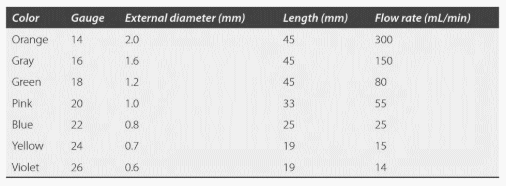
Present day IV cannulae are available from sizes 14 gauge to 26 gauge with universal color coding for easy recongnition of IV cannula. Smaller the gauge, wider is the cannula and has higher flow rate.

  • Normal adult size: 18-20 G
  • Situations requiring rapid fluid transfusion like trauma: 14-16 G
  • Preferred pediatric size: 22 G
  • Infants and neonates: 24-26 G

Here is an image mnemonic and will require your imagination. Imagine the environment around you.

  1. The earth has magma inside (orange color) – 14 G
  2. There is soil on surface (grey color) – 16 G
  3. Grass has grown on the soil (green color) – 18 G
  4. Pink flower has grown above the grass (pink color) – 20 G
  5. Above is the blue sky (blue color) – 22 G
  6. The sun is in the sky (yellow color) – 24 G
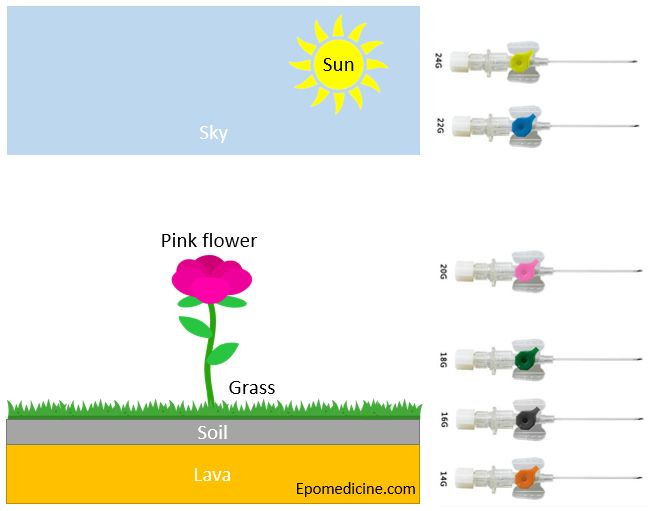
IV cannula mnemonic
You can add rainbow above the sun to remember the IV cannula of 26 G which is violet/purple in color.
iv cannula diameter flow rate

Or simply remember this mnemonic: Oh Great God, please bless your progeny (OGGPBYV)

  1. Orange
  2. Grey
  3. Green
  4. Pink
  5. Blue
  6. Yellow
  7. Purple/Violet

Another easy way to do is to use the rhyme:

a. Blue: Twenty two (22 G)
b. Green: Eighteen (18 G)

External diameter of cannula:

Remember the pink (20 G) cannula is 1 mm in diameter. For cannula next to pink: 1 +/- 0.2 mm

  • 18 G (green): 1.2 mm
  • 22 G (blue): 0.8 mm

For cannula smaller “gauze” than 18 G:

  • 16 G (grey): 1.2 + 0.4 = 1.6 mm
  • 14 G (orange):1.6 + 0.4 = 2 mm

For cannula larger than 22 G:

  • 24 G (yellow): 0.8 – 0.1 = 0.7 mm
  • 26 G (purple): 0.7 – 0.1 = 0.6 mm

Or, simply remember that the diameter of pink cannula is 1 mm, that of purple is almost half, i.e. 0.5 mm and that of orange is almost double, i.e. 2 mm and others are in between these.
46 shares
  • Facebook13
  • Twitter
Emergency Medicine Cardiovascular systemNursing

Post navigation

Previous post
Next post

Related Posts

Emergency Medicine

GIK Regimen – Rule of Ten

Jun 8, 2020Oct 22, 2022

Interchangably used as: GIK or GKI regimen. GKI stands for Glucose, Potassium and Insulin. This simple and effective combined insulin delivery method has gained wide acceptance in perioperative management of diabetic patients who would require Nil Per Oral (NPO) status. Recently, this composition has also been used for management of…

Read More
Emergency Medicine

Burn Injury : Mnemonic Approach (ATLS)

Aug 26, 2023Aug 26, 2023

Mnemonic: BURNS Burn depth and body surface area (BSA) Burn degree Burn depth Features Healing Mnemonic: Number of degrees = Number of structures involved Mnemonic: RBCS 1st Superficial (epidermis only) Red <1 wk 2nd Partial thickness – superficial (epidermis + papillary dermis) Blister + Blanches 1-3 wks Partial thickness –…

Read More
Emergency Medicine

Polytrauma Assessment and Management (ATLS) : Mnemonics

Jul 31, 2020Aug 26, 2023

SIEVE triage system Mnemonic: ABC-30-2 Can Do Approach to assessment and initial management Mnemonic: ARM Adjuncts to Primary Survey Reflects the adequacy of resuscitation. Mnemonic: PEA COVER Primary Survey Follow the look, listen, feel approach – Mnemonic: ABCDE 1. Airway and C-spine protection: 2. Breathing: 3. Circulation and control of…

Read More

Comments (4)

  1. John Campbell says:
    May 21, 2020 at 2:42 pm

    Think there might be some typo in the text. Picture (https://epomedicine.com/wp-content/uploads/2020/04/iv-cannula.gif) with below text are mismatch.

    External diameter of cannula:
    Remember the pink (20 G) cannula is 1 mm in diameter. For cannula next to pink: 1 +/- 0.2 mm

    18 G (green): 0.8 mm –> this green one should be 1.2mm as per in the picture.
    22 G (blue): 1.2 mm –> this blue one should be 0.8mm as per in the picture.
    For cannula smaller than 18 G:

    16 G (grey): 0.8 – 0.1 = 0.7 mm –> this grey one should be 1.6mm as per in the picture.
    14 G (orange): 0.7 – 0.1 = 0.6 mm –> this orange one should be 2.0mm as per in the picture.

    For cannula larger than 22 G:

    24 G (yellow): 1.2 + 0.4 = 1.6 mm –> this yellow one should be 0.7mm as per in the picture.
    26 G (purple): 1.6 + 0.4 = 2 mm –> this purple one should be 0.6mm as per in the picture.

    Please re-edit this content and make sure accurate double/triple-check information before publish. Thank you.

    Reply
    1. Epomedicine says:
      May 22, 2020 at 11:01 am

      Thank you for the correction. We have updated the article with correction.

      Reply
  2. Ibeh Dorothy says:
    Oct 1, 2020 at 3:39 pm

    Thanks, it is very insightful.

    Reply
    1. Raksha bhagat says:
      Mar 15, 2024 at 3:24 am

      Thanks…………. We want to more information….

      Reply

Leave a Reply to Epomedicine Cancel reply

Your email address will not be published. Required fields are marked *

This site uses Akismet to reduce spam. Learn how your comment data is processed.

Pre-clinical (Basic Sciences)

Anatomy

Biochemistry

Community medicine (PSM)

Embryology

Microbiology

Pathology

Pharmacology

Physiology

Clinical Sciences

Anesthesia

Dermatology

Emergency medicine

Forensic

Internal medicine

Gynecology & Obstetrics

Oncology

Ophthalmology

Orthopedics

Otorhinolaryngology (ENT)

Pediatrics

Psychiatry

Radiology

Surgery

RSS Ask Epomedicine

  • What to study for Clinical examination in Orthopedics?
  • What is the mechanism of AVNRT?

Epomedicine weekly

  • About Epomedicine
  • Contact Us
  • Author Guidelines
  • Submit Article
  • Editorial Board
  • USMLE
  • MRCS
  • Thesis
©2026 Epomedicine | WordPress Theme by SuperbThemes