Skip to content
Epomedicine

Mnemonics, Simplified Concepts & Thoughts

Epomedicine

Mnemonics, Simplified Concepts & Thoughts

Tanner stages : Simplified with Mnemonics

Epomedicine, Jun 19, 2022Jun 19, 2022

Breast Development

Mnemonic: ABCDE

  1. Stage 1 – Absent development
  2. Stage 2 – Breast bud
  3. Stage 3 – Common Contour (not separated)
  4. Stage 4 – Double mound (contour separated)
  5. Stage 5 – End stage development (Adult type)
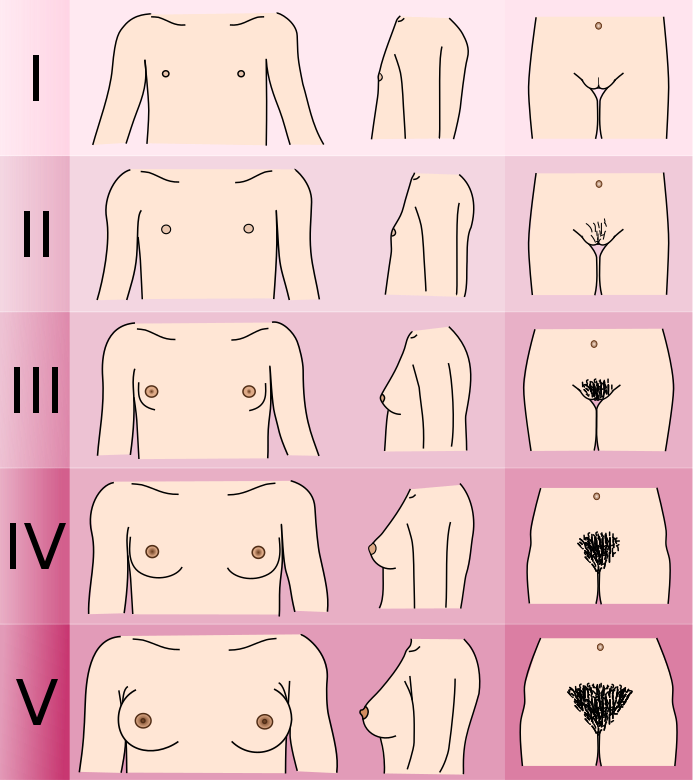
female tanner stage
M.Komorniczak, polish wikipedist.Illustration by : Michał KomorniczakThis file has been released into the Creative Commons 3.0. Attribution-ShareAlike (CC BY-SA 3.0)If you use on your website or in your publication my images (either original or modified), you are requested to give me details: Michał Komorniczak (Poland) or Michal Komorniczak (Poland).For more information, write to my e-mail address: [email protected], CC BY-SA 3.0, via Wikimedia Commons

Male Genitalia Development

Mnemonic: ABCDE

  1. Stage 1 – Absent development
  2. Stage 2 – Bulky testes and scrotum
  3. Stage 3 – Cock lengthens
  4. Stage 4 – Darkening of scrotum
  5. Stage 5 – End stage development (Adult type)
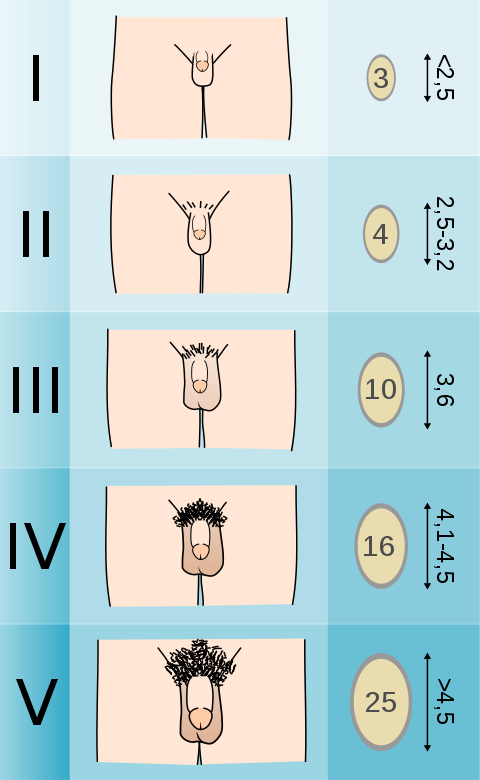
male tanner stage
M.Komorniczak, polish wikipedist.Illustration by : Michał KomorniczakThis file has been released into the Creative Commons 3.0. Attribution-ShareAlike (CC BY-SA 3.0)If you use on your website or in your publication my images (either original or modified), you are requested to give me details: Michał Komorniczak (Poland) or Michal Komorniczak (Poland).For more information, write to my e-mail address: [email protected], CC BY-SA 3.0, via Wikimedia Commons

Pubic Hair Development

Mnemonic: A Small CAT

  1. Stage 1 – Absent
  2. Stage 2 – Straight
  3. Stage 3 – Curling
  4. Stage 4 – Adult
  5. Stage 5 – Thighs
FemaleBothMale
StageBreastPubic HairGenitalia
1PreadolescentNoneChildhood size
2Breast budSparse, straightEnlargement of scrotum, testes
3Areolar diameter enlargesDarker, curlingPenis grows in length; testes continue to enlarge
4Secondary mound; separation of contoursCoarse, curly, adult typePenis grow in length/breadth; scrotum darkens, testes enlarge
5Mature femaleAdult, extends to thighAdult shape/size
  • Facebook
  • Twitter
Clinical Skills and Approaches Clinical examinationPediatrics

Post navigation

Previous post
Next post

Related Posts

Clinical Skills and Approaches nutritional history

Nutritional History Made Easy

Sep 5, 2015

Energy Requirement 1. For a child with normal body weight: 100 Kcal/kg for 1st 10 kg Add 50 Kcal/kg for next 10 kg Add 20 Kcal/kg for body weight additional to 20 kgs 2. By age: For ≤ 1 year: 100 Kcal/kg/day Every additional years till puberty: Add 100 Kcal/year…

Read More
Clinical Skills and Approaches Conjunctival-pallor

Pallor

Nov 15, 2013Aug 18, 2017

Synonyms: Paleness Definition of Pallor Pallor is the paleness of skin and mucous membranes, due to the reduced amount of oxyhemoglobin or decreased peripheral perfusion. Sites to look for pallor Lower palpebral conjunctiva Tip and dorsum of the tongue Soft palate Nail beds Palmar or plantar creases General body skin…

Read More
Clinical Skills and Approaches Bryant's triangle

Bryant’s triangle (Examination of Hip)

Jun 4, 2014Sep 5, 2022

Synonyms: Iliofemoral triangle Position: The patient lies supine with the pelvis square, and the limbs in identical position. Points of the Bryant’s triangle: The Bryant’s triangle is a right angled formed by: Anterior Superior Iliac Spine (ASIS) Tip of Greater trochanter Junction of perpendiculars from the 2 points above (1st draw…

Read More

Comment

  1. Rabindranath Das says:
    Sep 10, 2022 at 4:50 am

    Excellent

    Reply

Leave a Reply to Rabindranath Das Cancel reply

Your email address will not be published. Required fields are marked *

This site uses Akismet to reduce spam. Learn how your comment data is processed.

Pre-clinical (Basic Sciences)

Anatomy

Biochemistry

Community medicine (PSM)

Embryology

Microbiology

Pathology

Pharmacology

Physiology

Clinical Sciences

Anesthesia

Dermatology

Emergency medicine

Forensic

Internal medicine

Gynecology & Obstetrics

Oncology

Ophthalmology

Orthopedics

Otorhinolaryngology (ENT)

Pediatrics

Psychiatry

Radiology

Surgery

RSS Ask Epomedicine

  • What to study for Clinical examination in Orthopedics?
  • What is the mechanism of AVNRT?

Epomedicine weekly

  • About Epomedicine
  • Contact Us
  • Author Guidelines
  • Submit Article
  • Editorial Board
  • USMLE
  • MRCS
  • Thesis
©2026 Epomedicine | WordPress Theme by SuperbThemes