Skip to content
Epomedicine

Mnemonics, Simplified Concepts & Thoughts

Epomedicine

Mnemonics, Simplified Concepts & Thoughts

FARES method of Shoulder Reduction

Epomedicine, Nov 30, 2019Nov 30, 2019
fares method shoulder reduction

Indication: Anterior shoulder dislocation

Position of patient: Supine

Position of physician: Standing on the side of the dislocated shoulder

Steps:

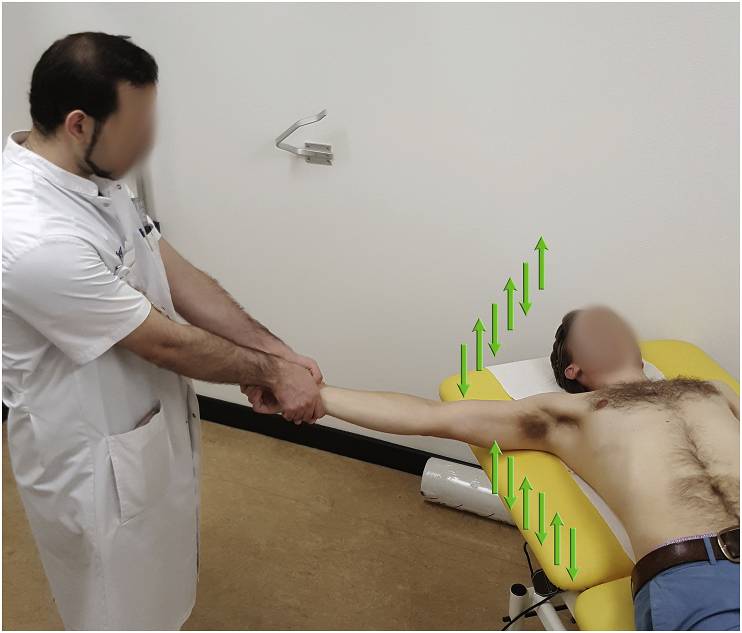
  1. Physician holds the wrist of the patient with both the arms keeping elbow of the patient extended and forearm in neutral position
  2. Arm is slowly abducted in brief oscillating movement (about 5 cm up and down movement – 2 to 3 oscillations per second)
  3. After 90 degrees of abduction, add external rotation while continuing oscillations
  4. Reduction is usually achieved around 120 degrees of abduction
  5. After achieving reduction, slowly internally rotate the arm to bring the forearm to lie across the patient’s chest
https://www.youtube.com/watch?v=6DLfst2tso0

Success rate: 88-95%

Reduction time: 2-3 minutes

Pain: 1-2 out of 10 on VAS scale

Reference: Alkaduhimi H, van der Linde JA, Flipsen M, van Deurzen DF, van den Bekerom MP. A systematic and technical guide on how to reduce a shoulder dislocation. Turk J Emerg Med. 2016 Nov 18;16(4):155-168. doi: 10.1016/j.tjem.2016.09.008. PMID: 27995208; PMCID: PMC5154590.
  • Facebook
  • Twitter
Clinical Skills and Approaches Emergency Medicine Emergency medicineMusculoskeletal systemOrthopedics

Post navigation

Previous post
Next post

Related Posts

Emergency Medicine

Bier Block

Jan 11, 2022Jan 11, 2022

Named after: German Surgeon August Bier (first introduced the block in 1908) Definition: It is a peripheral intravenous local anesthetic block (IVRA; Intravenous Regional Anesthesia) of the upper limb using a pneumatic cuff technique Mechanism of action: Local anesthesia diffuses into the small veins surrounding the nerves and then into…

Read More
Clinical Skills and Approaches relative bradycardia enteric fever

Relative Bradycardia

Nov 1, 2017

Synonyms: Faget sign, Sphygmo-thermic dissociation, Sphygmo-thermal dissociation Definition of Relative Bradycardia Physiologically, for each 1 °F rise in body temperature, there is a commensurate increase in the heart rate of 10 beats/min . When temperature elevations are not accompanied by a physiologic increase in the pulse, the patient is said…

Read More
Clinical Skills and Approaches pre-eclampsia features

Approach to hypertension in pregnancy

Aug 31, 2014Aug 17, 2015

Hypertension in pregnancy is one of the major cause of maternal, fetal and neonatal mortality and morbidity in both the developing and developed nations. About 10-15% of pregnancies are accompanied by hypertension and if these are detected early and effective interventions are performed, the prognosis is good. A. HISTORY FOR…

Read More

Leave a Reply Cancel reply

Your email address will not be published. Required fields are marked *

This site uses Akismet to reduce spam. Learn how your comment data is processed.

Epomedicine. FARES method of Shoulder Reduction [Internet]. Epomedicine; 2019 Nov 30 [cited 2025 Dec 23]. Available from: https://epomedicine.com/clinical-medicine/fares-method-of-shoulder-reduction/.

Pre-clinical (Basic Sciences)

Anatomy

Biochemistry

Community medicine (PSM)

Embryology

Microbiology

Pathology

Pharmacology

Physiology

Clinical Sciences

Anesthesia

Dermatology

Emergency medicine

Forensic

Internal medicine

Gynecology & Obstetrics

Oncology

Ophthalmology

Orthopedics

Otorhinolaryngology (ENT)

Pediatrics

Psychiatry

Radiology

Surgery

RSS Ask Epomedicine

  • What to study for Clinical examination in Orthopedics?
  • What is the mechanism of AVNRT?

Epomedicine weekly

  • About Epomedicine
  • Contact Us
  • Author Guidelines
  • Submit Article
  • Editorial Board
  • USMLE
  • MRCS
  • Thesis
©2025 Epomedicine . All rights reserved.