Skip to content
Epomedicine

Mnemonics, Simplified Concepts & Thoughts

Epomedicine

Mnemonics, Simplified Concepts & Thoughts

eschar

Eschar

Epomedicine, Sep 24, 2016

Synonyms

Tache noire

Definition of Eschar

An eschar is a local skin lesions coated by a thick coagulated crust or slough that usually results from burn or infection.
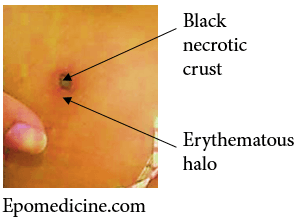
eschar

Causes of Eschar

  1. Tick bite fever
  2. Scrub typhus
  3. Anthrax
  4. Tularaemia
  5. Spider bites
  6. Disseminated fungal infection
  7. Post-burn

Diagnostic Clues

Cigarette-burn Sign

In scrub typhus, the eschar begins as a small papule, then enlarges, undergoes central necrosis, and eventually acquires a blackened crust with an erythematous halo that resembles a cigarette burn. The eschar resembling ‘cigarette burn mark’ is seen in 95% of cases and is most important diagnostic clue of scrub typhus 1Jeong YJ, Kim S, Wook YD, Lee JW, Kim KI, Lee SH. Scrub typhus: clinical, pathologic, and imaging findings. Radiograph 2007;27: 161–72..

Regional lymphadenopathy

Eschars are usually painless and non-pruritic and have great potential to go unnoticed and missed by the physicians. When an eschar is noticed, other regions of the body must be searched for the similar lesion and the draining lymph node region must be examined. A painful lymph node enlargement accompanies in several infections.

  • Facebook
  • Twitter
Clinical Skills and Approaches DermatologyInternal medicinePediatrics

Post navigation

Previous post
Next post

Related Posts

Clinical Skills and Approaches renal angle tenderness

Costovertebral or Renal angle tenderness

Jul 26, 2019Jul 26, 2019

Synonyms: Murphy’s kidney punch, CVA tenderness (CVAT) Anatomy of Costovertebral angle or Renal angle: Costovertebral angle is formed by the junction of the 12th, or lowermost, rib with the paravertebral muscles, which run parallel to and on both sides of the vertebral column. Eliciting costovertebral angle tenderness: Position of patient:…

Read More
Clinical Skills and Approaches Bryant's triangle

Bryant’s triangle (Examination of Hip)

Jun 4, 2014Sep 5, 2022

Synonyms: Iliofemoral triangle Position: The patient lies supine with the pelvis square, and the limbs in identical position. Points of the Bryant’s triangle: The Bryant’s triangle is a right angled formed by: Anterior Superior Iliac Spine (ASIS) Tip of Greater trochanter Junction of perpendiculars from the 2 points above (1st draw…

Read More
Clinical Skills and Approaches facial nerve examination

Examination of Facial Nerve (7th Cranial Nerve)

May 25, 2014Jul 7, 2016

The anatomy of facial nerve has already been discussed in detail earlier. It is essential to have proper knowledge of anatomy to understand this section of clinical examination of facial nerve. A) Inspection: Observe: Face at rest for any facial asymmetry Any facial tics, symmetry of eye blinking or eye…

Read More

Leave a Reply Cancel reply

Your email address will not be published. Required fields are marked *

This site uses Akismet to reduce spam. Learn how your comment data is processed.

Epomedicine. Eschar [Internet]. Epomedicine; 2016 Sep 24 [cited 2026 Jan 30]. Available from: https://epomedicine.com/clinical-medicine/eschar/.

Pre-clinical (Basic Sciences)

Anatomy

Biochemistry

Community medicine (PSM)

Embryology

Microbiology

Pathology

Pharmacology

Physiology

Clinical Sciences

Anesthesia

Dermatology

Emergency medicine

Forensic

Internal medicine

Gynecology & Obstetrics

Oncology

Ophthalmology

Orthopedics

Otorhinolaryngology (ENT)

Pediatrics

Psychiatry

Radiology

Surgery

RSS Ask Epomedicine

  • What to study for Clinical examination in Orthopedics?
  • What is the mechanism of AVNRT?

Epomedicine weekly

  • About Epomedicine
  • Contact Us
  • Author Guidelines
  • Submit Article
  • Editorial Board
  • USMLE
  • MRCS
  • Thesis
©2026 Epomedicine . All rights reserved.