Skip to content
Epomedicine

Mnemonics, Simplified Concepts & Thoughts

Epomedicine

Mnemonics, Simplified Concepts & Thoughts

gastric lymph node stations

TNM and Staging of Gastric Carcinoma Simplified

Epomedicine, Aug 15, 2016Aug 16, 2023

Unique features of stomach in relation to TNM cancer classification

1. Cancer penetrates the muscular propria and invades the ligaments (gastrohepatic and gastrocolic, i.e. lesser and greater omentum respectively) subserosally without breeching the serosa. Gastric cancer invasion of the lesser and greater omentum is T3, not T4. Perforation of the visceral peritoneum is required to be T4.

2. In other sites of GI tract, regional lymph nodes are beyond the serosa. But, in stomach the lymph nodes are located within the serosa. It is the only anatomic site in which positive nodes (T1 N1) are still stage I, assigned to IB. In view of the fact that regional lymph node metastasis usually begins in early period of gastric cancer, regional lymph node dissection should be recommended as part of curative resection.

3. Adding subscript numbers to T and N categories together correlates with stage.

4. The nodal categories are unique: N1, 1 to 2 nodes; N2, 3 to 6 nodes; and N3a 7–15 nodes, N3b has × 16 nodes, >15 nodes. In comparison to many digestive system sites where N1 encompasses all nodal categories, the stomach is the most elaborate.

Study Surgical Anatomy of Stomach for better understanding of Gastric Carcinoma.

TNM Classification of Gastric Carcinoma

Primary Tumor (T)

Stomach is a hollow tube, and like in other gastrointestinal tumors – T staging is dependent upon the depth of invasion.

  • T1: Mucosal and Submucosal
    • a – Mucosal (lamina propria or muscularis mucosae)
    • b – Submucosal
  • T2: Muscularis propria
  • T3: Subserosal without invasion of visceral peritoneum or adjacent structures (can involve gastrohepatic, gastrocolic ligaments and omentum subserosally)
  • T4: Serosal or Adjacent structures
    • a – Serosa (Visceral peritoneum)
    • b – Adjacent structures

Regional Lymph Nodes (N)
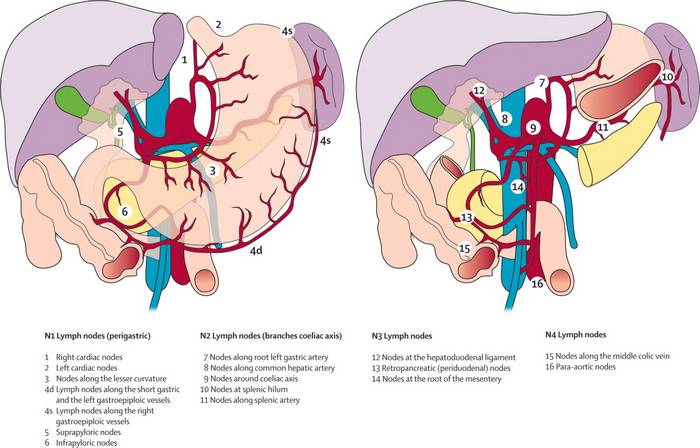
gastric lymph node stations

N staging is done based on number of involvement of nodes.

  • N1: 1-2
  • N2: 3-6
  • N3: ≥7
    • a – 7 to 15
    • b – >15

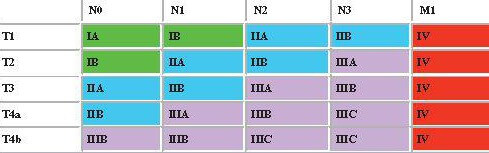
AJCC Staging of Gastric Carcinoma

  • M1 is a separate stage = Stage IV
  • Both T and N progression determines Stage group I-III
  • Subscript addition of T+N determines stage and substage progression; T4a applies to this but T4b is either IIIB or IIIC:
    • Stage IA = 1 = T1N0
    • Stage IB = 2 = T2No or T1N1
    • Stage IIA = 3 = T3N0 or T2N1 or T1N2
    • Stage IIB = 4 = T4(a)N0 or T3N1 or T2N2 or T1N3
    • Stage IIIA = 5 = T4(a)N1 or T3N2 or T2N3
    • Stage IIIB = 6 = T4(a)N2 or T3N3
      • T4b +/- N1 = Stage IIIB
    • Stage IIIC = 7 = T4(a)N3
      • T4b N2/N3 = Stage IIIC
gastric carcinoma staging matrix
22 shares
  • Facebook22
  • Twitter
PGMEE, MRCS, USMLE, MBBS, MD/MS Gastrointestinal systemGeneral SurgeryOncologyPathology

Post navigation

Previous post
Next post

Related Posts

PGMEE, MRCS, USMLE, MBBS, MD/MS

Appearance and Fusion of Ossification Centers

Oct 30, 2019Oct 30, 2019

Upper end of humerus Mnemonic: HGL – 1,3,5 a. Head – by 1 year b. Greater tuberosity – by 3 years c. Lesser tuberosity – by 5 years All 3 centers fuse together by 6 years (1 year after the last center appears) Upper end of femur Mnemonic: HGL –…

Read More
PGMEE, MRCS, USMLE, MBBS, MD/MS

Straight Leg Raising Test (SLRT) – Pathophysiology

Apr 20, 2020Jun 3, 2020

Epineurium of sciatic nerve (like all other nerves) is continuous with the duramater withing the spinal canal which is firmly attached to the foramen magnum above and the filum terminale below. In the elastic neuromeningeal pathway, tension applied at one point will spread through out the length of spine until…

Read More
PGMEE, MRCS, USMLE, MBBS, MD/MS

Thiocolchicoside vs Tizanidine vs Baclofen for Low Back Pain

Apr 30, 2025Apr 30, 2025

Thiocolchicoside is widely used in acute muscular low back pain due to its fast-acting and less sedative profile. Tizanidine is better suited for chronic cases but requires monitoring due to sedative and hepatic effects. Baclofen is more useful for spasticity of CNS origin and is less commonly used for routine…

Read More

Leave a Reply Cancel reply

Your email address will not be published. Required fields are marked *

This site uses Akismet to reduce spam. Learn how your comment data is processed.

Pre-clinical (Basic Sciences)

Anatomy

Biochemistry

Community medicine (PSM)

Embryology

Microbiology

Pathology

Pharmacology

Physiology

Clinical Sciences

Anesthesia

Dermatology

Emergency medicine

Forensic

Internal medicine

Gynecology & Obstetrics

Oncology

Ophthalmology

Orthopedics

Otorhinolaryngology (ENT)

Pediatrics

Psychiatry

Radiology

Surgery

RSS Ask Epomedicine

  • What to study for Clinical examination in Orthopedics?
  • What is the mechanism of AVNRT?

Epomedicine weekly

  • About Epomedicine
  • Contact Us
  • Author Guidelines
  • Submit Article
  • Editorial Board
  • USMLE
  • MRCS
  • Thesis
©2026 Epomedicine | WordPress Theme by SuperbThemes