Skip to content
Epomedicine

Mnemonics, Simplified Concepts & Thoughts

Epomedicine

Mnemonics, Simplified Concepts & Thoughts

Child Pugh Score

Child Pugh Score: Mnemonic and Explanation

Epomedicine, Aug 15, 2016

The Child-Pugh-Turcot (CTP) score consists of 5 clinical features and is used to assess the prognosis of chronic liver disease and cirrhosis.

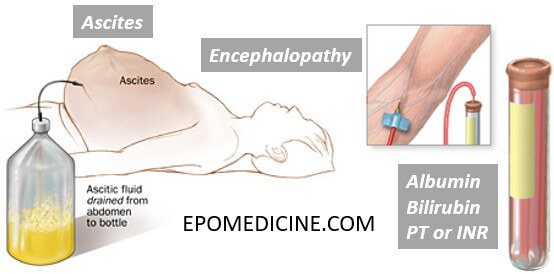
Mnemonic: A BEAP

  1. Albumin (gm/dl)
  2. Bilirubin (mg/dl)
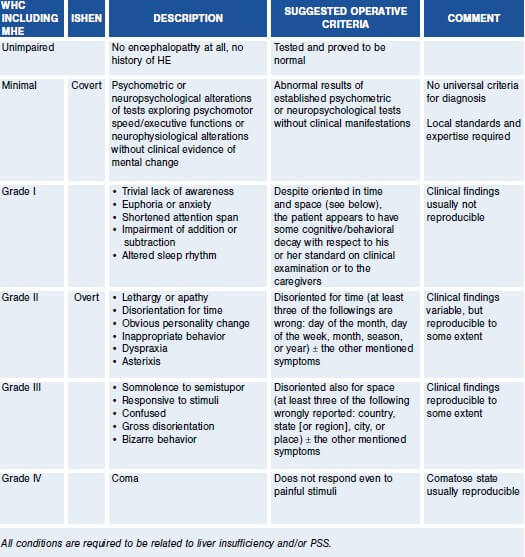
  3. Encephalopathy (Based on West Haven Criteria)
  4. Ascites
  5. Prothrombin Time (PT) Prolonged or INR
Child Pugh Score

Child-Pugh-Turcot Score

Factor 1 point 2 points 3 points
Bilirubin (mg/dl) < 2 2 – 3 < 3
Albumin (g/dl) > 3.5 2.8 – 3.5 < 2.8
INR or (Prothrombin time [seconds prolonged]) < 1.7 (< 4) 1.7 – 2.3 (4 – 6) > 2.3 (> 6)
Ascites None Mild (Diuretic responsive) Moderate or Severe (Diuretic refractory)
Hepatic encephalopathy None Grade I – II Grade III – IV

West Haven Criteria for Hepatic Encephalopathy
West Haven Hepatic Encephalopathy

Interpretation of Child Pugh Turcot Score

Points Class One year survival Two year survival Operative mortality
5 – 6 A 100% 85% Low (<5%)
7 – 9 B 81% 57% Moderate (~25%)
10 – 15 C 45% 35% High (>50%)

MELD (Model For End Stage Liver Disease) Score

Model for End-Stage Liver Disease (MELD) is a numerical scale, ranging from 6 (less ill) to 40 (gravely ill), used for liver transplant candidates age 12 and older. It gives each person a ‘score’ (number) based on how urgently he or she needs a liver transplant within the next three months. The number is calculated by a formula using three routine lab test results:

  1. Bilirubin
  2. INR (prothrombin time)
  3. Creatinine

For Pediatric population (<12 years), there is PELD (Pediatric End Stage Liver Disease) Score which uses Albumin, Growth failure and Age <1 year instead of Creatinine.

Calculate MELD score.

37 shares
  • Facebook35
  • Twitter
PGMEE, MRCS, USMLE, MBBS, MD/MS Gastrointestinal systemInternal medicine

Post navigation

Previous post
Next post

Related Posts

PGMEE, MRCS, USMLE, MBBS, MD/MS second messengers

Signaling Pathways of Hormones : Mnemonic

Jul 17, 2018

cAMP Mechanism Mnemonic: FLAT CAMP B-HCGS Remember “B-FLAT” mnemonic for hormones secreted by basophilic cells of the anterior pituitary. This is the same “FLAT” here. Also CAMP matches cAMP. Beta-HCG works by cAMP mechanism. All 2 except Beta 1 and 5-HT1 So, this is an easy mnemonic to remember. FSH…

Read More
PGMEE, MRCS, USMLE, MBBS, MD/MS lactational amenorrhea mechanism

Management of Puerperium

Apr 3, 2016

Normal puerperium has been already discussed earlier here. A) Immediately after labor within 1 hour Blood pressure and heart rate atleast every 15 minutes Monitor amount of vaginal bleeding Palpate fundus to ensure amount adequate contractions (if relaxed – massage uterus to enhance oxytocin release) B) 1st several hours 1….

Read More
PGMEE, MRCS, USMLE, MBBS, MD/MS

Pheochromocytoma : Mnemonics

Jun 25, 2023Jun 25, 2023

Pheochromocytoma is a catecholamine-producing tumor arising from chromaffin cells of the sympathetic nervous system derived embryologically from the primitive neural crest cells. Sites: Clinical features Mnemonic: 5 H or 7 P’s 5 H 7 P Hypertension Paroxysmal rise in pressure (BP) Headache Pain (headache) Hyperhidrosis Perspiration (hyperhidrosis) Hyperglycemia Pallor Hypermetabolism…

Read More

Leave a Reply Cancel reply

Your email address will not be published. Required fields are marked *

This site uses Akismet to reduce spam. Learn how your comment data is processed.

Epomedicine. Child Pugh Score: Mnemonic and Explanation [Internet]. Epomedicine; 2016 Aug 15 [cited 2025 Dec 15]. Available from: https://epomedicine.com/medical-students/child-pugh-score-mnemonic-explanation/.

Pre-clinical (Basic Sciences)

Anatomy

Biochemistry

Community medicine (PSM)

Embryology

Microbiology

Pathology

Pharmacology

Physiology

Clinical Sciences

Anesthesia

Dermatology

Emergency medicine

Forensic

Internal medicine

Gynecology & Obstetrics

Oncology

Ophthalmology

Orthopedics

Otorhinolaryngology (ENT)

Pediatrics

Psychiatry

Radiology

Surgery

RSS Ask Epomedicine

  • What to study for Clinical examination in Orthopedics?
  • What is the mechanism of AVNRT?

Epomedicine weekly

  • About Epomedicine
  • Contact Us
  • Author Guidelines
  • Submit Article
  • Editorial Board
  • USMLE
  • MRCS
  • Thesis
©2025 Epomedicine . All rights reserved.