Skip to content
Epomedicine

Mnemonics, Simplified Concepts & Thoughts

Epomedicine

Mnemonics, Simplified Concepts & Thoughts

glass prescription slip

Understanding Eye Glass Prescription Slip

Epomedicine, Aug 12, 2015Aug 17, 2015

A phoropter/refractor is an instrument commonly used by eye care professionals during an eye examination, containing different lenses used for refraction of the eye during sight testing, to measure an individual’s refractive error and determine his or her eyeglass prescription. Retinoscopy is done instead in children who are unable to communicate.

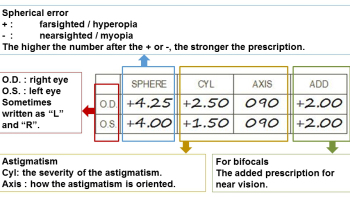
Below is an example of a glass prescription slip with a bird’s eye view interpretation for each components. As a doctor, understanding the glass prescription slip helps in making the diagnosis and proper counselling and as a patient one understands about his/her disease.
glass prescription slip
An example of glass prescription slip with interpretations.

Relevant terms to understand glass prescription slip:

1. OD (Oculus dexter): Right Eye

2. OS (Oculus sinister): Left Eye

3. OU (oculus uterque): Both Eyes

4. SPH (Sphere): Amount of lens power in dioptres required to correct near-sightedness (myopia) or far-sightedness (hypermetropia)

  • Correction is equal in all meridians of eye
  • If number has minus (-) sign: it is Myopia
  • If number has plus (+) sign: it is Hypermetropia

5. CYL (Cylinder): Amount of lens power for astigmatism

  • Correction in meridian specified by the prescribed axis
  • One meridian has no added curvature, and the meridian perpendicular to this “no added power” meridian contains the maximum power and lens curvature to correct astigmatism.
  • If number has minus (-) sign: it is Myopic astigmatism
  • If number has plus (+) sign: it is Hypermetropic astigmatism

6. Axis: The lens meridian that is 90 degrees away from the meridian that contains the cylinder power.

  • 90 indicates “with-the-rule” astigmatism
  • 180 indicates “against-the-rule” astigmatism

7. Near Add: Added magnifying power to the bottom of the multifocal lens to correct presbyopia

  • Always + even when not specified

Large difference in the power between two eyes (anisometropia) may lead to amblyopia in children. Hence, this is concerning.

  • Facebook
  • Twitter
PGMEE, MRCS, USMLE, MBBS, MD/MS OphthalmologyPatient

Post navigation

Previous post
Next post

Related Posts

PGMEE, MRCS, USMLE, MBBS, MD/MS

Working formulation of NHL (Mnemonic)

Jan 16, 2019Feb 26, 2019

All follicular except large cell: Low grade All diffuse: Intermediate grade Blastic and non-cleaved: High grade

Read More
PGMEE, MRCS, USMLE, MBBS, MD/MS pediatrician-patient

Pediatric History Taking – Structured format and Guide

May 19, 2019Oct 27, 2020

Identification (ID): Name Age/Date of Birth Sex Informant ( Reliability) Parent’s name, age, address, education, religion Chief Complaints (CC): Symptoms X Duration in Chronological order History of Presenting Illness (HPI): Symptoms: Location, quality, quantity, aggravating and alleviating factors Time course: Onset, duration, frequency, change over time Rx/Intervention: Medications, medical help…

Read More
PGMEE, MRCS, USMLE, MBBS, MD/MS visual cycle

Visual cycle – Simplified

May 31, 2019May 31, 2019

11-cis-retinal combines with opsin protein to form rhodopsin. Light stimulates conversion of rhodopsin bound 11-cis-retinal to all-trans-retinol (all-trans-retinol is transported from photoreceptor cells to retinal pigment epithelium), which subsequently dissociates from opsin (bleaching), leading to membrane depolarization and initiation of action potential in photoreceptors in the neural retina. Once in…

Read More

Comment

  1. Maksuda Mehmud Maniyar says:
    Jul 20, 2020 at 4:24 am

    I am medical student
    And your Content really help me in studies. Thank u very much…

    Reply

Leave a Reply Cancel reply

Your email address will not be published. Required fields are marked *

This site uses Akismet to reduce spam. Learn how your comment data is processed.

Pre-clinical (Basic Sciences)

Anatomy

Biochemistry

Community medicine (PSM)

Embryology

Microbiology

Pathology

Pharmacology

Physiology

Clinical Sciences

Anesthesia

Dermatology

Emergency medicine

Forensic

Internal medicine

Gynecology & Obstetrics

Oncology

Ophthalmology

Orthopedics

Otorhinolaryngology (ENT)

Pediatrics

Psychiatry

Radiology

Surgery

RSS Ask Epomedicine

  • What to study for Clinical examination in Orthopedics?
  • What is the mechanism of AVNRT?

Epomedicine weekly

  • About Epomedicine
  • Contact Us
  • Author Guidelines
  • Submit Article
  • Editorial Board
  • USMLE
  • MRCS
  • Thesis
©2026 Epomedicine | WordPress Theme by SuperbThemes