Skip to content
Epomedicine

Mnemonics, Simplified Concepts & Thoughts

Epomedicine

Mnemonics, Simplified Concepts & Thoughts

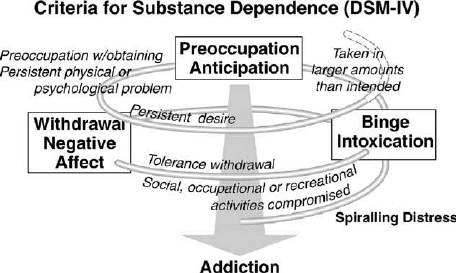
dependence cycle

Substance abuse vs Substance dependence

Epomedicine, Nov 4, 2016Nov 10, 2016

Both of these substance use disorders are maladpative patterns of substance use, leading to clinically significant impairment/distress but defined by separate criteria.

Substance abuse

≥1 of the following occurring within a 12 month period:

Mnemonic: 4 Rs

  1. Role failure: Recurrent use resulting in failure to fulfill role obligation
  2. Risky behavior: Recurrent use in situations which it is physically hazardous
  3. Run in with the law: Recurrent substance related legal problems
  4. Relationship problems: Continued use despite interference with social or interpersonal functioning
Substance abuse vs dependence
Nice illustration from sketchymedicine

Substance dependence

≥3 of the following in same 12 month period:

Mnemonic: WTC

  1. Withdrawal or use to avoid withdrawal
  2. Tolerance
  3. Time wasted in obtaining or using the substance
  4. Compulsive use in larger amount and longer period than intended
  5. Control and cut-down efforts unsuccessful
  6. Continuous use despite consequences (physical and psychological)
  7. Curtailment in activities of interest

dependence cycle

Changes in DSM-V

In DSM-V, the line of distinction between abuse and dependence has been erased and use of single diagnosis as “substance use disorder” has been proposed to remove possible confusion.

Broadly speaking, in DSM-V, following must be met out of 11 criteria:

  1. Mild: 2-3 symptoms
  2. Moderate: 4-5 symptoms
  3. Severe: 6-7 symptoms

The new list of 11 elements is the mixture of 4 “R”s and WTC as mentioned above with some changes:

  1. Addition: Drug craving
  2. Removal: Run in with the laws
12 shares
  • Facebook9
  • Twitter
PGMEE, MRCS, USMLE, MBBS, MD/MS PharmacologyPsychiatry

Post navigation

Previous post
Next post

Related Posts

PGMEE, MRCS, USMLE, MBBS, MD/MS

Fabry Disease : Mnemonic

Nov 1, 2024Nov 1, 2024

Mnemonic: FABRY CX 1. Febrile episodes, Foam cells 2. Angiokeratomas, Alpha galactosidase A deficiency 3. Burning pains in hands and feet 4. Renal failure 5. Youth death 6. Cardiovascular disease, Ceramide trihexoside accumulation 7. X-linked recessive inheritance Further reading:

Read More
PGMEE, MRCS, USMLE, MBBS, MD/MS mitochondria glucose catabolism

Electron Transport Chain (ETC) and Oxidative Phosphorylation : Mnemonic

Jan 30, 2016Nov 14, 2017

General concepts of ETC and Oxidative Phosphorylation: 1. Occurs in cell cytosol: Glycolysis 2. Occurs in mytochondrial matrix: Kreb’s (TCA) cycle 3. Occurs in mitochondrial inner membrane: ETC – Stepwise movement of electrons from high energy to low energy that activates proton pump which transports proton from the mitochondrial matrix to mitochondrial inter-membrane and…

Read More
PGMEE, MRCS, USMLE, MBBS, MD/MS

Unpaired Branches of Abdominal Aorta : Mnemonic

Jul 2, 2024Jul 2, 2024

Celiac trunk Superior mesenteric artery (SMA) Inferior mesenteric artery (IMA) Level T12 L1 L3 Branches LHS (Left Hand Side) MRI (distal to proximal) LeSS 1. Left gastric artery Middle colic artery Left colic artery 2. common Hepatic artery Right colic artery Sigmoid arteries 3. Splenic artery Ileocolic artery Superior rectal…

Read More

Leave a Reply Cancel reply

Your email address will not be published. Required fields are marked *

This site uses Akismet to reduce spam. Learn how your comment data is processed.

Epomedicine. Substance abuse vs Substance dependence [Internet]. Epomedicine; 2016 Nov 4 [cited 2026 May 16]. Available from: https://epomedicine.com/medical-students/substance-abuse-vs-substance-dependence/.

Pre-clinical (Basic Sciences)

Anatomy

Biochemistry

Community medicine (PSM)

Embryology

Microbiology

Pathology

Pharmacology

Physiology

Clinical Sciences

Anesthesia

Dermatology

Emergency medicine

Forensic

Internal medicine

Gynecology & Obstetrics

Oncology

Ophthalmology

Orthopedics

Otorhinolaryngology (ENT)

Pediatrics

Psychiatry

Radiology

Surgery

RSS Ask Epomedicine

  • What to study for Clinical examination in Orthopedics?
  • What is the mechanism of AVNRT?

Epomedicine weekly

  • About Epomedicine
  • Contact Us
  • Author Guidelines
  • Submit Article
  • Editorial Board
  • USMLE
  • MRCS
  • Thesis
©2026 Epomedicine | WordPress Theme by SuperbThemes