Skip to content
Epomedicine

Mnemonics, Simplified Concepts & Thoughts

Epomedicine

Mnemonics, Simplified Concepts & Thoughts

cholesterolosis of gallbladder

Strawberry Gallbladder (Cholesterolosis)

Epomedicine, Jun 12, 2015Aug 17, 2015
strawberry gallbladder
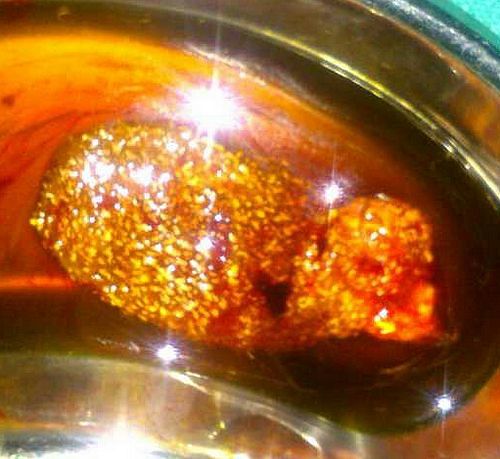
Strawberry gallbladder noted incidentally in a cholecystectomy specimen for cholelithiasis.

Synonyms:

Strawberry gallbladder is also known as hyperplastic cholecystoses. Hyperplastic cholecystoses are a spectrum of non-neoplastic proliferative disorders caused by deposition of cholesterol-laden macrophages within the wall of the gall bladder. The cholecystose range from abnormalities of the gallbladder wall (adenomyomatosis and strawberry gall bladder) to gallbladder polyps extending into the lumen.

Definition: 

Cholesterolosis occurs due to the accumulation of cholesterol esters and triglycerides in subepithelial macrophages and gallbladder epithelium. It is associated with bile supersaturation with cholesterol, but not with increased serum cholesterol. It is usually asymptomatic and detected incidentally in 30-50 % of cholecystectomy specimens. Cholesterolosis occurs in 2 major forms: localized and diffuse. Strawberry gallbladder refers to diffuse cholesterolosis characterized by tiny mural cholesterol deposits likened to strawberry seeds. It is a pathologic diagnosis rather than a clinical diagnosis.

Clinical features:

This is usually asymptomatic but sometimes may exhibit mild symptoms such as indigestion, gas and distress after meals. Pain in the upper quadrant is also noted.

Epidemiology:

In a Survey done to determine the association between cholesterolosis and gall bladder malignancy following results were observed :

  • Sample: 3123 cases
  • Gender predominance: more common in women than in men
  • Cholesterolosis has a strong negative association with gallbladder cancer

Gross features:

  1. Yellow, flat deposits on mucosal surface, focal or diffuse.
  2. May have speckled appearance (“strawberry gallbladder”), 20% are associated with cholesterol polyps.
  3. Polyps vary in size from 1-10 mm.
  4. Bile in the lumen is generally dark and thick, with a high concentration of cholesterol and sometimes floating yellow lipid particles (lipoidic corpuscles).

Microscopic features:

  1. Foamy macrophages in lamina propria and epithelium.
  2. Villous mucosal hyperplasia with macrophages at tips of villi.
  3. Usually no or minimal cholecystitis.
  4. Usually changes are restricted to gallbladder and don’t involve extrahepatic bile ducts.

Ultrasound features:

  1. Brightly echogenic non-mobile masses, with a ring down/ comet tail or reverberation artefact.
  2. No posterior acoustic shadowing.
  3. When cholesterosis is focal, it forms cholesterol polyps.

Primary concern:

Rule out gall bladder malignancy.

Submitted by: Dr. Sulabh Shrestha
3 shares
  • Facebook3
  • Twitter
PGMEE, MRCS, USMLE, MBBS, MD/MS Gastrointestinal systemGeneral SurgeryPathology

Post navigation

Previous post
Next post

Related Posts

PGMEE, MRCS, USMLE, MBBS, MD/MS

Osteoid Osteoma : Mnemonic

May 13, 2022May 13, 2022

Epidemiology and Clinical features Mnemonic: LMNOP Lower extremity predilection (proximal femur > tibial diaphysis) Male predilection (2:1 to 3:1) Night pain relieved by NSAIDs (absent in osteoblastoma) Osteogenic benign tumor Prostaglandins (PGE2) and Cyclooxygenase (COX1 and 2) release by nidus (explains night pain and response to NSAIDs) 3 Concentric layers…

Read More
PGMEE, MRCS, USMLE, MBBS, MD/MS

Compartments, Muscles and Fasciotomy of the leg

Jul 27, 2022Jul 27, 2022

Muscle Origin Insertion Action Innervation Anterior compartment 1. Tibialis anterior (TA) Superior 2/3 lateral surface of tibia Medial cuneiform, 1st metatarsal Dorsiflexion, foot inversion Deep peroneal nerve (L5) 2. Extensor digitorum longus (EDL) Superior 2/3 of fibula and interosseous membrane Middle and distal phalanx, lateral 4 toes Dorsiflexion, toe extension…

Read More
PGMEE, MRCS, USMLE, MBBS, MD/MS

Atropine Induced Paradoxical Bradycardia

Jan 5, 2022Jan 5, 2022

Atropine induced paradoxical bradycardia is the sinus bradyarrhythmia following low-dose atropine resulting from the paradoxical slowing in the sinoatrial (SA) node discharge rate. Mechanism of Atropine Induced Paradoxical Bradycardia Central vagotonic effect (blocking M1 acetylcholine receptors in parasympathetic ganglion controlling SA node) of atropine which, at higher doses, is masked…

Read More

Leave a Reply Cancel reply

Your email address will not be published. Required fields are marked *

This site uses Akismet to reduce spam. Learn how your comment data is processed.

Epomedicine. Strawberry Gallbladder (Cholesterolosis) [Internet]. Epomedicine; 2015 Jun 12 [cited 2026 Jun 12]. Available from: https://epomedicine.com/medical-students/strawberry-gallbladder-cholesterolosis/.

Pre-clinical (Basic Sciences)

Anatomy

Biochemistry

Community medicine (PSM)

Embryology

Microbiology

Pathology

Pharmacology

Physiology

Clinical Sciences

Anesthesia

Dermatology

Emergency medicine

Forensic

Internal medicine

Gynecology & Obstetrics

Oncology

Ophthalmology

Orthopedics

Otorhinolaryngology (ENT)

Pediatrics

Psychiatry

Radiology

Surgery

RSS Ask Epomedicine

  • What to study for Clinical examination in Orthopedics?
  • What is the mechanism of AVNRT?

Epomedicine weekly

  • About Epomedicine
  • Contact Us
  • Author Guidelines
  • Submit Article
  • Editorial Board
  • USMLE
  • MRCS
  • Thesis
©2026 Epomedicine | WordPress Theme by SuperbThemes