Mnemonic for Urea Cycle Intermediates
Orange Cola, Coffee, Alcohol of Argentina For Aggressive Urine
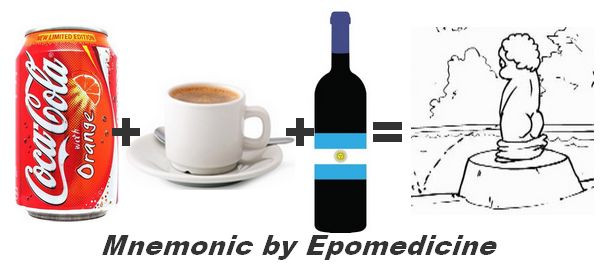
- Orange: Ornithine
- Cola: Carbamoyl Phosphate
- Coffee: Citrulline
- Alcohol: Aspartate (enters cycle)
- Argentina: Arginosuccinate
- For: Fumarate (leaves cycle)
- Aggressive: Arginine
- Urine: Urea (leaves cycle)
Structure of Urea
NH2-CO-NH2 (1 amide from aspartate and 1 from ammonia)
Amide group doesn’t raise the pH of blood, unlike ammonia.
Understanding the Urea Cycle
Location of cycle
Hepatocyte (Partially in mitochondria and partially in cytoplasm)
Kidney and Intestine contribute to most of body arginine because these possess all the urea cycle enzyme except arginase.
Brain can synthesize urea from citrulline, but lacks enzyme for formation of citrulline from ornithine.
Thus neither brain nor kidney can form urea in significant amount.
ATPs hydrolyzed
- 2 ATPs are utilized for synthesis of Carbomyl phosphate
- 1 ATP is converted to AMP and PPi, to produce arginosuccinate, which equals 2 ATPs.
- Hence, total 4 ATPs are utilized in the reaction.
- This cycle is totally irreversible.
Steps
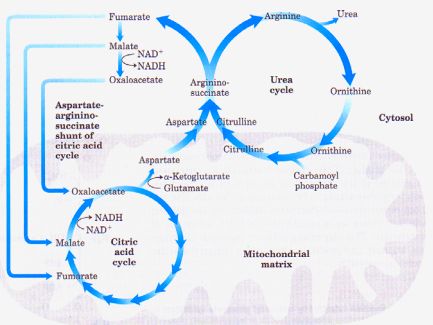
1st reaction (Mitochondrial matrix):
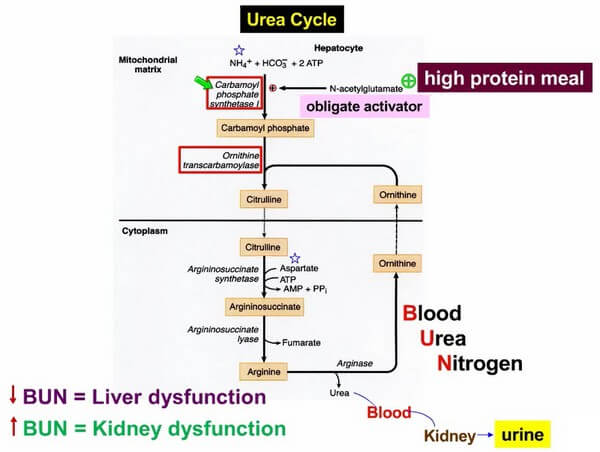
1. NH4 (from glutamine) + CO2 = Carbamoyl Phosphate
- Mediated by Carbamoyl Phosphate Synthetase (requires N-Acetyl Glutamate or NAG as obligate activator)
- NAG is activated by high protein meal
- Uses 2 molecules of ATP
2. Carbamoyl group (from Carbamoyl Phosphate) + Ornithine (NAG as precursor) = Citrulline
- Catalyzed by Ornithine transcarbamylase or OTC
3. Citrulline transporter transports citrulline from mitochondrial matrix to cell cytoplasm
2nd reaction (Cell cytoplasm):
Citrulline + Aspartate = Arginosuccinate
- Argininosuccinate synthetase + ATP (from beta-oxidation of fatty acids) + citrulline = citrullyl-AMP
- Citrullyl-AMP + NH4 (from aspartate) = Argininosuccinate
3rd reaction (Cell cytoplasm):
Aginosuccinate = Fumarate (leaves cycle) + Arginine
- Catalyzed by argininosuccinate lyase
4th reaction (Cell cytoplasm):
Arginine = Urea (enters blood to be delivered to kidney) + Ornithine (completes cycle)
- Catalyzed by arginase
Defects of Urea Cycle
Features common to both Carbamoyl Phosphate Synthetase and Ornithine Transcarbamoylase Deficiency
1. Onset: Within 1-3 days of birth
2. Accumulation of precursors:
- Increased blood glutamine
- Increased ammonia (hyperammonemia):
- Cerebral edema, lethargy, vomiting, convulsions, hyperventilation
- Alpha-ketoglutarate is consumed hindering TCA cycle
3. Decreased end-porduct:
- Blood Urea Nitrogen (BUN) is decreased
Carbamoyl Phospate Synthetase (CPS) Deficiency vs Ornithine Transcarbamoylase (OTC) Deficiency
CPS deficiency:
- Autosomal recessive
- No orotic aciduria (No Carbamoyl Phosphate)
OTC deficiency:
- X-linked recessive
- Orotic aciduria present
Mechanism of Orotic aciduria in OTC deficiency:
The sequence of events:
- ↓ OTC
- ↑ Carbamoyl Phosphate
- Carbamoyl Phosphate leaks out of mitochondria into cytoplasm
- In cytoplasm, Carbamoyl phosphate together with Aspartate forms Carbamoyl Aspartate
- Carbamoyl Aspartate forms Orotate which enters pyrimidine synthesis (UMP synthetic pathway)
Orotic Aciduria is also seen in UMP synthase deficiency:
- However, in UMP synthase deficiency (Hereditary Orotic Aciduria) – Ammonia, Glutamine and BUN levels are normal
- Megaloblastic anemia is a feature of UMP synthase deficiency
- In UMP synthase deficiency, Uracil is decreased but in OTC deficiency, Uracil is increased
Hyper-ammonemia (NH3 Intoxication)
Increase NH3 concentration causes:
- Increased transamination of alpha-ketoglutarate (a TCA cycle intermediate) to form glutamate → Decreased mitochondrial pool of alpha-ketoglutarate inhibiting TCA cycle and cellular respiration
- Increased glutamine synthesis from glutamate in brain leading to:
- Decreased brain cell pool of glutamic acid → Decreased synthesis of GABA (inhibitory neurotransmitter)
- Increased brain glutamine level and its outflow → Increased tryptophan level in brain cells because glutamine is carried out by the same transporter which allows entry of tryptophan in brain cells → Increased synthesis of serotonin

He is the section editor of Orthopedics in Epomedicine. He searches for and share simpler ways to make complicated medical topics simple. He also loves writing poetry, listening and playing music. He is currently pursuing Fellowship in Hip, Pelvi-acetabulum and Arthroplasty at B&B Hospital.
You can check this video for urea cycle mnemonic
https://youtu.be/ae3qLoCB38o