Skip to content
Epomedicine

Mnemonics, Simplified Concepts & Thoughts

Epomedicine

Mnemonics, Simplified Concepts & Thoughts

Trichomycosis Axillaris : Malodorous yellowish armpit hair

Epomedicine, Apr 24, 2021Apr 24, 2021

Synonym: Trichobateriosis axillaris, Bacterial trichonodosis, Trychomycosis palmellina

Definition: Asymptomatic superficial bacterial infection (mycosis is a misnomer because it is not a fungal infection) primarily of the axillary hairs (can also occur in pubic, perianal and scalp hair) caused by Corynebacterium sp.

Causative organism: Corynebacterium species particularly Corynebacterium flavescens

Mode of infection:

  1. Bacteria comes in contact with the hair shaft, and adhere to the surface, or the cuticle, of the hair, using a cement-like substance that is insoluble in water
  2. Micro-organism does not penetrate to the medulla’s cortex of the hair; instead, it only adheres strongly to the surface of the hair and develops slowly until it forms concretions around the hair shaft
  3. Encapsulated corynebacteria entrapped in a biofilm serve as the adhering mechanism, which possibly helps the organism to escape immunological attack by the host

Clinical variants:

  1. Trichomycosis flava (yellow)
  2. Trichomycosis rubra (red)
  3. Trichomycosis nigra (black)

Predisposing factors:

  1. Warm and humid climate
  2. Excessive sweating
  3. Inadequate hygiene
  4. Not shaving the area (hence, more common in male than female)
  5. Young adults
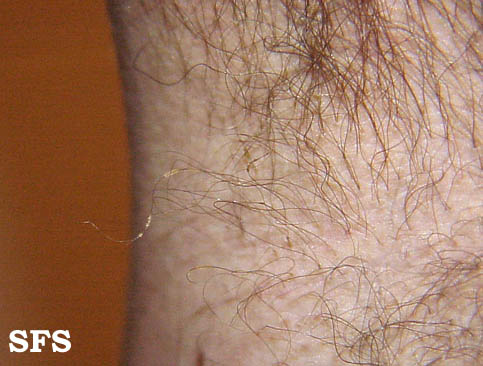
trichomycosis axillaris
Source: http://www.atlasdermatologico.com.br/disease.jsf?diseaseId=470

Clinical features:

  1. Formation of concretions around the hair shaft:
    • Early: Invisible and only a slight thickening can be “felt” on palpation and later the bacterial masses remain isolated or independent (pediculosis-like)
    • Chronic: Concretions extend along the entire length of the hair until they form a sheath, causing the hair to thicken, turn a yellowish, red or black color, and become creamy, opaque and soft.
  2. Bromhidrosis (malodor)
  3. Hyperhidrosis (excessive sweating)
  4. May stain clothing

Wood’s lamp examination: Pale-yellow fluorescence

Dermoscopy: Yellowish-white masses with a waxy appearance, adherent to the hair (feather, brush or skewer sign); Concretions with the appearance of a rosary of crystalline stones; a flame-like pale yellowish adherent nodule (plume sign)

KOH examination: Mucoid sheath around hairs

Gram stain: Hair shafts colonized by gram-positive coccobacilli

Culture: A mixture of microorganisms may be identified: Corynebacterium sp. (white-yellow growth) and Serratia mascescens (red growth)

Treatment:

A. General measures:

  1. Adequate hygiene
  2. Shaving of the affected area for 2-3 weeks
  3. Control of hyperhidrosis

B. Cleansing methods: Use of sulfur soaps

C. Topical treatments:

  1. 3% sulfur
  2. 2% sodium hypochlorite
  3. 1% mercury chloride
  4. 5% Benzoyl peroxide
  5. Antibiotics: Fusidic acid, 2% Erythromycin, 1% Clindamycin
  6. Antimycotic agents: Naftifine, Some azole derivatives

References:

  1. Bonifaz A, Váquez-González D, Fierro L, Araiza J, Ponce RM. Trichomycosis (trichobacteriosis): clinical and microbiological experience with 56 cases. Int J Trichology. 2013 Jan;5(1):12-6. doi: 10.4103/0974-7753.114704. PMID: 23960390; PMCID: PMC3746219.
  2. https://www.actasdermo.org/en-trichomycosis-axillaris-clinical-wood-lamp-articulo-S1578219017300331
  3. https://escholarship.org/uc/item/7488g7vb
  • Facebook
  • Twitter
PGMEE, MRCS, USMLE, MBBS, MD/MS Dermatology

Post navigation

Previous post
Next post

Related Posts

PGMEE, MRCS, USMLE, MBBS, MD/MS

Surgical Site Infection Risk Factors : Mnemonic

Jul 25, 2024Jul 25, 2024

Various types of surgical site infection (SSI) have been defined by CDC. Patient related factors Mnemonic: WASHING 1. Weight: Obesity (>20% of ideal body weight) 2. Antibiotic resistant skin flora: MRSA colonization 3. Advancing age 4. Smoking 5. HIV and other immune deficiency conditions 6. Infection coexisting at other sites…

Read More
PGMEE, MRCS, USMLE, MBBS, MD/MS retroperitoneal-structures

Retroperitoneal Organs : Mnemonic

Jun 27, 2018May 13, 2024

Retroperitoneal organs are partly covered on one side with parietal peritoneum. They are immobile or fixed. The classification of retroperitoneal organs divides primary and secondary retroperitoneal organs due to the embryonic development – Retroperitoneal structures Mnemonic: SAD PUCKER Primary retroperitoneal structures Mnemonic: SAUKER Secondary retroperitoneal structures Clinical significance Kocher maneuver…

Read More
PGMEE, MRCS, USMLE, MBBS, MD/MS fetal circulation schematic

Fetal Circulation Made Easy

Aug 8, 2016Jun 2, 2020

Following are the important features of fetal circulation: 1. Placenta plays the role of lungs; lungs are not functional: Like pulmonary veins, left umbilical vein carries highly oxygenated blood from placenta to heart. Like pulmonary artery, right and left umbilical arteries braing deoxygenated blood to placenta. 2. Mixing potentially occurs…

Read More

Leave a Reply Cancel reply

Your email address will not be published. Required fields are marked *

This site uses Akismet to reduce spam. Learn how your comment data is processed.

Epomedicine. Trichomycosis Axillaris : Malodorous yellowish armpit hair [Internet]. Epomedicine; 2021 Apr 24 [cited 2025 Dec 3]. Available from: https://epomedicine.com/medical-students/trichomycosis-axillaris-yellow-armpit-hair/.

Pre-clinical (Basic Sciences)

Anatomy

Biochemistry

Community medicine (PSM)

Embryology

Microbiology

Pathology

Pharmacology

Physiology

Clinical Sciences

Anesthesia

Dermatology

Emergency medicine

Forensic

Internal medicine

Gynecology & Obstetrics

Oncology

Ophthalmology

Orthopedics

Otorhinolaryngology (ENT)

Pediatrics

Psychiatry

Radiology

Surgery

RSS Ask Epomedicine

  • What to study for Clinical examination in Orthopedics?
  • What is the mechanism of AVNRT?

Epomedicine weekly

  • About Epomedicine
  • Contact Us
  • Author Guidelines
  • Submit Article
  • Editorial Board
  • USMLE
  • MRCS
  • Thesis
©2025 Epomedicine . All rights reserved.