Skip to content
Epomedicine

Mnemonics, Simplified Concepts & Thoughts

Epomedicine

Mnemonics, Simplified Concepts & Thoughts

Triangles of Neck

Epomedicine, Jul 16, 2024Jul 16, 2024
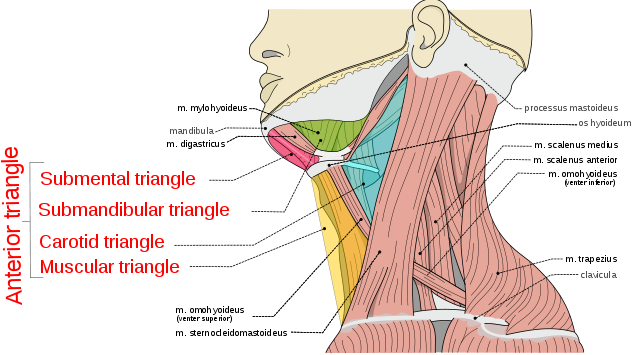
neck triangles
Olek Remesz (wiki-pl: Orem, commons: Orem) Modified by user:madhero88, CC BY 3.0, via Wikimedia Commons
TrianglesSubdivisionsBoundariesFloorContentsClinical relevance
Anterior
Digastric (submandibular) – further subdivided into 3 small triangles:
a. Lesser’s
b. Pirogov’s
c. Beclard’s
2 digastric bellies
Mandible
MylohyoidSubmandibular gland
Submandibular nodes
Facial nerve – Marginal mandibular branch (MMB)
Facial vessels
Lingual vessels
Hypoglossal nerve
Nerve to mylohyoid
Incision 2 finger breadth below inferior border of mandible avoids MMB of CN VII
Submental2 digastric bellies
Hyoid
MylohyoidSubmental nodes
Anterior jugular vein
Safe incision – no arteries
CarotidSCM
Superior belly of Omohyoid
Posterior belly of Digastric
Hyoglossus
Thyrohyoid
Middle/Inferior constrictors of
pharynx
Common carotid and bifurcation
IJV
CN X (and superior laryngeal nerve), XI, XII
Ansa cervicalis
Contains Farabeuf’s triangle (landmark for identifying IJV): IJV, Common facial vein, CN XII
MuscularSuperior belly of omohyoid
SCM
Anterior neck midline
Strap muscles (TOSS)
Thyroid gland (along with superior thyroid artery, anterior jugular and inferior thyroid veins)
Parathyroid gland
Cervical part of trachea and esophagus
Tracheostomy and thyroidectomy

Injury of superior thyroid artery – bleeding
Posterior
OccipitalSCM
Trapezius
Inferior belly of omohyoid
Levator scapulae
Splenius capitis
Middle/Posterior scalene
Accessory nerve (CN XI)
Artery – Occipital, Transverse cervical
Brachial plexus – parts
Cervical plexus (GLaST) – Greater auricular nerve, Lesser occipital nerve, Supraclavicular nerve, Transverse cervical nerve
Deep cervical lymph nodes
Supraclavicular or Subclavian or OmoclavicularSCM
Inferior belly of omohyoid
Clavicle
Subclavian artery (3rd part)
Subclavian vein (and EJV termination)
Brachial plexus – trunks
Supraclavicular vessels
Dorsal scapular artery
Phrenic nerve
Deep cervical nodes
Virchow/Troisier’s node
Mnemonic: TOSS muscles (Thyrohyoid, Omohyoid, Sternohyoid, Sternothyroid)

Further reading: Triangles of the neck: a review with clinical/surgical applications – PMC (nih.gov)
  • Facebook
  • Twitter
PGMEE, MRCS, USMLE, MBBS, MD/MS AnatomyOtorhinolaryngology

Post navigation

Previous post
Next post

Related Posts

PGMEE, MRCS, USMLE, MBBS, MD/MS

Dermatomes : Mnemonic

Sep 18, 2021Sep 18, 2021

Note: C1 doesn’t have a sensory branch For the purpose of making learning easier, we divide the remaining dermatomal segments into 4 groups which will be accompanied by analogies and mnemonics. C2-C4 These supply the “hooded cape” region. C2: hood region abutting the trigeminal distribution C3: upper neck C4: lower…

Read More
PGMEE, MRCS, USMLE, MBBS, MD/MS

Modified Ficat-Arlet Staging for AVN hip : Mnemonic

Jun 15, 2020Jun 15, 2020

Ficat and Arlet first classified avascular necrosis of femoral head (AVN) in 1964 before the advent of MRI which was later modified and published in 1985 to include pre-radiographic stages relying on invasive testing procedures. The classification system later underwent further modifications that include MRI findings, patient symptoms and modifies…

Read More
PGMEE, MRCS, USMLE, MBBS, MD/MS ORS resomal

ORS and ReSoMal – Mnemonic

Jun 11, 2019Jun 11, 2019

Oral Rehydration Solution (ORS) Grams per litre: SoDIum C-hloride: 2.6 gm SoDIum Ci-Trate: 2.9 gm Potassium chloride: 1.5 gm Glucose anhydrous: 13.5 gm Mnemonic: DI = 2 and C = 6Ci-Trate = Rotate 6, i.e. 9For Potassium chloride: Deduct 1 from the whole number and decimal both, i.e. (2-1).(6-1) =…

Read More

Leave a Reply Cancel reply

Your email address will not be published. Required fields are marked *

This site uses Akismet to reduce spam. Learn how your comment data is processed.

Pre-clinical (Basic Sciences)

Anatomy

Biochemistry

Community medicine (PSM)

Embryology

Microbiology

Pathology

Pharmacology

Physiology

Clinical Sciences

Anesthesia

Dermatology

Emergency medicine

Forensic

Internal medicine

Gynecology & Obstetrics

Oncology

Ophthalmology

Orthopedics

Otorhinolaryngology (ENT)

Pediatrics

Psychiatry

Radiology

Surgery

RSS Ask Epomedicine

  • What to study for Clinical examination in Orthopedics?
  • What is the mechanism of AVNRT?

Epomedicine weekly

  • About Epomedicine
  • Contact Us
  • Author Guidelines
  • Submit Article
  • Editorial Board
  • USMLE
  • MRCS
  • Thesis
©2026 Epomedicine | WordPress Theme by SuperbThemes