Skip to content
Epomedicine

Mnemonics, Simplified Concepts & Thoughts

Epomedicine

Mnemonics, Simplified Concepts & Thoughts

Thyroid Hormone Function & Synthesis : Mnemonics

Epomedicine, Aug 19, 2023May 21, 2024

Thyroid Hormone Functions

Mnemonic: 7 X B’s

  1. Basal metabolic rate
  2. Blood sugar (increases glycogenolysis & gluconeogenesis)
  3. Break down lipids (lipolysis)
  4. Bone growth (synergism with growth hormone)
  5. Beta-adrenergic effects
  6. Brain maturation
  7. Babies – stimulation of surfactant production

Thyroid Hormone Synthesis

Mnemonic: ATE ICE

1. Active transport of iodide:

  • Circulation to thyroid follicular cells: via NIS (Na-Iodide Symporter)
  • Thyroid follicular cells to lumen: via Pendrin

2. Thyroglobulin (rich in Tyrosine): formed in follicular ribosomes

3. Exocytosis of thyroglobulin into follicular lumen: stored as colloid

4. Iodination: Peroxidase enzyme –

  • Oxidation of Iodide (I-) to Iodine (I2)
  • I2 + Tyrosine (Organification) = MIT (Monoiodotyrosine), DIT (Diiodotyrosine)

5. Coupling:

  • MIT + DIT = T3
  • DIT + DIT = T4

6. Endocytosis: of T3 and T4 containing colloid into follicular cells and liberation of free T3 and T4 after proteolysis (mediated by proteases). At the peripheries, T4 is de-iodinated into more active T3.

Another mnemonic: IPOCP
1. Iodide transport
2. Peroxidation
3. Organification
4. Coupling
5. Peripheral conversion
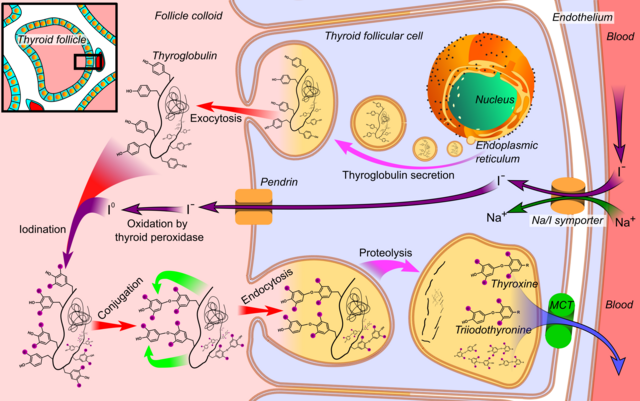
thyroid hormone synthesis
By Mikael Häggström, used with permission., CC0, via Wikimedia Commons
T3T4
Potency4 times more than T4Less
Rate of secretionLess10 times more than T3
Onset of actionRapid (2-3 hours)Slow (2-3 days)
Half-life1 day1 week
StorageLessMore (high affinity to proteins)
InactivationRapidSlow
Binding0.2% in unbound0.02% in unbound
Source20-25% by gland
75-80% by peripheral conversion
100% by gland

Inhibition of Thyroid Synthesis and Antithyroid Drugs

Metabolic stepInhibitor
Iodine transportInorganic anions (Perchlorate, Thiocyanate)
IodinationThionamides (PTU, Methimazole, Carbimazole), Iodides via Wolff-Chaikoff effect (Lugol’s iodone, KI)
CouplingThionamides
Colloid resorptionColchicine, Li+, I-
Deiodination of DIT + MITDinitrotyrosine
Hormone releaseIodine, Iodides of Na and K
Peripheral conversion of T4 to T3Dexamethasone, Beta-blockers (Propranolol), Radiocontrast dye, PTU
Destruction of thyroid tissueRadioactive iodine
  • Facebook
  • Twitter
PGMEE, MRCS, USMLE, MBBS, MD/MS

Post navigation

Previous post
Next post

Related Posts

PGMEE, MRCS, USMLE, MBBS, MD/MS gamma loop

Lower Motor Neuron Lesion (LMNL) – Anatomical Basis

Jul 25, 2016Jul 25, 2016

The anatomical basis of Upper Motor Neuron Lesion (UMNL) has already been discussed earlier. Similarly, we will explain the anatomical basis of clinical syndrome of Lower Motor Neuron Lesion (LMNL). A. Ipsilateral involvment: Lower motor neuron comprises of motor neurons in the anterior neurons and the fibers originating from them,…

Read More
PGMEE, MRCS, USMLE, MBBS, MD/MS cardiac impulse spread

Physiology of Conducting System of Heart

Jul 12, 2018Aug 10, 2023

Origin and Spread of Cardiac Impulse Mnemonic: SAIL MRS. SAVE APPS 1. SA node (generates impulse at highest rate, i.e. 70-80/min) 3 Internodal pathways: 2. AV node Bundle of His 3. Interventricular septum – Left 4. Midportion Right Septal activation Purkinje System 5. Septum (upper to lower) – purkinje system…

Read More

Leprosy: Etiopathogenesis, Classification and Complications

Nov 19, 2013

Synonyms: Hansen’s disease, Kushta roga, Mezels Definition: Leprosy is a chronic granulomatous disease, caused by Mycobacterium leprae which affects prinicpally the skin and  peripheral nerves. Other commonly affected sites are the cooler parts of the body like mucosa of upper respiratory tract, anterior chamber of eyes and testes. The cooler…

Read More

Leave a Reply Cancel reply

Your email address will not be published. Required fields are marked *

This site uses Akismet to reduce spam. Learn how your comment data is processed.

Pre-clinical (Basic Sciences)

Anatomy

Biochemistry

Community medicine (PSM)

Embryology

Microbiology

Pathology

Pharmacology

Physiology

Clinical Sciences

Anesthesia

Dermatology

Emergency medicine

Forensic

Internal medicine

Gynecology & Obstetrics

Oncology

Ophthalmology

Orthopedics

Otorhinolaryngology (ENT)

Pediatrics

Psychiatry

Radiology

Surgery

RSS Ask Epomedicine

  • What to study for Clinical examination in Orthopedics?
  • What is the mechanism of AVNRT?

Epomedicine weekly

  • About Epomedicine
  • Contact Us
  • Author Guidelines
  • Submit Article
  • Editorial Board
  • USMLE
  • MRCS
  • Thesis
©2026 Epomedicine | WordPress Theme by SuperbThemes