Tendon transfer is the use of the power of a functioning muscle unit to activate a non-functioning nerve/muscle/tendon unit. The transferred tendon remains attached to its parent muscle with an intact neurovascular pedicle.
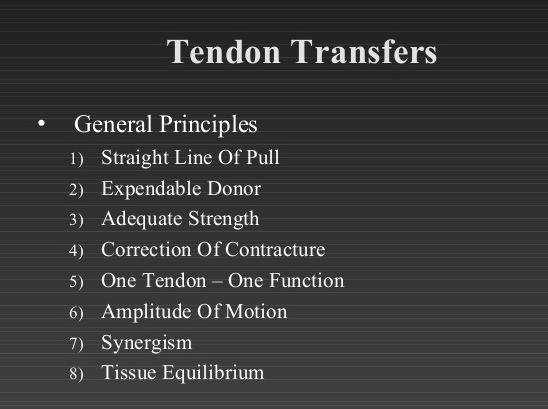
Mnemonic: SEACOAST-1
a. Synergistic: act together to produce a single composite movement (facilitate each other). e.g.
- Fist group: Wrist extensors, finger flexors, finger adductors, thumb flexors, forearm pronators, intrinsics
- Open hand group: Wrist flexors, finger extensors, finger abductors, forearm supinators
b. Expendable: There must be atleast 1 muscle that can continue to perform function of transferred tendon. e.g., 2 out of ECRB, ECRL, ECU (wrist extensors) can be transferred
c. Adequate strength: The donor muscle should achieve at-least 85% of the physiological power of the recipient to be effective. Muscles usually lose 1 grade MRC muscle power following transfer. The relative strengths (working capacity) of muscle are:
- BR, FCU: 2
- FCR, PT, Wrist extensors (ECU, ECRB, ECRL), Finger flexors (FPL, FDS, FDP): 1
- Finger extensors (EDC, EI, EDM): 0.5
- PL and Thumb extensors and abductors (APB, APL, EPL, EPB): 0.1
d. Contractures released: Joints should be supple. In hands, MCP joints must have full passive range of motion.
e. One tendon (donor), one function: Transfer of a single donor tendon to 2 recipients that perform opposing functions across a given joint will result in decreased transfer force, amplitude and efficiency.
f. Adequate excursion: Excursion of donor and recipient muscles should be matched. Boyes or Smith 3-5-7 rule provides a helpful mnemonic regarding excursion of wrist or finger extensors or flexors.
- BR and Wrist level tendons (ECRL, ECRB, ECU, FCR, FCU): 30 mm
- Digital extensors (EDC, EIP, EDQ, EPL): 50 mm
- Digital flexors (FDS): 70 mm
g. Straight line of pull: Tendon transfer should result in a linear vector of pull to maximize efficiency and minimize potential deforming forces. To achieve this, the muscle might have to be dissected free – till close to its origin (taking care not to injure the main nerves and vessels supplying it). The plane where it lies (above or below surrounding muscles) may also need to be changed.
h. Tissue equilibrium: The transferred tendons should lie in a healthy bed of tissue with no edema, inflammation, or scarring. If the bed is scarred, it should be excised and covered with flap earlier.
i. 1 joint/pulley
We can also use another mnemonic: 13 S
In a Sensible patient, I will transfer a:
- Strong, Sacrificeable, Synergistic tendon with Sufficient excursion
- Straight through a Scarless, Stable bed, Subcutaneously
- Across a Supple, Sensate joint
- To achieve a Single function by Securing distally
Operative technique
1. Repair technique: 3 Pulvertaft weaves
2. Tension: Set so as to allow for some slight postoperative stretch
3. Postoperative program: 3 weeks immobilization followed by active and passive mobilization
Common tendon transfers
How to do it?
- List functioning muscles
- List which of those muscles are expendable
- List hand functions requiring restoration
- Match #2 and #3
- Staging
Examples: To check for donor muscles – pronate forearm and extend wrist (closed fist group) and supinate forearm and flex wrist (open hand group) to check which muscles can be donor. Try to match the relative strengths –
| Function | Recipient | Relative strength | Donor | Relative strength | Eponyms |
| Wrist extension | ECRB | 1 | PT | 1 | Jones |
| Finger extension | EDC | 0.5 | FCU | 2 | Jones |
| EDC | 0.5 | FCR | 1 | Brand | |
| EDS | 0.5 | FDS | 1 | Modified Boyes | |
| Thumb extension | EPL | 0.1 | PL | 0.1 | |
| Opposition | AbPB | 0.1 | PL | 0.1 | Camitz |
| AbPB | 0.1 | FDS | 1 | Riodran | |
| AbPB | 0.1 | AdDQ | Huber | ||
| AbPB | 0.1 | EIP | 0.5 | Burkhlater | |
| Thumb IP flexion | FPL | 1 | BR | 2 | |
| Index and long finger flexion | FDP | 1 | FDP | 1 | Side to side |
| FDP | 1 | ECRL | 1 | ||
| Hand intrinsics | Lateral band | 0.5 | FDS | 1 | |
| Lateral band | 0.5 | EIP | 0.5 | ||
| Lateral band | 0.5 | EDQ | 0.5 | ||
| Thumb adduction | AdP | ECRL | 1 | ||
| BR | 2 | ||||
| Index abduction | 1st dorsal interossei | 0.5 | EIP | 0.5 | |
| 1st dorsal interossei | 0.5 | APL | 0.1 | ||
| 1st dorsal interossei | 0.5 | ECRL | 1 | ||
| Ring and small finger flexion | FDP | 1 | FDP | 1 | Side to side |
| FDP | 1 | ECRB | 1 | ||
| Elbow flexion | Biceps | P. major | Clark’s | ||
| Common flexor mass | Shifted proximally | Steindler | |||
| Biceps | L. dorsi | Hovnanian | |||
| Shoulder external rotation | L. dorsi and T. major | Transferred posterolaterally | L’Episcipo |