Skip to content
Epomedicine

Mnemonics, Simplified Concepts & Thoughts

Epomedicine

Mnemonics, Simplified Concepts & Thoughts

Surgical Sutures – Basics

Epomedicine, Sep 17, 2020Mar 5, 2024
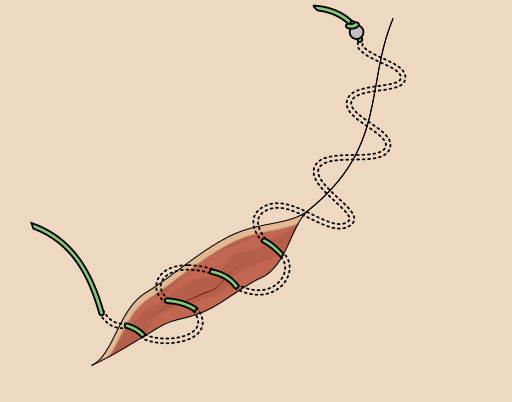
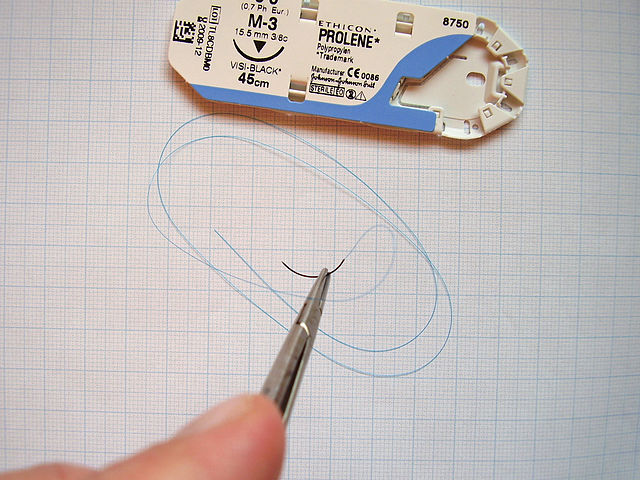
prolene
Werneuchen / Public domain
MonofilamentPolyfilament
AbsorbableCaprosyn (Polyglytone 621)
Monocryl (Polyglecaprone 25)
Biosyn (Polyglecaprone CV-23)
Maxon (Polytrimethylate carbon)
PDS (Polydiaxonone)
Catgut
Vicryl rapide (Polyglactin 910 rapide)
Vicryl (Polyglactin 910)
Dexon (Polyglycolic acid)
Non-absorbableNylon
Ethilon (Monofilament polyamide)
Prolene (Polypropylene)
Silk
Dacron
Ethibond (Polyester)
Braided nylon (Surgilon, Nurolon)
Supramid

Monofilament sutures:

  • Smooth and strong
  • Less chances of bacterial contamination
  • Knot tied may become loose

Polyfilament/Multifilament sutures:

  • Easier to handle and knot tied doesn’t slip
  • Bacteria may lodge in crevices of sutures – not suitable in presence of infection

Natural sutures:

  • Ingredient: Proteins
  • Degradation: Proteolysis
  • Strength distribution: Uneven
  • Inflammatory reaction: High
  • Absorption rate: Rapid

Synthetic sutures:

  • Ingredients: Copolymers
  • Degradation: Hydrolysis
  • Strength distribution: Even
  • Inflammatory reaction: Low
  • Absorption rate: Slow

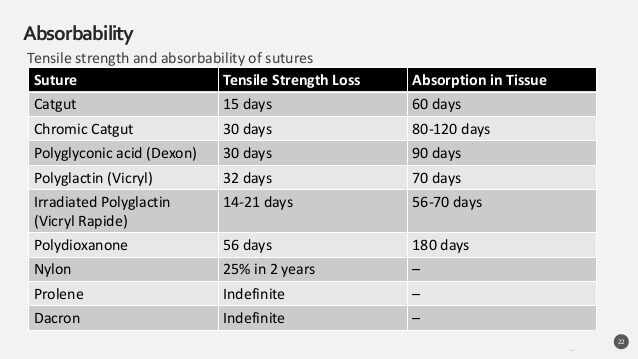
Absorbability:

There are 2 principal methods, by which the sutures are absorbed:

  1. Proteolytic enzyme degradation
  2. Hydrolysis
absorbability

Suture needles:

ShapePoint geometry
StraightTaper: Round body that smoothly tapers to a point
Half curvedCutting: Triangular body, sharp cutting edge on inside
1/4 circleReverse cutting: Cutting edge on outside
3/8 circleTrocar point: Small triangular cutting point & round, tapered body
1/2 circleBlunt: Blunt tip
5/8 circle
Compound curve

Suture size and Time of removal by Location:

LocationType of suture*Timing of suture removal (days)
Arms4-07 to 10
Face5-0 or 6-03 to 5
Hands or feet4-0 or 5-010 to 14
Legs4-010 to 14
Palms or soles3-0 or 4-014 to 21
Scalp4-07 to 10
Trunk3-0 or 4-010 to 14
  • Facebook
  • Twitter
Surgical Skills Surgical skills

Post navigation

Previous post
Next post

Related Posts

Surgical Skills

Techniques of Securing Surgical Drain to Skin (Drain Fixation)

Jun 10, 2021Jun 10, 2021

Choice of Suture: Non-absorbable (braided suture provides slightly superior grip on tubing than monofilament sutures) Technique 1: Create a series of knots around the drain. The long end of the thread (attached to the needle) is passed through the skin directly next to the drain exit site, to create a…

Read More
Surgical Skills

Biomechanics in MIPO (Minimally Invasive Plate Osteosynthesis)

Jan 17, 2024Jan 20, 2024

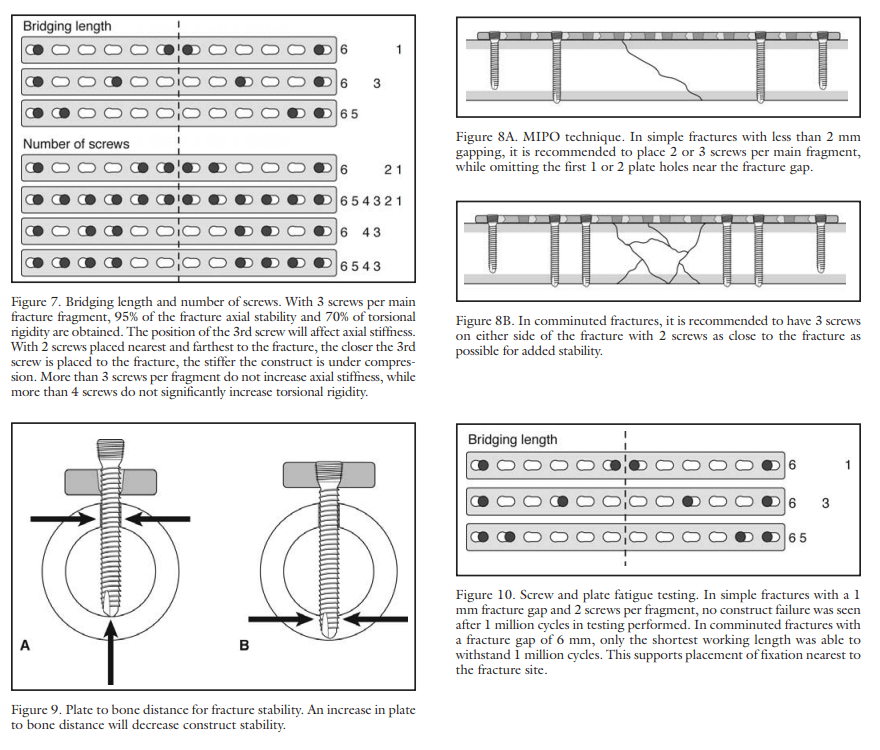
1. Provides optimal environment for fracture healing: 2. Relative stability of fracture: 3. Acts as internal fixator: 4. Plate length and Number of screws in Bridge plate function: 5. Plate working length: References: Dr. Sulabh Kumar Shrestha, MS Orthopedics He is the section editor of Orthopedics in Epomedicine. He searches…

Read More
Emergency Medicine

Bier Block

Jan 11, 2022Jan 11, 2022

Named after: German Surgeon August Bier (first introduced the block in 1908) Definition: It is a peripheral intravenous local anesthetic block (IVRA; Intravenous Regional Anesthesia) of the upper limb using a pneumatic cuff technique Mechanism of action: Local anesthesia diffuses into the small veins surrounding the nerves and then into…

Read More

Comment

  1. Younas Khan says:
    Jul 9, 2023 at 10:08 am

    It is very helpful for Surgical Student
    I really thankful to you
    Thank you so much

    Reply

Leave a Reply Cancel reply

Your email address will not be published. Required fields are marked *

This site uses Akismet to reduce spam. Learn how your comment data is processed.

Pre-clinical (Basic Sciences)

Anatomy

Biochemistry

Community medicine (PSM)

Embryology

Microbiology

Pathology

Pharmacology

Physiology

Clinical Sciences

Anesthesia

Dermatology

Emergency medicine

Forensic

Internal medicine

Gynecology & Obstetrics

Oncology

Ophthalmology

Orthopedics

Otorhinolaryngology (ENT)

Pediatrics

Psychiatry

Radiology

Surgery

RSS Ask Epomedicine

  • What to study for Clinical examination in Orthopedics?
  • What is the mechanism of AVNRT?

Epomedicine weekly

  • About Epomedicine
  • Contact Us
  • Author Guidelines
  • Submit Article
  • Editorial Board
  • USMLE
  • MRCS
  • Thesis
©2026 Epomedicine | WordPress Theme by SuperbThemes