Skip to content
Epomedicine

Mnemonics, Simplified Concepts & Thoughts

Epomedicine

Mnemonics, Simplified Concepts & Thoughts

Superficial and Deep Perineal Space or Pouch

Epomedicine, Aug 17, 2023Aug 17, 2023

Superficial and deep perineal space is located in the urogenital triangle, the boundaries of which are:

  • Apex: Pubic symphysis
  • Two sides: Ischiopubic ramus
  • Base: A line connecting 2 ischial tuberosity

Analogy: Remember a big mac. It has 3 layers of BUN and 2 hamburger PATTIES.
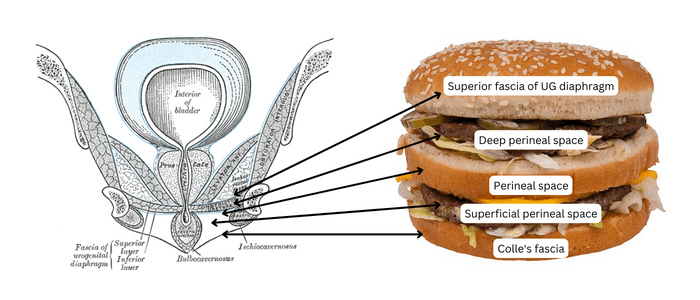
Perineal space big mac analogy
  • BUN = Fascia
    • Bottom bun = Superifical perineal fascia (Colle’s fascia – continuous with Scarpa’s fascia)
    • Middle bun = Inferior fascia of urogenital diaphragm (perineal membrane – anchoring point for erectile tissues)
    • Top bun = Superior fascia of urogenital diaphragm
  • PATTIES = Space
    • Between Bottom bun and Middle bun (bottom PATTY) = Superficial perineal space
    • Between Middle bun and Top bun (top PATTY) = Deep perineal space

Posteriorly, all 3 Fascias are attached to the perineal body, closing the spaces.

Superficial Perineal Space

Mnemonics:
1. Superficial to Perineal membrane
2. Sexually Pleasurable Structures
3. 4 arteries/nerves, 3 muscles, 2 erectile tissues, 1 gland/duct

Contents:

  1. 3 muscles:
    • Ischiocavernosus
    • Bulbospongiosus
    • Superficial transverse perineal muscles (2)
  2. 2 erectile tissues:
    • Crus of penis or clitoris (deep to ischiocavernosus)
    • Bulb of penis or vestibule (just under bulbospongiosus)
  3. 1 gland/duct:
    • Greater vestibular glands (Bartholin’s glands) in females
    • Duct of bulbourethral glands in males
  4. Arteries and nerves: “Perineal and Posterior”
    • Perineal artery (internal pudendal artery branch)
    • Posterior scrotal/labial artery (from perineal branch)
    • Posterior scrotal/labial nerve (from perineal branch of pudendal nerve)
    • Perineal branch of posterior cutaneous nerve of thigh

Deep Perineal Space

2 muscles:

  1. Deep transverse perineal muscles
  2. External urethral sphincter

1 gland:

  • Bulbourethral glands in males

Arteries and nerves: “Deep and Dorsal“

  • Deep and Dorsal artery of penis/clitoris
  • Artery of bulb of penis/vestibule
  • Urethral artery (internal pudendal artery branch)
  • Dorsal nerve of penis/clitoris (branch of pudendal nerve)
  • Facebook
  • Twitter
PGMEE, MRCS, USMLE, MBBS, MD/MS AnatomyGeneral SurgeryObGynReproductive system

Post navigation

Previous post
Next post

Related Posts

PGMEE, MRCS, USMLE, MBBS, MD/MS

ASA Classification: Made Easy

May 26, 2023Aug 16, 2023

The purpose of the system is to assess and communicate a patient’s pre-anesthesia medical co-morbidities. The classification system alone does not predict the perioperative risks, but used with other factors (e.g., type of surgery, frailty, level of deconditioning), it can be helpful in predicting perioperative risks. ASA grade Definition Mortality…

Read More
PGMEE, MRCS, USMLE, MBBS, MD/MS

Heart Sounds – Abnormal

Apr 24, 2019May 23, 2020

The basic clinical examination of the Cardiac System is by Auscultation (listening to the sounds made by the heart). As explained in the previous article physiological sounds made in each cardiac cycle viz. S1 and S2 due to the closure of the Atrio-Ventricular Valves and Outlet Valve in synchrony. Please…

Read More
PGMEE, MRCS, USMLE, MBBS, MD/MS

Inguinal Canal : Mnemonics

Jul 1, 2024Jul 1, 2024

Walls of Inguinal Canal Mnemonic: SALP 2 X MALT Starting from superior, moving counterclockwise in order to posterior: 1. Superior (Roof): 2 Muscles (Internal oblique, Transverse abdominus) 2. Anterior: 2 Aponeuroses (External abdominal oblique, Internal abdominal oblique) 3. Lower (Floor): 2 Ligaments (Lacunar and Inguinal) 4. Posterior: 2 T‘s (conjoint…

Read More

Leave a Reply Cancel reply

Your email address will not be published. Required fields are marked *

This site uses Akismet to reduce spam. Learn how your comment data is processed.

Pre-clinical (Basic Sciences)

Anatomy

Biochemistry

Community medicine (PSM)

Embryology

Microbiology

Pathology

Pharmacology

Physiology

Clinical Sciences

Anesthesia

Dermatology

Emergency medicine

Forensic

Internal medicine

Gynecology & Obstetrics

Oncology

Ophthalmology

Orthopedics

Otorhinolaryngology (ENT)

Pediatrics

Psychiatry

Radiology

Surgery

RSS Ask Epomedicine

  • What to study for Clinical examination in Orthopedics?
  • What is the mechanism of AVNRT?

Epomedicine weekly

  • About Epomedicine
  • Contact Us
  • Author Guidelines
  • Submit Article
  • Editorial Board
  • USMLE
  • MRCS
  • Thesis
©2026 Epomedicine | WordPress Theme by SuperbThemes