Skip to content
Epomedicine

Mnemonics, Simplified Concepts & Thoughts

Epomedicine

Mnemonics, Simplified Concepts & Thoughts

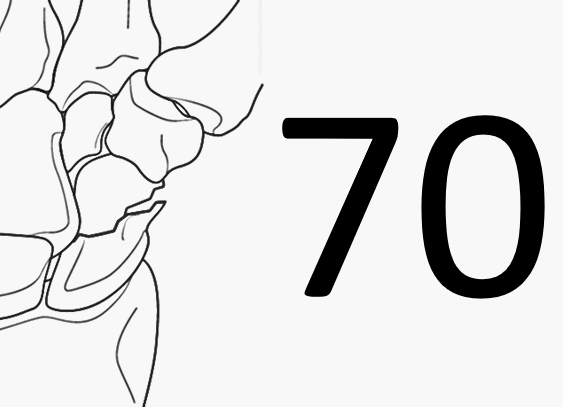
Scaphoid Fractures : Rule of 70s

Epomedicine, May 2, 2021Aug 12, 2021
Scaphoid mnemonic

70% of blood supply of scaphoid is by dorsal branch of radial artery

70% of scaphoid bones have arterial foramina through out their length

70% of carpal fractures are scaphoid fractures

70% of scaphoid fractures occur through the waist

70% of scaphoid fractures are detected on initial radiographs

70% proximal scaphoid fractures unite

70% unstable scaphoid fractures unite
  • Facebook
  • Twitter
PGMEE, MRCS, USMLE, MBBS, MD/MS Musculoskeletal systemOrthopedics

Post navigation

Previous post
Next post

Related Posts

PGMEE, MRCS, USMLE, MBBS, MD/MS superficial vein forearm

Superficial Veins of Forearm : Mnemonic

Jun 22, 2018

Origin: Dorsal venous network The 1st 2 letters of the word “biceps” that being the muscle with which the vein is in relation, will give a mnemonic aid to retain the relative position of the basilic and cephalic veins. (B.I., Basilic Internal) Basilic vein courses medially Cephalic vein course laterally…

Read More
PGMEE, MRCS, USMLE, MBBS, MD/MS

Proptosis : Mnemonic based Approach

Nov 13, 2020Nov 13, 2020

Proptosis refers to the forward displacement of the eyeball beyond the orbital margin with the patient looking straight ahead. The term “Exopthalmos” is reserved for bilateral proptosis or proptosis due to thyroid eye disease. Proptosis can be evaluated using a mnemonic 15 “P”s. A) Pseudoproptosis ruled out: 1. Enlarged globe:…

Read More
PGMEE, MRCS, USMLE, MBBS, MD/MS schatzker classification

Schatzker classification for Tibial plateau fracture : Mnemonic

Apr 15, 2020Aug 18, 2021

Schatzker system is widely accepted and used to classify tibial plateau fractures. It is based on a 2D representation of the fracture. As a general rule, it can be divided into low-energy and lateral tibial plateau variants (types I-III) and high energy variants (type IV-VI). However, it does not include…

Read More

Leave a Reply Cancel reply

Your email address will not be published. Required fields are marked *

This site uses Akismet to reduce spam. Learn how your comment data is processed.

Pre-clinical (Basic Sciences)

Anatomy

Biochemistry

Community medicine (PSM)

Embryology

Microbiology

Pathology

Pharmacology

Physiology

Clinical Sciences

Anesthesia

Dermatology

Emergency medicine

Forensic

Internal medicine

Gynecology & Obstetrics

Oncology

Ophthalmology

Orthopedics

Otorhinolaryngology (ENT)

Pediatrics

Psychiatry

Radiology

Surgery

RSS Ask Epomedicine

  • What to study for Clinical examination in Orthopedics?
  • What is the mechanism of AVNRT?

Epomedicine weekly

  • About Epomedicine
  • Contact Us
  • Author Guidelines
  • Submit Article
  • Editorial Board
  • USMLE
  • MRCS
  • Thesis
©2026 Epomedicine | WordPress Theme by SuperbThemes