Skip to content
Epomedicine

Mnemonics, Simplified Concepts & Thoughts

Epomedicine

Mnemonics, Simplified Concepts & Thoughts

Rheumatoid Arthritis – ACR 2021 Guidelines: Summary

Epomedicine, Feb 21, 2023Feb 21, 2023

Among various methods of measuring disease activity in rheumatoid arthritis, we will be discussing Clinical Disease Activity Index (CDAI).

CDAI = TJC(28) + SJC(28) + PGA(10) + EGA(10)

  • TJC = Tender Joint Count
  • SJC = Swollen Joint Count
  • PGA = Patient’s Global Assessment
  • EGA = Evaluator’s Global Assessment

Interpretation of CDAI:

CDAI Score RangeDisease Severity
≤ 2.8Remission
> 2.8 – 10.0Low
> 10.0 – 22.0Moderate
> 22.0High

DMARD naive patients

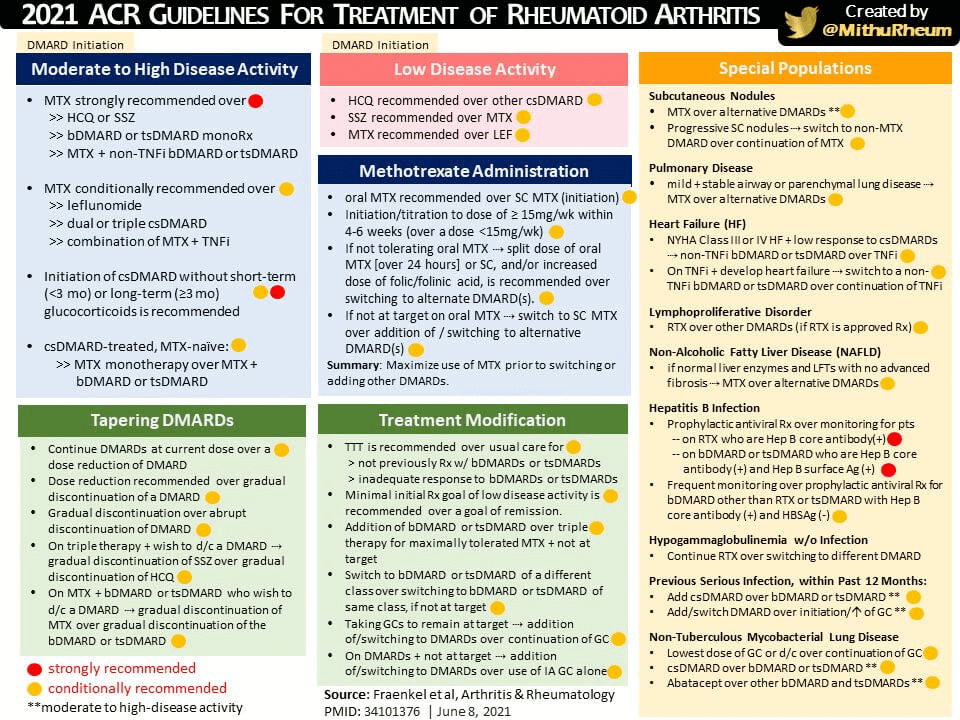
Low disease activity: Hydroxychloroquine (better tolerated) > Sulfasalazine (less immunosuppressive) > Methotrexate (better dosing flexibility & lower cost) > Leflunomide

Moderate to High disease activity:

  • Oral methotrexate ≥ 15 mg/week within 4-6 weeks over oral methotrexate <15 mg/week
  • Intolerance: Oral methotrexate > Split dose of oral methotrexate over 24 hours or Switching to weekly subcutaneous methotrexate or increasing folic/folinic acid dose > Switching DMARDs
  • Not at target: Oral methotrexate > Subcutaneous methotrexate > Switching or adding DMARDs > Intra-articular steroid alone.
    • Target = Low disease activity > Remission
  • Corticosteroid: No corticosteroid > Short term corticosteroid (<3 months) > Longer term corticosteroid (≥3 months)
2021 ACR recommendation rheumatoid arthritis
Source: (1) Mithu Maheswaranathan, MD on Twitter: “🆕 ACR 2021 Guidelines for Treatment of #RheumatoidArthritis 💊 🔴: strong recommendation 🟡: conditional recommendation 🔗: https://t.co/Uyk1VSDf7P https://t.co/eJl3cMZoZY” / Twitter

Modification of DMARDs

Not at target: Methotrexate + b/tsDMARD (switching to different class if required) > Methotrexate + Sulfasalazine + Hydroxychloroquine

At target with corticosteroids: DMARDs (addition/switching) > DMARDs + steroid continuation

Remission for ≥6 months: Continuation of all DMARDs at current dose > Dose reduction (maintain therapeutic dose of atleast 1 DMARD) > Gradual discontinuation of Sulfasalazine > Gradual discontinuation of Hydroxychloroquine > Gradual discontinuation of Methotrexate > Gradual discontinuation of b/tsDMARD

Progressive subcutaneous nodules on methotrexate: Switching DMARD > Continuing methotrexate

Reference and further reading: Fraenkel L, Bathon JM, England BR, St Clair EW, Arayssi T, Carandang K, Deane KD, Genovese M, Huston KK, Kerr G, Kremer J, Nakamura MC, Russell LA, Singh JA, Smith BJ, Sparks JA, Venkatachalam S, Weinblatt ME, Al-Gibbawi M, Baker JF, Barbour KE, Barton JL, Cappelli L, Chamseddine F, George M, Johnson SR, Kahale L, Karam BS, Khamis AM, Navarro-Millán I, Mirza R, Schwab P, Singh N, Turgunbaev M, Turner AS, Yaacoub S, Akl EA. 2021 American College of Rheumatology Guideline for the Treatment of Rheumatoid Arthritis. Arthritis Rheumatol. 2021 Jul;73(7):1108-1123. doi: 10.1002/art.41752. Epub 2021 Jun 8. PMID: 34101376.

  • Facebook
  • Twitter
PGMEE, MRCS, USMLE, MBBS, MD/MS Internal medicineRheumatology

Post navigation

Previous post
Next post

Related Posts

PGMEE, MRCS, USMLE, MBBS, MD/MS omental cake

Omental Cake

Jul 11, 2016

Definition of Omental Caking Thickening of the omentum resulting from localized or diffuse infiltration of omental fat by soft tissue density mass is referred as “omental caking”. It is a radiological sign, which is often identified in CT scan. Involved Anatomical Structure in Omental Caking Greater Omentum – an extension of…

Read More
PGMEE, MRCS, USMLE, MBBS, MD/MS

Gastric Acid Secretion Made Easy

Aug 12, 2023Aug 12, 2023

Steps for gastric acid secretion by parietal cells 1. H+ and HCO3- are produced from CO2 and H2O. 2. H+ is secreted into the lumen by H+/K+ ATPase pump. 3. HCO3- moves out of the cell, across the basolateral membrane via antiport with Cl-. 4. Cl- diffuses passively into the…

Read More
PGMEE, MRCS, USMLE, MBBS, MD/MS

Heel Pad Syndrome vs Plantar Fasciitis

Apr 18, 2025Apr 18, 2025

Heel pad syndrome and plantar fasciitis both cause heel pain, but they affect different areas and have distinct characteristics. Further reading and differential diagnoses of heel pain: Heel Pain : Mnemonic Plantar Fasciitis Heel Pad Syndrome Definition Inflammation of the calcaneal origin of plantar fascia Traumatic irritation of the specialized…

Read More

Leave a Reply Cancel reply

Your email address will not be published. Required fields are marked *

This site uses Akismet to reduce spam. Learn how your comment data is processed.

Pre-clinical (Basic Sciences)

Anatomy

Biochemistry

Community medicine (PSM)

Embryology

Microbiology

Pathology

Pharmacology

Physiology

Clinical Sciences

Anesthesia

Dermatology

Emergency medicine

Forensic

Internal medicine

Gynecology & Obstetrics

Oncology

Ophthalmology

Orthopedics

Otorhinolaryngology (ENT)

Pediatrics

Psychiatry

Radiology

Surgery

RSS Ask Epomedicine

  • What to study for Clinical examination in Orthopedics?
  • What is the mechanism of AVNRT?

Epomedicine weekly

  • About Epomedicine
  • Contact Us
  • Author Guidelines
  • Submit Article
  • Editorial Board
  • USMLE
  • MRCS
  • Thesis
©2026 Epomedicine | WordPress Theme by SuperbThemes