Skip to content
Epomedicine

Mnemonics, Simplified Concepts & Thoughts

Epomedicine

Mnemonics, Simplified Concepts & Thoughts

Prolonged QT Interval : Mnemonics

Epomedicine, Jul 25, 2023Jul 25, 2023

Normal QT Interval

Duration: 0.3-0.44 s (0.46 s for women); tends to increase as the heart rate decreases

Bazett’s formula for corrected QT interval (QTc): QTc = QT/ √RR

Prolonged QT Interval

Duration: >0.44 s (men) and >0.46 s (women)

Can lead to: Polymorphic VT (Torsades de pointes)
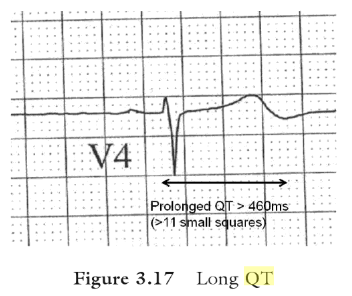
prolonged QT

Causes:

Mnemonic: CDEF

  1. Congenital:
    • Lange-Nielsen syndrome (Autosomal recessive, Deafness)
    • Romano-Ward syndrome (Autosomal dominant, No deafness)
  2. Drugs: Mnemonic – “Anti-ABCDEF”
    • Anti-Arrhythmics (Class IA, e.g. Quinidine, Procainamide, Disopyramide and Class III, e.g. Amiodarone, Sotalol, Ibutilide)
    • Anti-Anginal (Ranolazine)
    • Anti-Allergics (Diphenhydramine)
    • Anti-Biotics (Fluoroquinolones, Macrolides, Trimethoprim)
    • Anti-Cychotics (Haloperidol, Thioridazine, Quetiapine, Risperidone)
    • Anti-Depressants (SSRIs, TCAs)
    • Anti-Emetics (Ondansetron, Metoclopramide)
    • Anti-Fungals (Azoles)
  3. Electrolytes: All decreasing (‘hypo’)
    • Hypocalcemia
    • Hypokalemia
    • Hypomagnesemia
  4. Further more:
    • Acute MI
    • Myocarditis
    • Hypothermia
    • Subarachnoid hemorrhage

Management:

Mnemonic: ABCDE

  1. Avoid etiologic drugs
  2. Beta-blockers (Propanolol or Nadalol)
  3. Cardiac Device (ICD)
  4. Electrolyte correction
  • Facebook
  • Twitter
PGMEE, MRCS, USMLE, MBBS, MD/MS Cardiovascular systemECGInternal medicine

Post navigation

Previous post
Next post

Related Posts

PGMEE, MRCS, USMLE, MBBS, MD/MS

Approach and management of pediatric hydronephrosis

Jan 11, 2024Jan 11, 2024

Pediatric hydronephrosis is a broad term and encompasses various spectrum of disease. It can be broadly classified into: Antenatal hydronephrosis (ANH) It accounts for 1-3% of all pregnancies (Shamshirsaz et.al;2012) and the incidence will continue to rise due to increase use of prenatal ultrasound scan. USG is the mainstay of…

Read More
PGMEE, MRCS, USMLE, MBBS, MD/MS Postaural wilde's incision

Approaches to Middle ear and Mastoid surgery

May 11, 2014

Endomeatal (Transcanal or Transmeatal) Approach: Not used commonly in children owing to relatively small ear canal This incision is used when the mesotympanum and hypotympanum are the surgical sites A posterior tympanomeatal flap is raised to enter into the middle ear. The flap includes skin over the medial two-thirds of the bony…

Read More
PGMEE, MRCS, USMLE, MBBS, MD/MS surface lungs

Respiratory Examination – Relevant Anatomy and Physiology

Apr 4, 2015

1. Division of Airway: Extrathoracic (Upper) airway: Nose to Upper trachea Intrathoracic (Lower) airway: Lower trachea to Alveoli and lungs Note: Vocal fold is also regarded as the demarcating line between upper and lower respiratory tract 2. Angle of Louis: Junction of body of sternum to manubrium (2nd costal cartilage…

Read More

Comment

  1. Kelvin says:
    Jul 29, 2023 at 5:46 pm

    GOAT. ( Greatest Of All Time ). 👍🏾👍🏾👍🏾. God bless you for teaching and sharing.❤️❤️❤️❤️❤️

    Reply

Leave a Reply to Kelvin Cancel reply

Your email address will not be published. Required fields are marked *

This site uses Akismet to reduce spam. Learn how your comment data is processed.

Pre-clinical (Basic Sciences)

Anatomy

Biochemistry

Community medicine (PSM)

Embryology

Microbiology

Pathology

Pharmacology

Physiology

Clinical Sciences

Anesthesia

Dermatology

Emergency medicine

Forensic

Internal medicine

Gynecology & Obstetrics

Oncology

Ophthalmology

Orthopedics

Otorhinolaryngology (ENT)

Pediatrics

Psychiatry

Radiology

Surgery

RSS Ask Epomedicine

  • What to study for Clinical examination in Orthopedics?
  • What is the mechanism of AVNRT?

Epomedicine weekly

  • About Epomedicine
  • Contact Us
  • Author Guidelines
  • Submit Article
  • Editorial Board
  • USMLE
  • MRCS
  • Thesis
©2026 Epomedicine | WordPress Theme by SuperbThemes