Skip to content
Epomedicine

Mnemonics, Simplified Concepts & Thoughts

Epomedicine

Mnemonics, Simplified Concepts & Thoughts

Prolonged QT Interval : Mnemonics

Epomedicine, Jul 25, 2023Jul 25, 2023

Normal QT Interval

Duration: 0.3-0.44 s (0.46 s for women); tends to increase as the heart rate decreases

Bazett’s formula for corrected QT interval (QTc): QTc = QT/ √RR

Prolonged QT Interval

Duration: >0.44 s (men) and >0.46 s (women)

Can lead to: Polymorphic VT (Torsades de pointes)
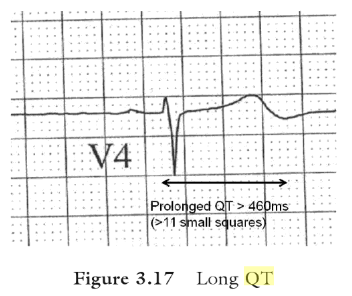
prolonged QT

Causes:

Mnemonic: CDEF

  1. Congenital:
    • Lange-Nielsen syndrome (Autosomal recessive, Deafness)
    • Romano-Ward syndrome (Autosomal dominant, No deafness)
  2. Drugs: Mnemonic – “Anti-ABCDEF”
    • Anti-Arrhythmics (Class IA, e.g. Quinidine, Procainamide, Disopyramide and Class III, e.g. Amiodarone, Sotalol, Ibutilide)
    • Anti-Anginal (Ranolazine)
    • Anti-Allergics (Diphenhydramine)
    • Anti-Biotics (Fluoroquinolones, Macrolides, Trimethoprim)
    • Anti-Cychotics (Haloperidol, Thioridazine, Quetiapine, Risperidone)
    • Anti-Depressants (SSRIs, TCAs)
    • Anti-Emetics (Ondansetron, Metoclopramide)
    • Anti-Fungals (Azoles)
  3. Electrolytes: All decreasing (‘hypo’)
    • Hypocalcemia
    • Hypokalemia
    • Hypomagnesemia
  4. Further more:
    • Acute MI
    • Myocarditis
    • Hypothermia
    • Subarachnoid hemorrhage

Management:

Mnemonic: ABCDE

  1. Avoid etiologic drugs
  2. Beta-blockers (Propanolol or Nadalol)
  3. Cardiac Device (ICD)
  4. Electrolyte correction
  • Facebook
  • Twitter
PGMEE, MRCS, USMLE, MBBS, MD/MS Cardiovascular systemECGInternal medicine

Post navigation

Previous post
Next post

Related Posts

PGMEE, MRCS, USMLE, MBBS, MD/MS

Nerve Conduction Study (NCS) and Electromyography (EMG) : Mnemonic Approach

Sep 15, 2021Oct 4, 2022

Nerve Conduction Study (NCS) In the Nerve conduction study, assessment must be done for ABCDEFGH. Action potential Amplitude Measures the height of response in millivolts (mV) for motor nerve and microvolts (μV) for sensory nerve Indicates quantity of axons contributing to action potential Block of conduction CMAP on proximal stimulation…

Read More
PGMEE, MRCS, USMLE, MBBS, MD/MS Heart Sounds - Murmurs Cover Picture

Heart Sounds – Murmurs

Feb 12, 2020Aug 17, 2020

Murmur is a low, indistinct sound. In terms of medicine, it is the sound produced due to turbulent flow within the heart and great vessels. They are described and named in relation to the normal heart sounds, location, and quality. Please go through these articles before reading further: Heart Sounds…

Read More
PGMEE, MRCS, USMLE, MBBS, MD/MS Child Pugh Score

Child Pugh Score: Mnemonic and Explanation

Aug 15, 2016

The Child-Pugh-Turcot (CTP) score consists of 5 clinical features and is used to assess the prognosis of chronic liver disease and cirrhosis. Mnemonic: A BEAP Albumin (gm/dl) Bilirubin (mg/dl) Encephalopathy (Based on West Haven Criteria) Ascites Prothrombin Time (PT) Prolonged or INR Child-Pugh-Turcot Score Factor 1 point 2 points 3…

Read More

Comment

  1. Kelvin says:
    Jul 29, 2023 at 5:46 pm

    GOAT. ( Greatest Of All Time ). 👍🏾👍🏾👍🏾. God bless you for teaching and sharing.❤️❤️❤️❤️❤️

    Reply

Leave a Reply Cancel reply

Your email address will not be published. Required fields are marked *

This site uses Akismet to reduce spam. Learn how your comment data is processed.

Epomedicine. Prolonged QT Interval : Mnemonics [Internet]. Epomedicine; 2023 Jul 25 [cited 2026 Jan 8]. Available from: https://epomedicine.com/medical-students/prolonged-qt-interval-mnemonics/.

Pre-clinical (Basic Sciences)

Anatomy

Biochemistry

Community medicine (PSM)

Embryology

Microbiology

Pathology

Pharmacology

Physiology

Clinical Sciences

Anesthesia

Dermatology

Emergency medicine

Forensic

Internal medicine

Gynecology & Obstetrics

Oncology

Ophthalmology

Orthopedics

Otorhinolaryngology (ENT)

Pediatrics

Psychiatry

Radiology

Surgery

RSS Ask Epomedicine

  • What to study for Clinical examination in Orthopedics?
  • What is the mechanism of AVNRT?

Epomedicine weekly

  • About Epomedicine
  • Contact Us
  • Author Guidelines
  • Submit Article
  • Editorial Board
  • USMLE
  • MRCS
  • Thesis
©2026 Epomedicine . All rights reserved.