Skip to content
Epomedicine

Mnemonics, Simplified Concepts & Thoughts

Epomedicine

Mnemonics, Simplified Concepts & Thoughts

Personality Disorders – Mnemonic

Epomedicine, May 17, 2019May 17, 2019

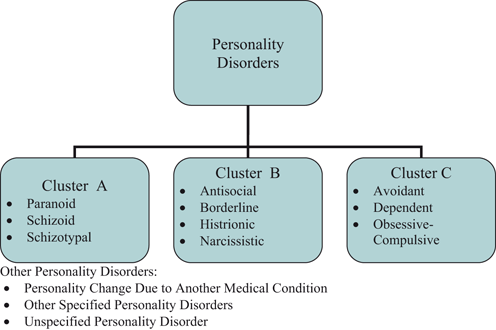
If you are having a hard time remembering the clusters and which disorder falls into which cluster, this mnemonic will be helpful.

Three clusters: A, B and C; remember as WWW – Weird, Wild and Worried, respectively.
personality disorders

Cluster A – Weird (Genetic association with Schizophrenia)

  1. Accusatory: Paranoid (Suspicious)
  2. Aloof: Schizoid (Voluntary social withdrawal)
  3. Awkward: Schizotypal (Schizoid + Magical thinking)
https://www.youtube.com/watch?v=9BqaHfJI1Z4

Cluster B – Wild (Genetic association with mood disorders and substance abuse)

  1. Bad: Antisocial (>/=18 years with a history of Conduct Disorder, Sociopath and Manipulative)
  2. Borderline: Borderline (Unstable and afraid of abandonment)
  3. flamBoyant: Histrionic (Attention-seeking and excessive emotionality)
  4. Best: Narcisstic (Grandiosity, reacts to criticism)
https://www.youtube.com/watch?v=2XZ9cLJd5Gc

Cluster C – Worried (Genetic association with Anxiety disorders)

  1. Cowardly: Avoidant (Seeks social relationship but avoids social situation; hypersensitive to rejection)
  2. Compulsive: Obsessive-compulsive (Inflexible but inefficient)
    • Obsessive-compulsive personality disorder: Ego-syntonic (happy with how they are)
    • Obsessive-compulsive disorder: Ego-dystoni (wishes they could stop)
  3. Clingy: Dependent (Submissive)
https://www.youtube.com/watch?v=_n2YUhNg41M
57 shares
  • Facebook51
  • Twitter
PGMEE, MRCS, USMLE, MBBS, MD/MS Psychiatry

Post navigation

Previous post
Next post

Related Posts

PGMEE, MRCS, USMLE, MBBS, MD/MS

Kanavel Sign for Pyogenic Flexor Tenosynovitis

Sep 30, 2020Sep 30, 2020

1. Exquisite tenderness over the course of the sheath, limited to the sheath Present in 64% cases Late sign of proximal extension of pyogenic tenosynovitis Most important sign as described by Kanavel 2. Flexion of the finger (‘hook’ sign) Present in 69% cases 3. Exquisite pain on extending the finger,…

Read More
PGMEE, MRCS, USMLE, MBBS, MD/MS Facial nerve corticonuclear tract

Facial Nerve Anatomy

May 23, 2014Aug 5, 2023

SYNONYMS: Cranial nerve seven (VII), Nervus facialis Supranuclear pathways 1. Somatomotor cortex: controlling motor component of facial nerve lies in precentral gyrus (Broadmann area 4,6,8) 2. Volitional component: Corticonuclear tracts descend and cross to supply both ipsilateral and contralateral facial (mainly to the contralateral side) nucleus i.e. frontal branch components…

Read More
PGMEE, MRCS, USMLE, MBBS, MD/MS parinaud syndrome

Parinaud Syndrome – Anatomical Basis

May 19, 2019May 19, 2019

Synonyms: Dorsal midbrain sydnrome, Pretectal syndrome Main components of Parinaud syndrome: Vertical gaze palsy Convergence-retraction nystagmus Pupillary light-near dissociation Lid retraction (Collier’s sign) Anatomical basis of Parinaud syndrome: Site of lesion: Dorsal midbrain Close to cerebral aqueduct and pineal gland – hydrocephalus and pinealoma Arterial supply – posterior cerebral artery…

Read More

Comments (2)

  1. Prajwal Nayak says:
    Aug 3, 2024 at 7:14 am

    Thank you so much 🙏

    Reply
  2. Dr M R Lamba says:
    Sep 6, 2025 at 5:22 am

    Very nice

    Reply

Leave a Reply to Prajwal Nayak Cancel reply

Your email address will not be published. Required fields are marked *

This site uses Akismet to reduce spam. Learn how your comment data is processed.

Epomedicine. Personality Disorders – Mnemonic [Internet]. Epomedicine; 2019 May 17 [cited 2026 Jan 21]. Available from: https://epomedicine.com/medical-students/personality-disorders-mnemonic/.

Pre-clinical (Basic Sciences)

Anatomy

Biochemistry

Community medicine (PSM)

Embryology

Microbiology

Pathology

Pharmacology

Physiology

Clinical Sciences

Anesthesia

Dermatology

Emergency medicine

Forensic

Internal medicine

Gynecology & Obstetrics

Oncology

Ophthalmology

Orthopedics

Otorhinolaryngology (ENT)

Pediatrics

Psychiatry

Radiology

Surgery

RSS Ask Epomedicine

  • What to study for Clinical examination in Orthopedics?
  • What is the mechanism of AVNRT?

Epomedicine weekly

  • About Epomedicine
  • Contact Us
  • Author Guidelines
  • Submit Article
  • Editorial Board
  • USMLE
  • MRCS
  • Thesis
©2026 Epomedicine . All rights reserved.