Skip to content
Epomedicine

Mnemonics, Simplified Concepts & Thoughts

Epomedicine

Mnemonics, Simplified Concepts & Thoughts

Personality Disorders – Mnemonic

Epomedicine, May 17, 2019May 17, 2019

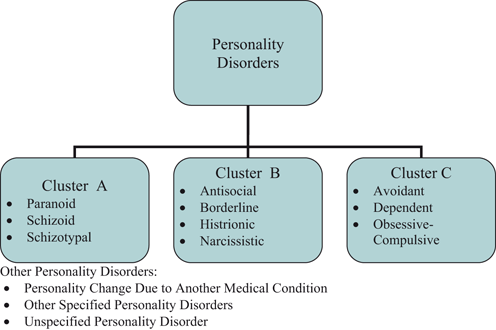
If you are having a hard time remembering the clusters and which disorder falls into which cluster, this mnemonic will be helpful.

Three clusters: A, B and C; remember as WWW – Weird, Wild and Worried, respectively.
personality disorders

Cluster A – Weird (Genetic association with Schizophrenia)

  1. Accusatory: Paranoid (Suspicious)
  2. Aloof: Schizoid (Voluntary social withdrawal)
  3. Awkward: Schizotypal (Schizoid + Magical thinking)
https://www.youtube.com/watch?v=9BqaHfJI1Z4

Cluster B – Wild (Genetic association with mood disorders and substance abuse)

  1. Bad: Antisocial (>/=18 years with a history of Conduct Disorder, Sociopath and Manipulative)
  2. Borderline: Borderline (Unstable and afraid of abandonment)
  3. flamBoyant: Histrionic (Attention-seeking and excessive emotionality)
  4. Best: Narcisstic (Grandiosity, reacts to criticism)
https://www.youtube.com/watch?v=2XZ9cLJd5Gc

Cluster C – Worried (Genetic association with Anxiety disorders)

  1. Cowardly: Avoidant (Seeks social relationship but avoids social situation; hypersensitive to rejection)
  2. Compulsive: Obsessive-compulsive (Inflexible but inefficient)
    • Obsessive-compulsive personality disorder: Ego-syntonic (happy with how they are)
    • Obsessive-compulsive disorder: Ego-dystoni (wishes they could stop)
  3. Clingy: Dependent (Submissive)
https://www.youtube.com/watch?v=_n2YUhNg41M
57 shares
  • Facebook51
  • Twitter
PGMEE, MRCS, USMLE, MBBS, MD/MS Psychiatry

Post navigation

Previous post
Next post

Related Posts

PGMEE, MRCS, USMLE, MBBS, MD/MS

MRI Physics Made Easy

Sep 12, 2020Sep 12, 2020

Human body is made up of water, which means a large number of atoms inside our body is hydrogen atoms, the nucleus of which contains a positively charged proton that spins (or precesses) around an axis like a child’s top. This spinning generates its own tiny magnetic field, giving the…

Read More
PGMEE, MRCS, USMLE, MBBS, MD/MS renal papillary necrosis patterns

Ball-on-Tee, Lobster Claw and Signet Ring Sign – Renal papillary necrosis

Oct 27, 2016

Synonym: Necrotizing papillitis In renal papillary necrosis, part or all of necrotic renal papilla sloughs and may fall into the pelvicalyceal system, which may remain there (and get calcified) or may be voided down the ureter (often causing obstruction). The renal medulla and papillae are vulnerable to ischemic necrosis because…

Read More
PGMEE, MRCS, USMLE, MBBS, MD/MS

Wound Strength

Jul 5, 2025Jul 5, 2025

Wound strength is determined by both quantity and quality of collagen and an appropriate balance of deposition and breakdown. The amount of collagen in a wound plateaus at several weeks post-injury. Timeline: 1. First few weeks: Strength increases rapidly, reaching about 20% of pre-injury strength at 3 weeks.  2. Around 6 weeks: Wound strength…

Read More

Comments (2)

  1. Prajwal Nayak says:
    Aug 3, 2024 at 7:14 am

    Thank you so much 🙏

    Reply
  2. Dr M R Lamba says:
    Sep 6, 2025 at 5:22 am

    Very nice

    Reply

Leave a Reply Cancel reply

Your email address will not be published. Required fields are marked *

This site uses Akismet to reduce spam. Learn how your comment data is processed.

Epomedicine. Personality Disorders – Mnemonic [Internet]. Epomedicine; 2019 May 17 [cited 2025 Dec 15]. Available from: https://epomedicine.com/medical-students/personality-disorders-mnemonic/.

Pre-clinical (Basic Sciences)

Anatomy

Biochemistry

Community medicine (PSM)

Embryology

Microbiology

Pathology

Pharmacology

Physiology

Clinical Sciences

Anesthesia

Dermatology

Emergency medicine

Forensic

Internal medicine

Gynecology & Obstetrics

Oncology

Ophthalmology

Orthopedics

Otorhinolaryngology (ENT)

Pediatrics

Psychiatry

Radiology

Surgery

RSS Ask Epomedicine

  • What to study for Clinical examination in Orthopedics?
  • What is the mechanism of AVNRT?

Epomedicine weekly

  • About Epomedicine
  • Contact Us
  • Author Guidelines
  • Submit Article
  • Editorial Board
  • USMLE
  • MRCS
  • Thesis
©2025 Epomedicine . All rights reserved.