Skip to content
Epomedicine

Mnemonics, Simplified Concepts & Thoughts

Epomedicine

Mnemonics, Simplified Concepts & Thoughts

pth magnesium

Why mild hypomagnesemia causes hyperparathyroidism and severe hypomagnesemia causes hypoparathyroidism?

Epomedicine, Feb 16, 2017Jul 29, 2023

You must have seen the statement in First Aid that says – low serum magnesium causes increase in Parathyroid hormone secretion and very low serum magnesium causes decrease in Parathyroid hormone secretion. Doesn’t this make you curious? Let’s explore the underlying mechanism in depth.

How Calcium and Magnesium Mediated PTH Feedback Inhibition Works ?

1. Both the divalent cations (Ca++ and Mg++) act on the same negative feedback receptor on parathyroid chief cells.

2. Extracellular magnesium is a direct agonist of the CaSR (Calcium Sensing Receptor) with a potency of 2-3 times less than that of calcium.

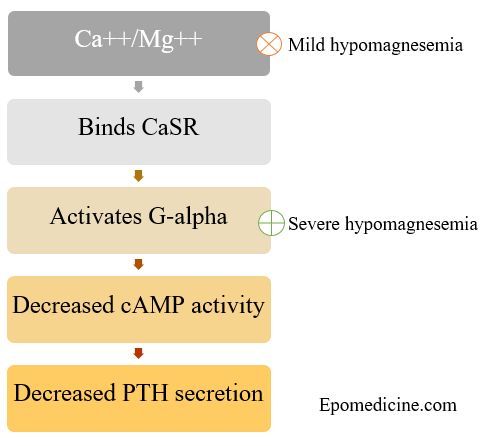
3. Increased Magnesium and calcium leads to increased binding of divalent cations with CaSR which activates the G-alpha subunit (both q and i) leading to decreased cAMP activity.

4. Hence, PTH release is inhbited.

Why PTH release increases in Mild hypomagnesemia ?

  • Seen in magnesium level as low as 0.5 mmol/L.
  • Decrease in extracellular Magnesium leads to decreased CaSR activation.
  • This leads to decreased feedback inhibition of PTH and hence, increased PTH secretion.
pth magnesium

Why PTH release decreases in Severe hypomagnesemia?

  • Seen in magnesium level <0.5 mmol/L.
  • Magnesium binding site responsible for inhibition of PTH secretion is not identical with the extracellular binding site of the CaSR.
  • Intracellular magnesium depletion leads to decreased magnesium binding to G-alpha subunit associated with CaSR.
  • This leads to disinhibition of G-alpha subunit which mimicks CaSR activation.
  • This leads to decreased PTH release (not decreased PTH synthesis).

This effect is called paradoxical block of PTH secretion.

Conclusion:

1. Mild hypomagnesemia → Decreased extracellular Mg++ → Decreased feedback inhibition → ↑PTH secretion

2. Severe hypomagnesemia → Decreased intracellular Mg++ → Removal of CaSR associated G-alpha disinhibition → ↓PTH secretion

References:

  1. Immunoendocrinology: Scientific and Clinical Aspects edited by George S. Eisenbarth
  2. Hypoparathyroidism edited by Maria Luisa Brandi, Edward Meigs Brown
1 shares
  • Facebook
  • Twitter
PGMEE, MRCS, USMLE, MBBS, MD/MS Endocrine systemPhysiology

Post navigation

Previous post
Next post

Related Posts

PGMEE, MRCS, USMLE, MBBS, MD/MS Appendicular-skeleton

Summary of Clinical Tests and Signs in Orthopedics

Jun 5, 2014

Adson’s test: for thoracic outlet syndrome Allen’s test: for testing patency of radial and ulnar arteries Alli’s test: for DDH Anvil test: for testing tenderness of the spine Ape thumb: for median nerve injury Apley’s grinding test: for meniscus injury Apprehension test: for recurrent dislocation of the shoulder Barlow’s test:…

Read More
PGMEE, MRCS, USMLE, MBBS, MD/MS coombs test

Coomb’s test : Mnemonic

May 23, 2019May 23, 2019

Components of Coomb’s test: Mnemonic: ABCD A: Antibody (to be detected) B: Blood antigen (RBC) C: Coomb’s reagent (Anti-antibody) D: Detect agglutination Direct Coomb’s/Antiglobulin test (DAT or DCT): Mnemonic: In DAT/DCT we take A+B from patient and add C [(A+B) + C] Another Mnemonic: DCBA (Direct Coomb’s detect Blood Bound…

Read More
PGMEE, MRCS, USMLE, MBBS, MD/MS palatogenesis

Face and Palate Development – Embryology made Easy

Aug 7, 2016Aug 7, 2016

4 week embryo 5 mesenchymal prominences (facial primordia) appear in relation to the stomodeum (a depression in the surface ectoderm which marks the future mouth and oral cavity): Cranially: Frontonasal prominence (unpaired) Laterally: Maxillary prominence (paired; 1st pharyngeal arch) Caudally: Mandibular prominence (paired; 1st pharyngeal arch) 5 week embryo Localized…

Read More

Leave a Reply Cancel reply

Your email address will not be published. Required fields are marked *

This site uses Akismet to reduce spam. Learn how your comment data is processed.

Pre-clinical (Basic Sciences)

Anatomy

Biochemistry

Community medicine (PSM)

Embryology

Microbiology

Pathology

Pharmacology

Physiology

Clinical Sciences

Anesthesia

Dermatology

Emergency medicine

Forensic

Internal medicine

Gynecology & Obstetrics

Oncology

Ophthalmology

Orthopedics

Otorhinolaryngology (ENT)

Pediatrics

Psychiatry

Radiology

Surgery

RSS Ask Epomedicine

  • What to study for Clinical examination in Orthopedics?
  • What is the mechanism of AVNRT?

Epomedicine weekly

  • About Epomedicine
  • Contact Us
  • Author Guidelines
  • Submit Article
  • Editorial Board
  • USMLE
  • MRCS
  • Thesis
©2026 Epomedicine | WordPress Theme by SuperbThemes