Skip to content
Epomedicine

Mnemonics, Simplified Concepts & Thoughts

Epomedicine

Mnemonics, Simplified Concepts & Thoughts

men syndrome

MEN syndrome : Mnemonics

Epomedicine, Feb 17, 2017May 21, 2024

MEN syndrome is an autosomal dominant (AD) predisposition to developing multiple endocrine tumors.

Mnemonic: MEN are Dominant.

Points to remember:

  1. Parathyroid hyperplasia is common to MEN I and MEN IIa syndrome.
  2. Medullary carcinoma of thyroid is common to MEN IIa and MEN IIb syndrome.
  3. MEN I occurs due to mutation in Menin I gene located on chromosome 11q.
  4. MEN II occurs due to mutation in Menin II gene located on choromsome 10q.
  5. MEN IV (similar to MEN I) occurs due to mutation in CDKN1B located on chromosome 12p.
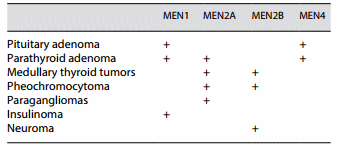
men syndrome tumors

MEN I or MEN 1 (Wermer’s syndrome)

Mnemonic: 3 X P’s

  1. Pituitary adenoma
  2. Parathyroid hyperplasia
  3. Pancreatic islet cell tumor (Zollinger-Ellison syndrome in 50% and Insulinoma in 20%)
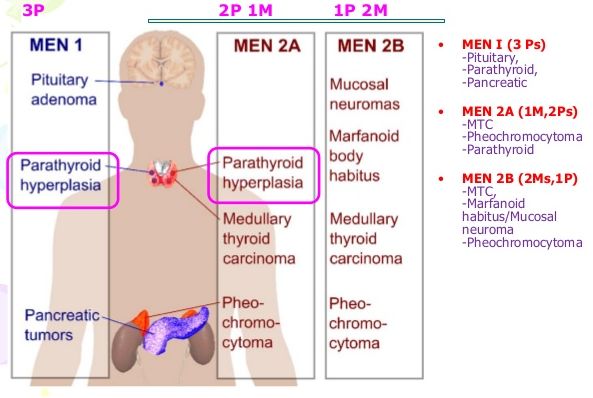
men syndrome

MEN IIA or MEN 2A (Sipple’s syndrome)

Mnemonic: 3 X C’s

  1. Catecholamine releasing tumor: Pheochromocytoma
  2. Calcitonin releasing tumor: Medullary carcinoma of thyroid
  3. Calcium increasing: Parathyroid hyperplasia (hyperparathyroidism)

MEN IIB or 2B (MEN III)

Mnemonic: 2C 2M

  1. Catecholamine releasing tumor: Pheochromocytoma
  2. Calcitonin releasing tumor: Medullary carcinoma of thyroid
  3. Mucosal neuromas
  4. Marfanoid habitus

MEN IV or MEN 4

Men IV syndrome is clinically indistinguishable from MEN I syndrome. In addition, these may have:

  1. Reproductive organ tumors (e.g. testicular tumors, neuroendocrine cervical carcinoma)
  2. Adrenal + Renal tumors

Reference: Endocrinology: Adult and Pediatric By J. Larry Jameson, Leslie J. De Groot
37 shares
  • Facebook36
  • Twitter
PGMEE, MRCS, USMLE, MBBS, MD/MS Endocrine systemInternal medicinePathology

Post navigation

Previous post
Next post

Related Posts

PGMEE, MRCS, USMLE, MBBS, MD/MS

Surgical Site Infection (SSI) : CDC Definitions Simplified

Jan 18, 2021Jan 18, 2021

Superficial Incisional SSI Stab wound, pin site infection or stitch abscess alone is not considered an SSI. a. Time: Occurs within 30 days after any operative procedure (where day 1 = the procedure date) AND b. Site: Involves only skin and subcutaneous tissue of the incision AND c. Infection: At…

Read More
PGMEE, MRCS, USMLE, MBBS, MD/MS

Pathophysiology of Acute Compartment syndrome

Apr 27, 2023Apr 27, 2023

Definition Mubarak and Hargens (1981) defined compartment syndrome as an elevation of the interstitial pressure in a closed osseofascial compartment that results in microvascular compromise. Pathophysiology Tissue perfusion = Capillary perfusion pressure – Interstitial fluid pressure 3 major theories for microvascular dysfunction and ischemia: Tissue survival: Vicious cycle of compartment…

Read More
PGMEE, MRCS, USMLE, MBBS, MD/MS

Heart Sounds – Abnormal

Apr 24, 2019May 23, 2020

The basic clinical examination of the Cardiac System is by Auscultation (listening to the sounds made by the heart). As explained in the previous article physiological sounds made in each cardiac cycle viz. S1 and S2 due to the closure of the Atrio-Ventricular Valves and Outlet Valve in synchrony. Please…

Read More

Leave a Reply Cancel reply

Your email address will not be published. Required fields are marked *

This site uses Akismet to reduce spam. Learn how your comment data is processed.

Epomedicine. MEN syndrome : Mnemonics [Internet]. Epomedicine; 2017 Feb 17 [cited 2025 Dec 3]. Available from: https://epomedicine.com/medical-students/men-syndrome-mnemonics/.

Pre-clinical (Basic Sciences)

Anatomy

Biochemistry

Community medicine (PSM)

Embryology

Microbiology

Pathology

Pharmacology

Physiology

Clinical Sciences

Anesthesia

Dermatology

Emergency medicine

Forensic

Internal medicine

Gynecology & Obstetrics

Oncology

Ophthalmology

Orthopedics

Otorhinolaryngology (ENT)

Pediatrics

Psychiatry

Radiology

Surgery

RSS Ask Epomedicine

  • What to study for Clinical examination in Orthopedics?
  • What is the mechanism of AVNRT?

Epomedicine weekly

  • About Epomedicine
  • Contact Us
  • Author Guidelines
  • Submit Article
  • Editorial Board
  • USMLE
  • MRCS
  • Thesis
©2025 Epomedicine . All rights reserved.