Skip to content
Epomedicine

Mnemonics, Simplified Concepts & Thoughts

Epomedicine

Mnemonics, Simplified Concepts & Thoughts

Meckel’s Diverticulum : Rule of 2

Epomedicine, Sep 7, 2023Sep 7, 2023

General description

  • Most common congenital abnormality of gastrointestinal tract
  • Occurs due to incomplete obliteration of omphalomesenteric duct in the 7th week of gestation
  • True diverticulum (presence of all layers of small bowel wall)
  • Develop from anti-mesenteric surface of the mid-distal ileum
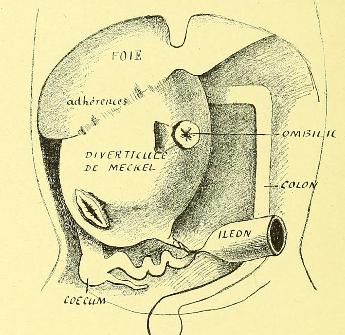
meckels diverticulum
“This image is taken from Page 28 of Contribution a la pathologie du diverticule de Meckel” by Medical Heritage Library, Inc. is licensed under CC BY-NC-SA 2.0.

Rule of 2s

1. Occurs in 2% population

2. Symptomatic cases are 2 times more common in males

3. Located within 2 feet proximal to ileocecal valve

4. 2 inches long and 2 cm diameter

5. 2 types of ectopic mucosa: gastric and pancreatic

  • Meckel’s scan (Tc99m) identifies gastric mucosa

6. Symptomatic only in 2% adults

  • Meckel’s diverticulitis
  • Gastrointestinal hemorrhage
  • Small bowel obstruction

7. Usually symptomatic before 2 years age

8. 2 types of surgery:

  • Long diverticula (height to diameter ratio >2): Diverticulectomy
    • If inflamed/perforated base or complicated obstruction: Wedge or segmental resection
  • Short diverticula (height to diameter ratio <2): Wedge or segmental resection
  • Facebook
  • Twitter
PGMEE, MRCS, USMLE, MBBS, MD/MS EmbryologyGeneral SurgeryPediatrics

Post navigation

Previous post
Next post

Related Posts

PGMEE, MRCS, USMLE, MBBS, MD/MS

Enzyme Inducers and Inhibitors : Mnemonic

Oct 1, 2021Oct 1, 2021

Cytochrome P450 Inducers Mnemonic: SCRAP GP Sulfonylureas, Smoking Carbamazepine, Corticosteroids Rifamycins (Rifampicin, Rifabutin) Alcohol (Chronic) Phenytoin Griseofulvin Phenobarbital Cytochrome P450 Inhibitors Mnemonic 1: VIDEOCASE Valproate Isoniazid Disulfiram Erythromycin, Clarithromycin (not Azithromycin) Omeprazole Cimetidine Allopurinol Sulfonamides Ethanol (Acute) Mnemonic 2: SICKFACES.COM Sodium valproate Isoniazid Cimetidine Ketoconazole Fluconazole Alcohol (Acute) Chloramphenicol Erythromycin…

Read More
PGMEE, MRCS, USMLE, MBBS, MD/MS

4 Box Model for Clinical Decision Making

Oct 23, 2020Oct 23, 2020

Remember the 4 Cs: Clinical indication (Principle of Benevolence and Non-maleficence) Choice of patient (Principle of respect for Autonomy) Contextual features (Principle of Loyalty and Fairness) Condition (quality) of life (Principle of Benevolence, Non-maleficence and respect for Autonomy) A 5th box can be added: Catholic perspective Example: Clinical indications 18…

Read More
PGMEE, MRCS, USMLE, MBBS, MD/MS

Antibiofilm Antibiotics

Apr 22, 2025

Biofilms are immobile microbial communities which colonize and grow on surfaces of medical implants such as sutures, catheters and implants, by self-produced extracellular polymeric substances and cause infections which can only be treated by their removal. It provides additional resistance to the bacteria by various mechanisms like altered pH, osmolarity,…

Read More

Leave a Reply Cancel reply

Your email address will not be published. Required fields are marked *

This site uses Akismet to reduce spam. Learn how your comment data is processed.

Pre-clinical (Basic Sciences)

Anatomy

Biochemistry

Community medicine (PSM)

Embryology

Microbiology

Pathology

Pharmacology

Physiology

Clinical Sciences

Anesthesia

Dermatology

Emergency medicine

Forensic

Internal medicine

Gynecology & Obstetrics

Oncology

Ophthalmology

Orthopedics

Otorhinolaryngology (ENT)

Pediatrics

Psychiatry

Radiology

Surgery

RSS Ask Epomedicine

  • What to study for Clinical examination in Orthopedics?
  • What is the mechanism of AVNRT?

Epomedicine weekly

  • About Epomedicine
  • Contact Us
  • Author Guidelines
  • Submit Article
  • Editorial Board
  • USMLE
  • MRCS
  • Thesis
©2026 Epomedicine | WordPress Theme by SuperbThemes