Skip to content
Epomedicine

Mnemonics, Simplified Concepts & Thoughts

Epomedicine

Mnemonics, Simplified Concepts & Thoughts

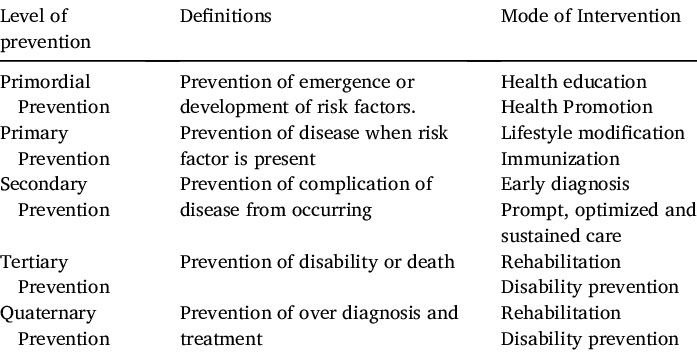
Levels of Disease Prevention : Mnemonic

Epomedicine, Aug 18, 2024Aug 18, 2024
LevelMnemonicTarget populationGoalsMode of intervention
PrimordialPrevent risk factorsGeneral populationPrevent emergence of risk factorsHealth education
Health promotion
PrimaryPrevent diseaseGeneral populationPrevent disease onsetLifestyle modification
Immunization
SecondaryScreeningSubclinical (asymptomatic)Prevent symptom onsetEarly diagnosis
Prompt optimized & sustained care
TertiaryTreatmentClinical (symptomatic)Prevent clinical disease progression & complicationsRehabilitation
Disability prevention
QuarterneryQuit unnecessary treatmentSymptomatic patients but overmedicalized or not treatablePrevent overtreatment & iatrogenic harmRehabilitation
Disability prevention
level of prevention
Dutta, Deep & Arora, Varun & Dhingra, Atul & Das, Ashok & Fariduddin, Md & Shaikh, Khalid & Priya, Gagan & Shah, P & Rehim, A & John, Mathew & Shaikh, Shehla & Orabi, A & Saraswati, Made & Selim, Shahjada & Baruah, Manash & Gangopadhyay, Kalyan & Langi, Yuanita & Nair, Tiny & Dhanwal, Dinesh & Kalra, Sanjay. (2021). Quinary prevention in diabetes care: Need for multidisciplinary approach. Clinical Epidemiology and Global Health. 11. 10.1016/j.cegh.2021.100757. [CC BY-NC-ND]

Example

For Diabetes mellitus:

  1. Primordial prevention: Health education about diabetes mellitus
  2. Primary prevention: Healthy diet and exercise to prevent diabetes onset in future
  3. Secondary prevention: Glucose screening for type 2 diabetes mellitus
  4. Tertiary prevention: Use medications to treat previously diagnosed diabetes
  5. Quarternery prevention: Discontinue sulfonylurea after multiple hypoglycemic episodes
  • Facebook
  • Twitter
PGMEE, MRCS, USMLE, MBBS, MD/MS Community medicine

Post navigation

Previous post
Next post

Related Posts

PGMEE, MRCS, USMLE, MBBS, MD/MS

Clinical Criteria for Diagnosis of Enteric Fever

Aug 5, 2019May 31, 2020

In the Absence of Microbiological Confirmation, these case defintions and criteria may be helpful. Case definitions of Typhoid Fever a. Confirmed enteric fever: A patient with persistent fever (38 °C or more) lasting 3 or more days, with laboratory-confirmed S. typhi organisms (blood, bone marrow, bowel fluid) A clinical compatible…

Read More
PGMEE, MRCS, USMLE, MBBS, MD/MS

SIMPLE approach to Nutritional Care in Elderly Patients

Jul 4, 2025Jul 4, 2025

The essence of this approach is that, rather than requiring a highly specialized nutritionist, a systematic assessment on the part of all the disciplines that are interacting with the patients can achieve what is needed for the nutritional care of the older patient with a fragility fracture, regardless of setting…

Read More
PGMEE, MRCS, USMLE, MBBS, MD/MS

Ligaments of Pelvis

Oct 3, 2020Oct 3, 2020

Inherent stability of the pelvis is provided by ligaments. The 3 groups of ligaments are: 1. Sacrum to Pelvis: Sacroiliac ligamentous complex: is divided into posterior (short and long) and anterior ligaments. Posterior ligaments provide most of the stability. Sacrotuberous ligament: runs from the posterolateral aspect of the sacrum and the…

Read More

Leave a Reply Cancel reply

Your email address will not be published. Required fields are marked *

This site uses Akismet to reduce spam. Learn how your comment data is processed.

Pre-clinical (Basic Sciences)

Anatomy

Biochemistry

Community medicine (PSM)

Embryology

Microbiology

Pathology

Pharmacology

Physiology

Clinical Sciences

Anesthesia

Dermatology

Emergency medicine

Forensic

Internal medicine

Gynecology & Obstetrics

Oncology

Ophthalmology

Orthopedics

Otorhinolaryngology (ENT)

Pediatrics

Psychiatry

Radiology

Surgery

RSS Ask Epomedicine

  • What to study for Clinical examination in Orthopedics?
  • What is the mechanism of AVNRT?

Epomedicine weekly

  • About Epomedicine
  • Contact Us
  • Author Guidelines
  • Submit Article
  • Editorial Board
  • USMLE
  • MRCS
  • Thesis
©2026 Epomedicine | WordPress Theme by SuperbThemes