Skip to content
Epomedicine

Mnemonics, Simplified Concepts & Thoughts

Epomedicine

Mnemonics, Simplified Concepts & Thoughts

Levels of Disease Prevention : Mnemonic

Epomedicine, Aug 18, 2024Aug 18, 2024
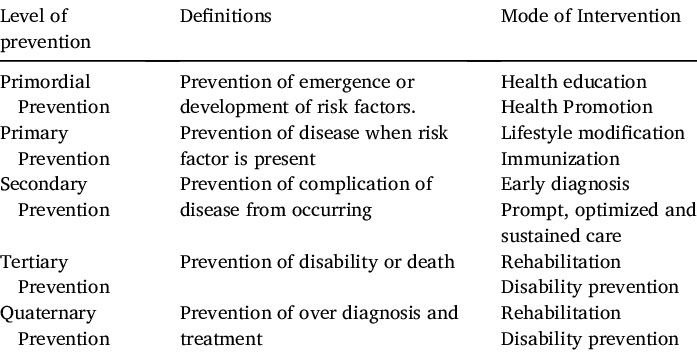
LevelMnemonicTarget populationGoalsMode of intervention
PrimordialPrevent risk factorsGeneral populationPrevent emergence of risk factorsHealth education
Health promotion
PrimaryPrevent diseaseGeneral populationPrevent disease onsetLifestyle modification
Immunization
SecondaryScreeningSubclinical (asymptomatic)Prevent symptom onsetEarly diagnosis
Prompt optimized & sustained care
TertiaryTreatmentClinical (symptomatic)Prevent clinical disease progression & complicationsRehabilitation
Disability prevention
QuarterneryQuit unnecessary treatmentSymptomatic patients but overmedicalized or not treatablePrevent overtreatment & iatrogenic harmRehabilitation
Disability prevention
level of prevention
Dutta, Deep & Arora, Varun & Dhingra, Atul & Das, Ashok & Fariduddin, Md & Shaikh, Khalid & Priya, Gagan & Shah, P & Rehim, A & John, Mathew & Shaikh, Shehla & Orabi, A & Saraswati, Made & Selim, Shahjada & Baruah, Manash & Gangopadhyay, Kalyan & Langi, Yuanita & Nair, Tiny & Dhanwal, Dinesh & Kalra, Sanjay. (2021). Quinary prevention in diabetes care: Need for multidisciplinary approach. Clinical Epidemiology and Global Health. 11. 10.1016/j.cegh.2021.100757. [CC BY-NC-ND]

Example

For Diabetes mellitus:

  1. Primordial prevention: Health education about diabetes mellitus
  2. Primary prevention: Healthy diet and exercise to prevent diabetes onset in future
  3. Secondary prevention: Glucose screening for type 2 diabetes mellitus
  4. Tertiary prevention: Use medications to treat previously diagnosed diabetes
  5. Quarternery prevention: Discontinue sulfonylurea after multiple hypoglycemic episodes

  • Facebook
  • Twitter
PGMEE, MRCS, USMLE, MBBS, MD/MS Community medicine

Post navigation

Previous post
Next post

Related Posts

PGMEE, MRCS, USMLE, MBBS, MD/MS primary bone tumors and tumor-like lesions

Differential Diagnoses of Bone Tumors : Mnemonic Approach

May 31, 2019Oct 6, 2021

Lytic and Sclerotic Bone Lesions Mnemonic for Solitary lytic lesions: FEGNOMASHIC Fibrous dysplasia Enchondroma Eosinophilic granuloma Giant cell tumor Nonossifying fibroma Osteoblastoma, Osteosarcoma (telangiectatic) Metastases Myeloma Aneursymal bone cyst Simple bone cyst Hyperparathyroidism (brown tumor) Infection Chondroblastoma Chondromyxoid fibroma Mnemonic for Multiple lytic lesions: FEMHI Fibrous dysplasia Eosinophilic granuloma/Enchondroma Metastasis/Mutiple…

Read More
PGMEE, MRCS, USMLE, MBBS, MD/MS

Swan neck deformity vs Boutonniere deformity

Jun 5, 2022Jun 5, 2022

Alterations in the relationships between the balanced extrinsic and intrinsic musculature of the hand due to trauma or secondary to the effects of systemic disease may cause the development of functional deformities such as a boutonnière or swan-neck deformity. Swan-neck deformity Boutonniere deformity Deformity PIPJ Hyperextension PIPJ Flexion DIPJ Flexion…

Read More
PGMEE, MRCS, USMLE, MBBS, MD/MS visual cycle

Visual cycle – Simplified

May 31, 2019May 31, 2019

11-cis-retinal combines with opsin protein to form rhodopsin. Light stimulates conversion of rhodopsin bound 11-cis-retinal to all-trans-retinol (all-trans-retinol is transported from photoreceptor cells to retinal pigment epithelium), which subsequently dissociates from opsin (bleaching), leading to membrane depolarization and initiation of action potential in photoreceptors in the neural retina. Once in…

Read More

Leave a Reply Cancel reply

Your email address will not be published. Required fields are marked *

This site uses Akismet to reduce spam. Learn how your comment data is processed.

Epomedicine. Levels of Disease Prevention : Mnemonic [Internet]. Epomedicine; 2024 Aug 18 [cited 2025 Dec 6]. Available from: https://epomedicine.com/medical-students/levels-of-disease-prevention-mnemonic/.

Pre-clinical (Basic Sciences)

Anatomy

Biochemistry

Community medicine (PSM)

Embryology

Microbiology

Pathology

Pharmacology

Physiology

Clinical Sciences

Anesthesia

Dermatology

Emergency medicine

Forensic

Internal medicine

Gynecology & Obstetrics

Oncology

Ophthalmology

Orthopedics

Otorhinolaryngology (ENT)

Pediatrics

Psychiatry

Radiology

Surgery

RSS Ask Epomedicine

  • What to study for Clinical examination in Orthopedics?
  • What is the mechanism of AVNRT?

Epomedicine weekly

  • About Epomedicine
  • Contact Us
  • Author Guidelines
  • Submit Article
  • Editorial Board
  • USMLE
  • MRCS
  • Thesis
©2025 Epomedicine . All rights reserved.