Boundary lubrication
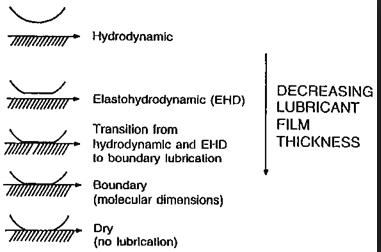
A monolayer of lubricant molecule (lubricin) adsorbed on each surface (boundary) of the joint prevents direct cartilage to cartilage (articular) contact
Fluid-film lubrication
Cartilage surfaces are separated by a fluid film
1. Hydrodynamic lubrication:
- Opposite cartilage surfaces slide and draw fluid into the space between the cartilages
- Two surfaces are angled to each other and the viscosity in the resulting wedge of fluid separates the two surfaces
2. Squeeze film lubrication:
- Joint is loaded perpendicularly and two opposing cartilage surfaces are brought together but the viscosity of incompressible fluid maintains lubrication
- Fluid is squeezed out and gradually thinned bringing cartilage surfaces nearer, hence, carries high load for a short time
2. Elastohydrodynamic lubrication: Combination of hydrodynamic and squeeze film
- When the hydrodynamic pressure is high enough to deform the cartilage tissue
- Yielding articular surface creates a larger surface area when compressed by the fluid and there is less dissipation of the fluid-film, and therefore the load is sustained for a longer period
- Predominant lubrication mechanism in synovial fluids during dynamic joint function
Mixed lubrication
Combination of boundary lubrication and elastohydrodynamic lubrication and consists of 2 contradicting theories –
1. Weeping (Hydrostatic) lubrication: As articular cartilage is a compliant, porous material that is saturated with liquid, when the tissue is compressed by loading, it gradually weeps out the interstitial fluid into the space between two opposing cartilage and the liquid phase takes over the majority of the load. The fluid can only weep into the joint, because the impervious layer of calcified cartilage keeps in from being forced into the subchondral bone.
2. Boosted lubrication: The surface roughness of the cartilage may provide extra space in the intra-articular gap to trap pools of fluid. When synovial fluid is trapped in the intra-articular gap under loading, entrained lubricating proteins may be concentrated by the leakage of the water components either along the gap or into the cartilage, effectively filtering the fluid. The concentrated synovial fluid is considered as a gel-like material assisting in joint lubrication.
Video:
https://www.youtube.com/watch?v=QeowNt3Jez8
Application in Gait Cycle
| Gait phase | Load | Velocity of sliding | Lubrication |
| Swing | Light (~20N) | Hydrodynamic | |
| Heel strike | Suddenly rises (~2 kN) | Low | Squeeze film |
| Mid-stance | Lower | Higher | Elastohydrodynamic |
| Toe-off | Maximum | Minimal | Squeeze film and Boundary |
| Prolonged stance | Boosted |
In metal-plastic artificial joints, fluid film lubrication mechanisms are ineffective because of the hardness of the materials and the limited surface areas, so that surface-to-surface rubbing takes place during sliding.
References:
- Wu, Y. (2017). Joint Lubrication: The Influence of Cartilage Surface Topology and Synovial Fluid Viscosity.
- Basic Orthopaedic Sciences, 2nd Edition – Edited by Manoj Ramachandran