Iliofemoral ligament (Y-ligament, Ligament of Bigelow)
Epomedicine,
Structure
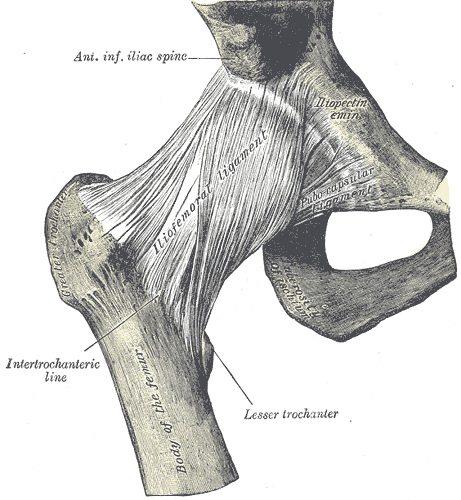
Inverted “Y” shaped
Proximal attachment: Lower part of Anterior inferior iliac spine (AIIS) and rim of acetabulum
Distal attachment: Divides into 2 bands which attaches to inferomedial (vertically oriented fibers) and superolateral (obliquely oriented fibers) part of inter-trochanteric line
More than 0.5 cm thick
Rupture strength: 350 kg
It is one of the strongest ligaments in the body, the other being the interosseous sacro-iliac ligament.
By Henry Vandyke Carter – Henry Gray (1918) Anatomy of the Human Body [CC BY SA 4.0]
Functions
Strengthens the anterior part of the articular capsule
Prevents hyperextension of joint when standing
In the erect posture, the center of gravity of the body falls slightly behind a line joining the centers of the two hip joints. As such, there is a natural tendency for the body to fall backwards on the hip joints. This is resisted by the iliofemoral ligaments.
Clinical correlates
Hip dislocation: In hip dislocation, the surgeon may use the iliofemoral ligament as a support to lever the head of the femur back into the acetabulum.
Hip dysplasia: Patients with hip dysplasia were found to have thinner iliofemoral ligaments
References:
Anatomy, descriptive and applied – Henry Gray
Cunningham’s manual of practical anatomy – 16th edition
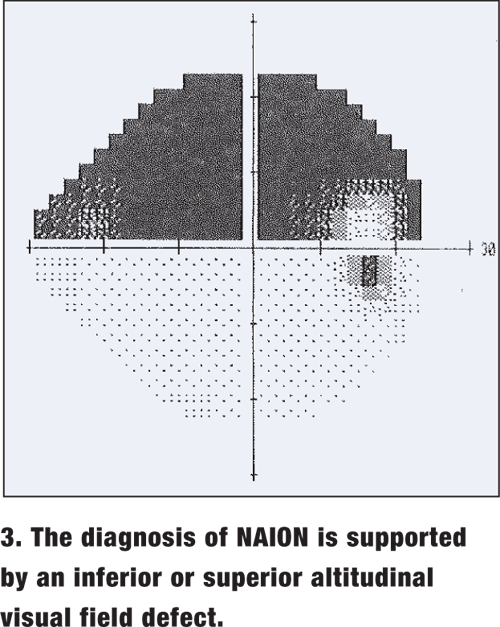
Acute or sudden vision loss is due to one of the following causes: Opacification of normally transparent structures anterior to retina Retinal abnormalities Abnormalities of optic nerve and visual pathway Systematic history and ocular examination is necessary. Step 1: Unilateral or Bilateral Sudden vision loss ? Monocular loss of vision:…
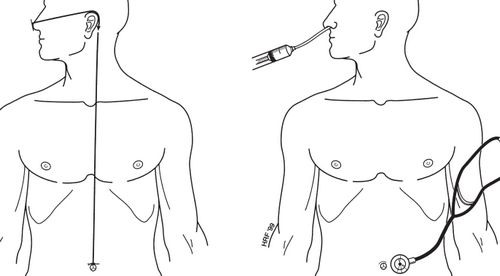
Indications Gastric decompression Gavage (feeding) Gastric lavage (irrigation or dilution of gastric contents) Sampling of the gastric contents for analysis Sometimes used to instil air into the stomach to detect a gastric perforation on erect CXR Contraindications Basilar skull fractures (Risk of NG reaching brain) Facial fractures (risk of cribiform…
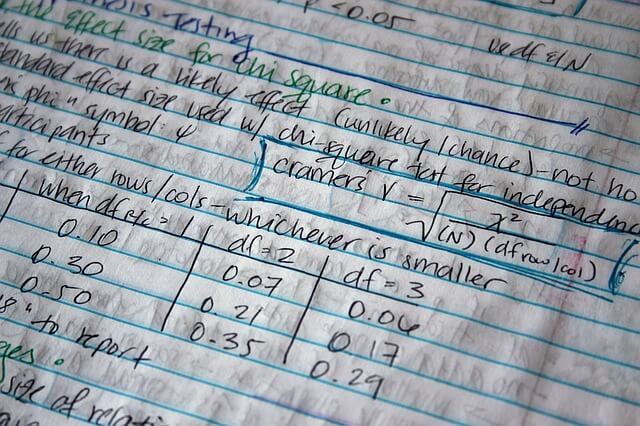
Steps: Types of data Mnemonic: NOIR Qualitative or Categorical data a. Nominal (relating to name): Groups e.g. gender (male/female), color (black/white), blood groups (A/B/AB/O), religions (hindu/muslim/christian) b. Ordinal (relating to order): Rank-ordered data but without meaningful difference; e.g. socio-economic status (low, middle and high), rank (1st, 2nd and 3rd)– without…