Skip to content
Epomedicine

Mnemonics, Simplified Concepts & Thoughts

Epomedicine

Mnemonics, Simplified Concepts & Thoughts

How to check an Error in ABG ? ABG analysis

Dr. Pedchrome, May 1, 2023May 1, 2023

Sometimes, clinicians might find ABG result not matching with the patient condition. These results might arise from technical errors in machine and there are certain points which can be used to check the error.

How to Check whether ABG result is Right or has Error?

  1. Check patient and ABG correlation
  2. Check Lab values: If TCO2- HCO3 > 4meq/L , likely technical error.
  3. For pH 7.3 to 7.5, actual bicarb should be

X= 24X PaCO2/HCO3

Y= 80- V

Y should be around last 2 digits after decimal of pH.

V= 30

  1. PaO2 –pCo2 relationship: paO2 + PaCO2 should never exceed > 150 mmHg( if not under oxygen.)
  2. PaO2-FiO2 relationship.

Also:

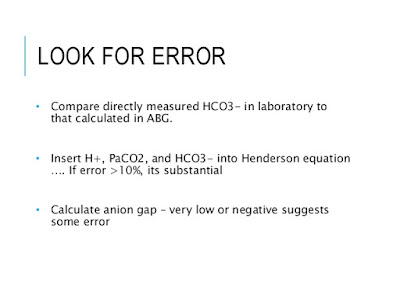
abg error

And:

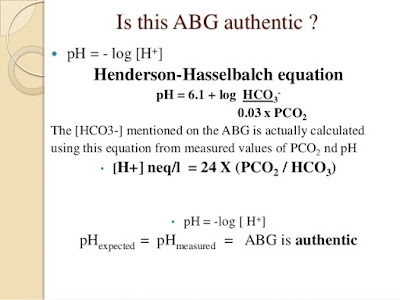
abg authentic

If you have any comments, please leave it below.

Pediatric doctor
Dr. Pedchrome

MD Pediatrics and Fellowship Neonatology, he chooses to stay anonymous. He often writes his views online as well as share few important topics for medical students, doctors and specially parents. He does research in pediatrics.
  • Facebook
  • Twitter
PGMEE, MRCS, USMLE, MBBS, MD/MS Internal medicinePediatrics

Post navigation

Previous post
Next post

Related Posts

PGMEE, MRCS, USMLE, MBBS, MD/MS glass prescription slip

Understanding Eye Glass Prescription Slip

Aug 12, 2015Aug 17, 2015

A phoropter/refractor is an instrument commonly used by eye care professionals during an eye examination, containing different lenses used for refraction of the eye during sight testing, to measure an individual’s refractive error and determine his or her eyeglass prescription. Retinoscopy is done instead in children who are unable to…

Read More
PGMEE, MRCS, USMLE, MBBS, MD/MS

Dermatomes : Mnemonic

Sep 18, 2021Sep 18, 2021

Note: C1 doesn’t have a sensory branch For the purpose of making learning easier, we divide the remaining dermatomal segments into 4 groups which will be accompanied by analogies and mnemonics. C2-C4 These supply the “hooded cape” region. C2: hood region abutting the trigeminal distribution C3: upper neck C4: lower…

Read More
PGMEE, MRCS, USMLE, MBBS, MD/MS cellular adaptations

Cellular Adaptations

Jun 17, 2016Aug 31, 2018

Hypertrophy, Hyperplasia, Atrophy and Metaplasia are the main four types of cellular adaptations. Adaptations are: Reversible changes In the number, size, phenotype, metabolic activity or functions of cells In response to the changes in the environment (stress).   Hypertrophy Definition: Increase in cell size Occurs in: non-dividing (permanent) cells: cardiac and…

Read More

Comment

  1. Kelvin says:
    May 7, 2023 at 7:57 am

    This is helpful. Thank you thank you and thank you, for teaching and sharing.
    God bless you ❤️❤️❤️❤️❤️

    Reply

Leave a Reply Cancel reply

Your email address will not be published. Required fields are marked *

This site uses Akismet to reduce spam. Learn how your comment data is processed.

Pedchrome. How to check an Error in ABG ? ABG analysis [Internet]. Epomedicine; 2023 May 1 [cited 2026 Jan 21]. Available from: https://epomedicine.com/medical-students/how-to-check-an-error-in-abg-abg-analysis/.

Pre-clinical (Basic Sciences)

Anatomy

Biochemistry

Community medicine (PSM)

Embryology

Microbiology

Pathology

Pharmacology

Physiology

Clinical Sciences

Anesthesia

Dermatology

Emergency medicine

Forensic

Internal medicine

Gynecology & Obstetrics

Oncology

Ophthalmology

Orthopedics

Otorhinolaryngology (ENT)

Pediatrics

Psychiatry

Radiology

Surgery

RSS Ask Epomedicine

  • What to study for Clinical examination in Orthopedics?
  • What is the mechanism of AVNRT?

Epomedicine weekly

  • About Epomedicine
  • Contact Us
  • Author Guidelines
  • Submit Article
  • Editorial Board
  • USMLE
  • MRCS
  • Thesis
©2026 Epomedicine . All rights reserved.