Skip to content
Epomedicine

Mnemonics, Simplified Concepts & Thoughts

Epomedicine

Mnemonics, Simplified Concepts & Thoughts

ECG Axis Determination : Mnemonic

Epomedicine, Aug 11, 2019Aug 11, 2019
ecg axis

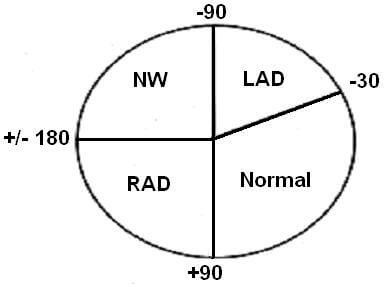
Lead I = left (0 degrees)
Lead aVF = floor (90 degrees)

Lead I +ve and Lead aVF +ve = Between 0-90 degrees (Normal axis)

Lead I -ve and Lead aVF +ve = Between 90-180 degrees (Right axis deviation)

Lead I +ve and Lead aVF -ve = Between 0 to -90 degrees (possible Left axis deviation)

Lead I -ve and Lead aVF -ve = Between -90 to 180 degrees (Extreme axis)

However, normal axis is -30 to 90 degrees. So, when Lead I is +ve and Lead aVF is -ve, the axis is between 0 to -90 degrees. By lookin at lead II, we can find possible left axis deviation.

In such cases:

  • If lead II +ve = 0 to -30 degrees (Normal axis)
  • If lead II -ve = -30 to -90 degrees (Left axis deviation)
3 shares
  • Facebook
  • Twitter
PGMEE, MRCS, USMLE, MBBS, MD/MS Cardiovascular systemECGInternal medicine

Post navigation

Previous post
Next post

Related Posts

PGMEE, MRCS, USMLE, MBBS, MD/MS men syndrome

MEN syndrome : Mnemonics

Feb 17, 2017May 21, 2024

MEN syndrome is an autosomal dominant (AD) predisposition to developing multiple endocrine tumors. Mnemonic: MEN are Dominant. Points to remember: MEN I or MEN 1 (Wermer’s syndrome) Mnemonic: 3 X P’s MEN IIA or MEN 2A (Sipple’s syndrome) Mnemonic: 3 X C’s MEN IIB or 2B (MEN III) Mnemonic: 2C 2M…

Read More
PGMEE, MRCS, USMLE, MBBS, MD/MS chest tube isnertion

Chest Tube Insertion or Tube Thoracostomy

Dec 5, 2015Nov 24, 2018

Indications of chest tube insertion Pneumothorax: In any ventilated patient (positive airway pressure will force air into the pleural cavity and produce tension pneumothorax) Tension pneumothorax after initial needle thoracocentesis Persistent or Recurrent pneumothorax after simple aspiration Large secondary spontaneous pneumothorax in patients >50 years Pleural effusion: Malignant pleural effusion…

Read More
PGMEE, MRCS, USMLE, MBBS, MD/MS

Triple deformity of Knee : Mnemonic

Mar 18, 2023Mar 18, 2023

Triple deformity of knee consists of 3 components: 1. Flexion deformity at knee 2. Posterolateral subluxation of tibia 3. External rotation of tibia over femoral condyle Mechanism behind triple deformity of knee: Causes of Triple deformity of knee: Mnemonic: TRIPLE 1. Tuberculosis (TB) knee – commonest cause 2. Rheumatoid arthritis…

Read More

Leave a Reply Cancel reply

Your email address will not be published. Required fields are marked *

This site uses Akismet to reduce spam. Learn how your comment data is processed.

Pre-clinical (Basic Sciences)

Anatomy

Biochemistry

Community medicine (PSM)

Embryology

Microbiology

Pathology

Pharmacology

Physiology

Clinical Sciences

Anesthesia

Dermatology

Emergency medicine

Forensic

Internal medicine

Gynecology & Obstetrics

Oncology

Ophthalmology

Orthopedics

Otorhinolaryngology (ENT)

Pediatrics

Psychiatry

Radiology

Surgery

RSS Ask Epomedicine

  • What to study for Clinical examination in Orthopedics?
  • What is the mechanism of AVNRT?

Epomedicine weekly

  • About Epomedicine
  • Contact Us
  • Author Guidelines
  • Submit Article
  • Editorial Board
  • USMLE
  • MRCS
  • Thesis
©2026 Epomedicine | WordPress Theme by SuperbThemes