Skip to content
Epomedicine

Mnemonics, Simplified Concepts & Thoughts

Epomedicine

Mnemonics, Simplified Concepts & Thoughts

Dermatomes : Mnemonic

Epomedicine, Sep 18, 2021Sep 18, 2021

Note: C1 doesn’t have a sensory branch

For the purpose of making learning easier, we divide the remaining dermatomal segments into 4 groups which will be accompanied by analogies and mnemonics.
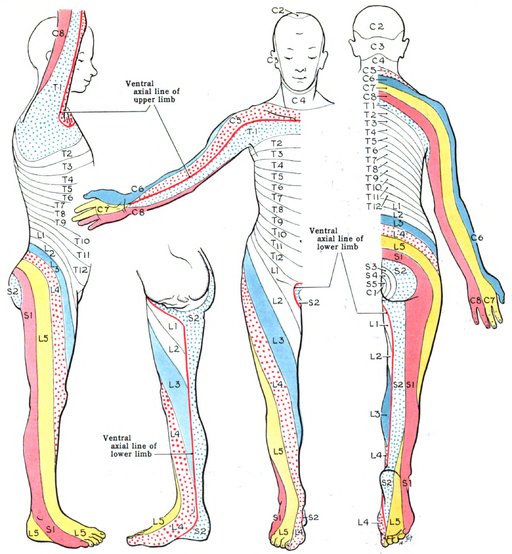
dermatome map
Grant, John Charles Boileau, Public domain, via Wikimedia Commons

C2-C4

These supply the “hooded cape” region.

  • C2: hood region abutting the trigeminal distribution
  • C3: upper neck
  • C4: lower neck and shoulders

C5-T1

Dermatome C7 extends to the middle finger and divides dermatomes C5 and C6 (lateral) from C8 through T1 (medial).

  • C5: lateral aspect of arm
  • C6: lateral aspect of forearm and hand
  • C7: middle finger and ray
  • C8: medial aspect of hand
  • T1: medial aspect of forearm

T2-L1

These are present over the trunk and progresses sequentially from top to bottom. Remembering important landmarks is helpful.

  • T4: nipples
  • T10: umbilicus (0 looks like umbilicus)
  • L1: inguinal area

S2-S5

2, 3, 4, 5, stand on S1, lie on S2, sit on S3, wipe S4/S5

  • Slap thigh lateral then medial: L2 then L3
  • Slap lower legs medial then lateral: L4 then L5
  • Stand on sole of foot: S1
  • Lie on back of thigh and calf: S2
  • Sit on buttocks: S3
  • Wipe perianal area: S4, S5

Also note that: L5 is for Large toe and S1 is for Small toe
36 shares
  • Facebook
  • Twitter
PGMEE, MRCS, USMLE, MBBS, MD/MS Internal medicineNervous systemPediatrics

Post navigation

Previous post
Next post

Related Posts

PGMEE, MRCS, USMLE, MBBS, MD/MS gastric glands

Gastric glands and cells

Jul 15, 2018Jun 16, 2023

Anatomically, stomach can be divided into 3 parts from above to below: Gastric pits deepen as we move below from cardiac to pyloric glands. Mucus secreting cells: Present in all 3 glands – cardiac, fundic and pyloric but predominate in cardiac and pyloric glands. Pyloric glands have 1 more cell…

Read More
PGMEE, MRCS, USMLE, MBBS, MD/MS glycogen stroage diseases

Glycogen Storage Diseases with Mnemonics

Jan 22, 2017Mar 10, 2018

Once again, I’m back with a biochemistry topic that everyone hates. Let’s try to break the topic, simplify it and cover all the important aspects of Glycogen Storage Diseases (GSD). 7 types of Glycogen Storage Diseases Mnemonic:VP CAM HT. This is a pretty lame mnemonic for the order of the…

Read More
PGMEE, MRCS, USMLE, MBBS, MD/MS decorticate decerebrate

Decorticate and Decerebrate Rigidity – Mnemonics

Jun 3, 2019Jun 3, 2019

Rubrospinal tract mediates flexor of the upper arm. Here is a way to remember these two postures and never forget again. Decerebrate has more “E” and more “R”. Extended upper limbs Rubrospinal tract transected (Red nucleus is above the level of lesion, i.e. below midbrain level) Decorticate has “COR”. Upper…

Read More

Leave a Reply Cancel reply

Your email address will not be published. Required fields are marked *

This site uses Akismet to reduce spam. Learn how your comment data is processed.

Epomedicine. Dermatomes : Mnemonic [Internet]. Epomedicine; 2021 Sep 18 [cited 2025 Dec 23]. Available from: https://epomedicine.com/medical-students/dermatomes-mnemonic/.

Pre-clinical (Basic Sciences)

Anatomy

Biochemistry

Community medicine (PSM)

Embryology

Microbiology

Pathology

Pharmacology

Physiology

Clinical Sciences

Anesthesia

Dermatology

Emergency medicine

Forensic

Internal medicine

Gynecology & Obstetrics

Oncology

Ophthalmology

Orthopedics

Otorhinolaryngology (ENT)

Pediatrics

Psychiatry

Radiology

Surgery

RSS Ask Epomedicine

  • What to study for Clinical examination in Orthopedics?
  • What is the mechanism of AVNRT?

Epomedicine weekly

  • About Epomedicine
  • Contact Us
  • Author Guidelines
  • Submit Article
  • Editorial Board
  • USMLE
  • MRCS
  • Thesis
©2025 Epomedicine . All rights reserved.