Skip to content
Epomedicine

Mnemonics, Simplified Concepts & Thoughts

Epomedicine

Mnemonics, Simplified Concepts & Thoughts

Bundle Branch Block : Mnemonic

Epomedicine, Aug 11, 2019Aug 11, 2019

If the QRS complex is wide (>0.12 s/>3 small squares), the ventricular activity may be arising from the ventricle conducting system. caused by a ‘bundle branch block’.

WiLLiaM MaRRoW (classic mnemonic)

Wi – V1
LL – LBBB
M – V6

M – V1
RR – RBBB
W – V6

ViLLheiM MaRRooN (more accurate)

V – V1
LL – LBBB
M – V6

M – V1
RR – RBBB
N – V6

With a Left bundle branch block (LBBB), you get W or more accurately V shaped complex (rS) in V1 and M shaped complex (R) in V6.

With a Right bundle branch block (RBBB), you get M shaped complex (rSR’) in V1 and W or more accurately N shaped complex (qRs) in V6.
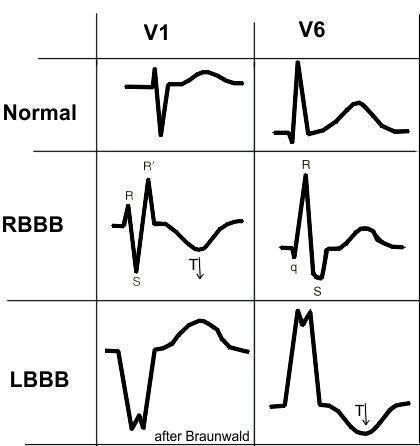
lbbb rbbb ecg

If LBBB is present, no comment can be made on the rest of the ST segment, and thus it may be a sign of acute MI.
18 shares
  • Facebook18
  • Twitter
PGMEE, MRCS, USMLE, MBBS, MD/MS Cardiovascular systemECGInternal medicine

Post navigation

Previous post
Next post

Related Posts

PGMEE, MRCS, USMLE, MBBS, MD/MS diastema

Few Etiology Mnemonics

Sep 30, 2019Oct 13, 2019

YELLOW NAILS N: Non pitting Lymphedema A: Autoimmune disorders (thyroiditis, rheumatoid arthritis) I: Infections (Pneumonia, AIDS) L: Lung disorders (pleural effusions and bronchiectasis) S: Serious: Malignancy (mycosis fungoides, laryngeal carcinoma, bronchial carcinoma, breast cancer, endometrial cancer, gallbladder cancer, NH Lymphoma) DIASTEMA causes (see Terry Thomas “sign”) D: Developmental cyst orofacial line I:…

Read More
PGMEE, MRCS, USMLE, MBBS, MD/MS ovarian neoplasm

Pathology of Ovarian Tumors – Quick Review

Feb 7, 2017

The latest TNM and FIGO staging for Ovarian Cancer has been discussed earlier here. Here, we will discuss pathology of ovarian tumors in short and in a way thats easy to grasp. WHO Classification of Ovarian Tumors Cells of origin Surface coelomic epithelium Germ cells Sex cord, stromal cells Metastatic…

Read More
PGMEE, MRCS, USMLE, MBBS, MD/MS esr

ESR and CRP in Musculoskeletal infection

Aug 5, 2020Jan 27, 2022

ESR (Erythrocyte Sedimentation Rate) Usually elevated within 48-72 hours of the infection onset (less reliable in the first 48 hours of infection) Continues to rise for 3-5 days after institution of successful therapy and continuing rise beyond 4th-5th day of treatment can be an indication of treatment failure (not good…

Read More

Leave a Reply Cancel reply

Your email address will not be published. Required fields are marked *

This site uses Akismet to reduce spam. Learn how your comment data is processed.

Pre-clinical (Basic Sciences)

Anatomy

Biochemistry

Community medicine (PSM)

Embryology

Microbiology

Pathology

Pharmacology

Physiology

Clinical Sciences

Anesthesia

Dermatology

Emergency medicine

Forensic

Internal medicine

Gynecology & Obstetrics

Oncology

Ophthalmology

Orthopedics

Otorhinolaryngology (ENT)

Pediatrics

Psychiatry

Radiology

Surgery

RSS Ask Epomedicine

  • What to study for Clinical examination in Orthopedics?
  • What is the mechanism of AVNRT?

Epomedicine weekly

  • About Epomedicine
  • Contact Us
  • Author Guidelines
  • Submit Article
  • Editorial Board
  • USMLE
  • MRCS
  • Thesis
©2026 Epomedicine | WordPress Theme by SuperbThemes