Skip to content
Epomedicine

Mnemonics, Simplified Concepts & Thoughts

Epomedicine

Mnemonics, Simplified Concepts & Thoughts

Bacterial Food Poisoning

Epomedicine, Jul 5, 2024Jul 5, 2024
bacterial food poisoning
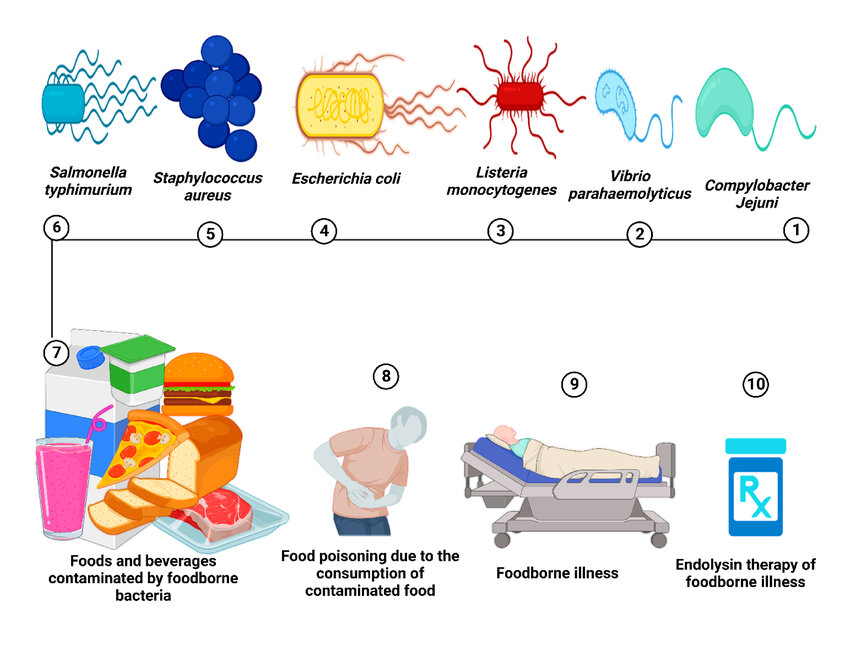
Khan, Fazal & Chen, Jie-Hua & Zhang, Rui & Liu, Bin. (2023). A comprehensive review of the applications of bacteriophage-derived endolysins for foodborne bacterial pathogens and food safety: recent advances, challenges, and future perspective. Frontiers in Microbiology. 14. 10.3389/fmicb.2023.1259210. [CC BY 4.0]

Mnemonic: AB-BC-CES

BacteriaVomitingDiarrheaFeverFood sourceDuration
1-6 hrs (Preformed toxins)
Aureus (S. aureus)++++/-+/-Meats, dairy, bakery24-48 hrs
B. Cereus++++/-–Reheated fried rice24 hrs
8-16 hrs
B. Cereus (diarrheal toxin)+/-+++–Meats, stews, gravy24-48 hrs
C. Perfringes+/-+++–Rewarmed meat and poultry dishes24-48 hrs
>16 hrs
C. Botulinum (12-72 hrs)+/-––Canned foodsdays-months
C. Jejuni (2-5 days)+/-+++–Poultry, raw milk2-10 days
Cholerae – vibrio (24-72 hrs)++++–Contaminated water, Shellfish
ETEC (1-3 days)+/-++++/-Water, fecal contaminated foods3-7 days
EHEC (1-8 days)++++ (bloody)–Beef, raw milk, raw vergetables5-10 days
Shigella (1-2 days)+/-+ (blood and pus)+Salad, eggs1-2 days
Salmonella (1-3 days)–+++Beef, poultry, eggs, dairy4-7 days
Incubation period – above and in brackets along with the name of bacteria

Further reading:

  1. Current Medical Diagnosis and Treatment, 2018
  2. Diagnosis and Management of Foodborne Illness | AAFP
  • Facebook
  • Twitter
PGMEE, MRCS, USMLE, MBBS, MD/MS Gastrointestinal systemMicrobiology

Post navigation

Previous post
Next post

Related Posts

PGMEE, MRCS, USMLE, MBBS, MD/MS

Thyroid Eye Signs : Mnemonics

Aug 31, 2024Aug 31, 2024

Classification Mnemonic: NO SPECS Class Signs Comment 0 No eye signs or symptoms 1 Only signs of hyperthyroidism Lid lag, Lid retraction 2 Soft tissue swelling Periorbital edema; red, itchy eye 3 Proptosis 4 Extraocular muscle involvement Often results in diplopia; pain especially on upgaze 5 Corneal involvement Generally a…

Read More
PGMEE, MRCS, USMLE, MBBS, MD/MS

Antiarrhythmics Classification (Vaughan Williams)

May 27, 2024May 27, 2024

Understand the conducting system of heart, cardiac action potential and pacemaker action potential. Mnemonic to remember Vaughan Williams classification for anti-arrhythmic – Some Block Potassium Channel DAAM! Mnemonic Class Mechanism of action Comments Example Use Some IA Sodium channel blocker (moderate)Intermediate action Moderate ↓ phase 0 slope↑ EFR & AP…

Read More
PGMEE, MRCS, USMLE, MBBS, MD/MS

Wormian Bones

Aug 7, 2024Aug 7, 2024

Wormian bones are abnormal ossicles that develop from extra ossification centers within the cranium. They are most frequently located in the lambdoid suture or the coronal suture, and have been seen in the fontanelles, particularly the posterior fontanelle. Commonest Cause Idiopathic (Anatomic variant) Other Causes Mnemonic: PORK CHOPS 1. Pyknodyostosis…

Read More

Leave a Reply Cancel reply

Your email address will not be published. Required fields are marked *

This site uses Akismet to reduce spam. Learn how your comment data is processed.

Pre-clinical (Basic Sciences)

Anatomy

Biochemistry

Community medicine (PSM)

Embryology

Microbiology

Pathology

Pharmacology

Physiology

Clinical Sciences

Anesthesia

Dermatology

Emergency medicine

Forensic

Internal medicine

Gynecology & Obstetrics

Oncology

Ophthalmology

Orthopedics

Otorhinolaryngology (ENT)

Pediatrics

Psychiatry

Radiology

Surgery

RSS Ask Epomedicine

  • What to study for Clinical examination in Orthopedics?
  • What is the mechanism of AVNRT?

Epomedicine weekly

  • About Epomedicine
  • Contact Us
  • Author Guidelines
  • Submit Article
  • Editorial Board
  • USMLE
  • MRCS
  • Thesis
©2026 Epomedicine | WordPress Theme by SuperbThemes