Skip to content
Epomedicine

Mnemonics, Simplified Concepts & Thoughts

Epomedicine

Mnemonics, Simplified Concepts & Thoughts

Postaural wilde's incision

Approaches to Middle ear and Mastoid surgery

Epomedicine, May 11, 2014

Endomeatal (Transcanal or Transmeatal) Approach:

  • Not used commonly in children owing to relatively small ear canal
  • This incision is used when the mesotympanum and hypotympanum are the surgical sites
  • A posterior tympanomeatal flap is raised to enter into the middle ear. The flap includes skin over the medial two-thirds of the bony external auditory canal.
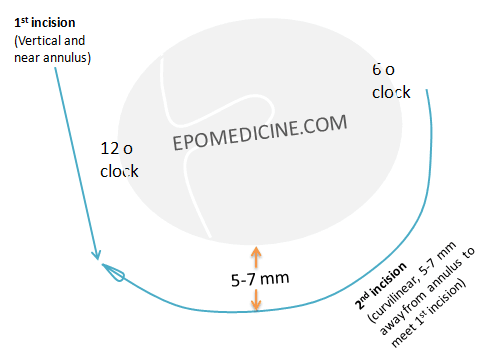
Endomeatal rosen incision
Rosen incision (Endomeatal approach)

Indications:

  1. Exploratory tympanotomy
  2. Underlay or Inlay myringoplasty
  3. Ossiculoplasty (Ossicular reconstruction)
  4. Stapedotomy and Stapedectomy (Otosclerosis surgeries)

Endaural Approach (Lempert or Heerman incision):

  • Commonly used in infants and young children
  • Accessibility of epitympanum and postero-superior part of mesotympanum
  • Temporalis fascia graft can be easily obtained
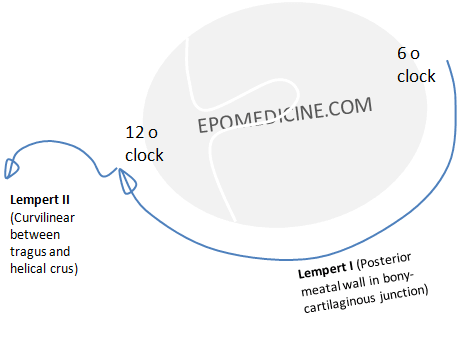
Endaural lempert incision

Indications:

  1. Excision of osteomas and exostoses of ear canal
  2. Large tympanic membrane perforation
  3. Atticoantrotomy for Attic cholesteatomas
  4. Modified radical mastoidectomy

Postaural Approach (Wilde’s incision):

In children, the incision is shorter and horizontal to avoid injury to the facial nerve as mastoid is not well developed and the stylomastoid foramen (from where facial nerve emerges) lies superficially
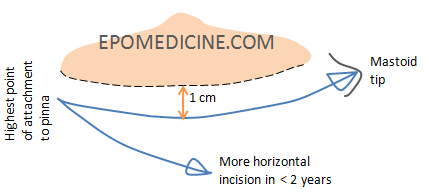
Postaural wilde's incision


Indications:

  1. Cortical mastoidectomy
  2. Modified radical and radical mastoidectomy
  3. Tympanoplasty (when perforation extends anterior to handle of malleus)
  4. Decompression of facial nerve
  5. Endolymphatic sac surgery
24 shares
  • Facebook23
  • Twitter
PGMEE, MRCS, USMLE, MBBS, MD/MS General SurgeryOtorhinolaryngology

Post navigation

Previous post
Next post

Related Posts

PGMEE, MRCS, USMLE, MBBS, MD/MS

Methotrexate : Mnemonic

Feb 21, 2023Feb 21, 2023

Methotrexate is a dihydrofolate reductase (DHFRase) inhibitor which inhibits DNA repair, synthesis and cellular replication. Actively proliferating tissues such as malignant cells, bone marrow, fetal cells, buccal and intestinal mucosa, and cells of the urinary bladder are in general more sensitive to its effect. A convenient regimen for Low Dose…

Read More
PGMEE, MRCS, USMLE, MBBS, MD/MS

Gout : Mnemonics

Sep 20, 2022Sep 20, 2022

Urate Lowering Therapy (ULT) Mnemonic: 1, 2, 3, 4, 5, 6 Start Urate Lowering Therapy if: ≥1 subcutaneous tophi ≥2 flares per year ≥3 stage CKD with Serum uric acid (SUA) ≥ 9 mg/dl Other indications: Urate renal stone, Evidence of joint destruction in X-ray 4. ≥4 weeks to be…

Read More
PGMEE, MRCS, USMLE, MBBS, MD/MS respiratory center lesion

Respiratory Center Simplified

Jul 9, 2018

Mnemonic: Boat starts and PRASaD DIVEs 1. pre-Botzinger complex Starts respiratory rhythm (pacemaker): Boat Starts Location: Between nucleus ambiguus and lateral reticular nucleus (upper medulla) 2. Pneumotaxic center Represses Apneustic center: PR-A Location: Upper pons (Nucleus parabrachialis and Kolliker-fuse nucleus) 3. Apneustic center Stimulates DRG: A-SaD Location: Lower pons 4….

Read More

Leave a Reply Cancel reply

Your email address will not be published. Required fields are marked *

This site uses Akismet to reduce spam. Learn how your comment data is processed.

Epomedicine. Approaches to Middle ear and Mastoid surgery [Internet]. Epomedicine; 2014 May 11 [cited 2026 Jan 1]. Available from: https://epomedicine.com/medical-students/approaches-to-middle-ear-and-mastoid-surgery/.

Pre-clinical (Basic Sciences)

Anatomy

Biochemistry

Community medicine (PSM)

Embryology

Microbiology

Pathology

Pharmacology

Physiology

Clinical Sciences

Anesthesia

Dermatology

Emergency medicine

Forensic

Internal medicine

Gynecology & Obstetrics

Oncology

Ophthalmology

Orthopedics

Otorhinolaryngology (ENT)

Pediatrics

Psychiatry

Radiology

Surgery

RSS Ask Epomedicine

  • What to study for Clinical examination in Orthopedics?
  • What is the mechanism of AVNRT?

Epomedicine weekly

  • About Epomedicine
  • Contact Us
  • Author Guidelines
  • Submit Article
  • Editorial Board
  • USMLE
  • MRCS
  • Thesis
©2026 Epomedicine . All rights reserved.