Skip to content
Epomedicine

Mnemonics, Simplified Concepts & Thoughts

Epomedicine

Mnemonics, Simplified Concepts & Thoughts

cornea histology schematic

Histology of Cornea and Corneal Dystrophies

Epomedicine, May 22, 2014Aug 31, 2024

Prefix: kerat-

Definition: The cornea is a transparent, avascular, watch-glass like structure which forms anterior one-sixth of the outer fibrous coat of the eyeball and covers iris, pupil and anterior chamber.

Histology:
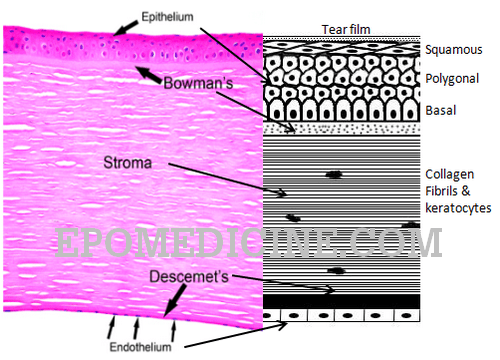
cornea histology schematic

It consists of 5 distinct layers which can be remembered using the mnemonic “ABCDE“:

LayersThickness (µm)CompositionPathophysiology
Anterior epithelium50a. Top: 3-4 layers of squamous cells (uppermost are apical cells)b. Middle: 1-3 layers of wing cells (flattened polygonal shape)

c. Deep: 1 layer of basal cells

d. Basal lamina: scaffold for epithelim; collagen type IV; secreted by basal cells

Epithlial basement membrane dystrophy (AD)

Meesmann’s (AD)

Bowman’s membrane8-14Unorganized type I collagen fibers  in GAG matrix
Acellular
Reis-Buckler’s (AD)
Corneal stroma (Substantia propria)500 (~90%)~ 80% water by weightParallely organized lamellae of collagen I, IV and V in mucopolysaccharide matrix

Cells: Keratocytes, Langerhans’ cells, pigmented melanocytes, macrophages, histiocytes

Only MMP-2 is found in healthy cornea

Granular (AD)

Macular (AR)

Lattice (AD)

Descemet’s membrane10-12Anterior organized fetal banded layer (no change with age 3 µm)Posterior unorganized non-banded layer (thickens with age 2-10 µm)

PAS + true basement membrane

 
Endothelium5Single layer of interdigitating hexagonal cells (It is a misnomer as the cells are not endothelial cells)Schwalbe’s line: termination of corneal endothelium (junction between endothelium and trabecular meshwork)

Posterior embryotoxon: thickening and anterior displacement of Schwalbe’s line

Posterior polymorphous corneal dystrophy (AD)

Fuch’s dystrophy (AD)

The pre-Descemet’s layer/Dua’s layer, also termed the Dua-Fine layer and the pre-posterior limiting lamina layer, lies anterior to the Descemet’s membrane in the cornea, is 10 μm (range 6-16) thick, made predominantly of type I and some type VI collagen with abundant elastin, more than any other layer of the cornea.

Corneal Wound Healing in Short:

Epithelium: by migration and mitosis; rapid (starts 24-48 hours and completed by 6-8 days)

Stroma: non-complicated wound (avascular healing); complicated wound (vascular healing)

Descemet’s membrane and endothelium: slow regeneration

  1. Endothelium: mitosis and migration
  2. Descemet’s membrane: replacement by hyaline material derived from endothelium
12 shares
  • Facebook12
  • Twitter
PGMEE, MRCS, USMLE, MBBS, MD/MS AnatomyOphthalmology

Post navigation

Previous post
Next post

Related Posts

PGMEE, MRCS, USMLE, MBBS, MD/MS

Talus Anatomy : Mnemonic

Jan 3, 2023Jan 4, 2023

Mnemonic: 0, 1, 2, 3, 4, 5 0 : Attachments of muscles and tendons 1 : Sinus and Canal 2 : Processes and Tubercles 3 : Parts 4 : Blood vessels: 5 : Articulating surfaces

Read More
PGMEE, MRCS, USMLE, MBBS, MD/MS

Atropine Induced Paradoxical Bradycardia

Jan 5, 2022Jan 5, 2022

Atropine induced paradoxical bradycardia is the sinus bradyarrhythmia following low-dose atropine resulting from the paradoxical slowing in the sinoatrial (SA) node discharge rate. Mechanism of Atropine Induced Paradoxical Bradycardia Central vagotonic effect (blocking M1 acetylcholine receptors in parasympathetic ganglion controlling SA node) of atropine which, at higher doses, is masked…

Read More
PGMEE, MRCS, USMLE, MBBS, MD/MS ECG interval

Basics of ECG- Interpretation of waves and intervals

Nov 9, 2013Jun 12, 2016

A normal ECG is electrical representation of a normal heart beat or sinus rhythm. The cardiac action potential causing deporalization and repolarization of various cardiac tissues gives a pattern of rhythic change is Electrocardiograph which can be used to diagnose different diseases of the CVS.   Normal Rate The beats…

Read More

Leave a Reply Cancel reply

Your email address will not be published. Required fields are marked *

This site uses Akismet to reduce spam. Learn how your comment data is processed.

Pre-clinical (Basic Sciences)

Anatomy

Biochemistry

Community medicine (PSM)

Embryology

Microbiology

Pathology

Pharmacology

Physiology

Clinical Sciences

Anesthesia

Dermatology

Emergency medicine

Forensic

Internal medicine

Gynecology & Obstetrics

Oncology

Ophthalmology

Orthopedics

Otorhinolaryngology (ENT)

Pediatrics

Psychiatry

Radiology

Surgery

RSS Ask Epomedicine

  • What to study for Clinical examination in Orthopedics?
  • What is the mechanism of AVNRT?

Epomedicine weekly

  • About Epomedicine
  • Contact Us
  • Author Guidelines
  • Submit Article
  • Editorial Board
  • USMLE
  • MRCS
  • Thesis
©2026 Epomedicine | WordPress Theme by SuperbThemes