Skip to content
Epomedicine

Mnemonics, Simplified Concepts & Thoughts

Epomedicine

Mnemonics, Simplified Concepts & Thoughts

Aortic arch derivatives : Mnemonic

Epomedicine, May 28, 2023May 28, 2023

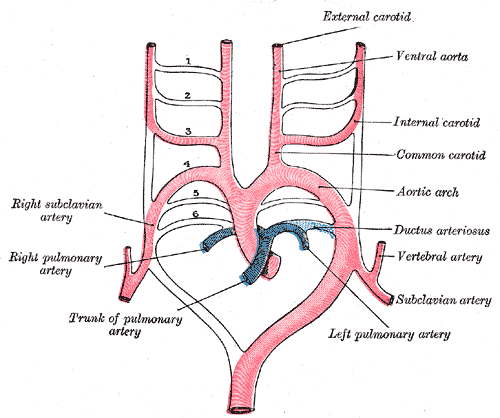
The aortic arches or pharyngeal arch arteries are formed sequentially with the pharyngeal arches.

Aortic archDerivativesMnemonic
1stMaxillary artery (part)1st arch is maximal
2ndStapedial artery
Hyoid artery
Second = Stapedial
3rdCommon carotid artery
Proximal part of internal carotid artery
C = 3rd letter of alphabet
4thLeft: Aortic arch
Right: Subclavian artery (proximal part)
4th arch = 4 limbs (systemic)
Four rhymes with Aor-ta
5thNoneFifth arch = Fails
6thPulmonary arteries (proximal part)
Left only: Ductus arteriosus (ligamentum arteriosum)
6 ∂ looks like lungs
Pulmonary & Pulmonary-to-systemic shunt
7thinterSegmental artery = Subclavian arterySeven = Segmental = Subclavian
aortic arch derivatives
Henry Vandyke Carter, Public domain, via Wikimedia Commons

Also remember the mnemonic: MSCARD

  1. 1st aortic arch: Maxillary artery
  2. 2nd aortic arch: Stapedial artery
  3. 3rd aortic arch: Carotid arteries (common and internal)
  4. 4th aortic arch:
    • Arch of aorta
    • Right subclavian artery
  5. 5th aortic arch: Degenerates
1 shares
  • Facebook
  • Twitter
PGMEE, MRCS, USMLE, MBBS, MD/MS AnatomyCardiovascular systemEmbryology

Post navigation

Previous post
Next post

Related Posts

PGMEE, MRCS, USMLE, MBBS, MD/MS jones criteria

Revised Jone’s Criteria – Mnemonic

Jun 6, 2019Jun 6, 2019

Remember SPACE LEAF for Revised Jone’s Criteria (2015). Major criteria Mnemonic: SPACE Subcutaneous nodules Pancarditis Arthritis (Polyarthritis; for moderate to high-risk population – monoarthritis also qualifies) Chorea Erythema marginatum Minor criteria Mnemonic: LEAF Long PR interval ESR ≥ 60mm/hr (or ≥ 30mm/hr in moderate to high-risk population) and CRP ≥…

Read More
PGMEE, MRCS, USMLE, MBBS, MD/MS cellular adaptations

Cellular Adaptations

Jun 17, 2016Aug 31, 2018

Hypertrophy, Hyperplasia, Atrophy and Metaplasia are the main four types of cellular adaptations. Adaptations are: Reversible changes In the number, size, phenotype, metabolic activity or functions of cells In response to the changes in the environment (stress).   Hypertrophy Definition: Increase in cell size Occurs in: non-dividing (permanent) cells: cardiac and…

Read More
PGMEE, MRCS, USMLE, MBBS, MD/MS

Kambin’s Triangle or Prism

Apr 10, 2025Apr 10, 2025

There is confusion regarding the borders of Kambin’s triangle across the literature. Kambin originally described the borders of this triangular working zone as: Though it was named as a “triangle” it was described with 4 borders with 2 triangles (in AP view and Lateral view) which gives a 3D structure…

Read More

Leave a Reply Cancel reply

Your email address will not be published. Required fields are marked *

This site uses Akismet to reduce spam. Learn how your comment data is processed.

Pre-clinical (Basic Sciences)

Anatomy

Biochemistry

Community medicine (PSM)

Embryology

Microbiology

Pathology

Pharmacology

Physiology

Clinical Sciences

Anesthesia

Dermatology

Emergency medicine

Forensic

Internal medicine

Gynecology & Obstetrics

Oncology

Ophthalmology

Orthopedics

Otorhinolaryngology (ENT)

Pediatrics

Psychiatry

Radiology

Surgery

RSS Ask Epomedicine

  • What to study for Clinical examination in Orthopedics?
  • What is the mechanism of AVNRT?

Epomedicine weekly

  • About Epomedicine
  • Contact Us
  • Author Guidelines
  • Submit Article
  • Editorial Board
  • USMLE
  • MRCS
  • Thesis
©2026 Epomedicine | WordPress Theme by SuperbThemes