Skip to content
Epomedicine

Mnemonics, Simplified Concepts & Thoughts

Epomedicine

Mnemonics, Simplified Concepts & Thoughts

otawa ankle and foot rules

Ottawa Foot, Ankle and Knee rules – Mnemonic

Epomedicine, Oct 29, 2017Apr 10, 2020

Ottawa Ankle and Foot Rules

otawa ankle and foot rules

Mnemonic: 44-55-66-PM

Patients need an X-ray only if:

4: Unable to do 4 steps immediately AND
4: Unable to do 4 steps at Emergency Department

OR

5: Has pain at the base of 5th metatarsal
5: Has pain at the 5caphoid (Navicular)

OR

6: Tenderness in 6 cm tip or Posterior edge of lateral Malleolus
6: Tenderness in 6 cm tip or Posterior edge of medial Malleolus

Ottawa Knee Rules
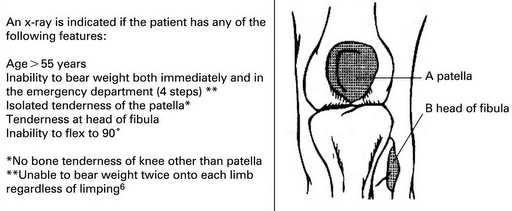
ottawa knee rule

Mnemonic: WAIT

WAIT, get an X-ray of knee if:

  1. Weight bearing for 4 steps not possible – immediately and in ER
  2. Age ≥55 years
  3. Inability to flex knee to 90 degrees
  4. Tenderness isolated to patella or head of fibula
15 shares
  • Facebook14
  • Twitter
Emergency Medicine Emergency medicineMusculoskeletal systemOrthopedicsRadiology

Post navigation

Previous post
Next post

Related Posts

Emergency Medicine avnrt mechanism

Short Approach to SVT and AVNRT management

Apr 11, 2017Apr 11, 2017

This is an ECG from a patient who came with a complaint of palpitation: Analyze the ECG: Rhythm: Regular Heart rate: Around 170/min QRS: Around 0.08 s i.e. ≤0.1 s (narrow QRS complex) ECG diagnosis: Regular Supraventricular Tachycardia (SVT) Now, look for P waves – There are no P waves In…

Read More
Emergency Medicine DKA

DKA : Mnemonic Approach and Clinical Aspects

Aug 5, 2019Aug 7, 2020

Diagnostic criteria for DKA a. Plasma glucose (mg/dl): >250 b. Arterial pH: 7.25 to 7.3: mild DKA 7 to 7.24: moderate DKA <7: severe DKA c. Serum bicarbonate (mEq/L): 15 to 18: mild DKA 10 to 15: moderate DKA <10: severe DKA d. Urine and serum ketones (nitroprusside reaction): Positive…

Read More
Emergency Medicine hypothermia ecg

ECG changes in Hypothermia

Nov 10, 2013Jun 12, 2016

Synonyms: Accidental hypothermia, Neurotensin-induced hypothermia, Endogenous cryogen-induced hypothermia, Hypoxia-induced hypothermia, Primary hypothermia, Secondary hypothermia Definition: The normal body temperature is around 37 c or 98.6 F. Hypothermia is defined as the lowering of core body temperature below 35°C or 95°F. Classification (Grading): Mild: 32°C to 35°C (90°F to 95°F) Moderate: 28°C…

Read More

Leave a Reply Cancel reply

Your email address will not be published. Required fields are marked *

This site uses Akismet to reduce spam. Learn how your comment data is processed.

Epomedicine. Ottawa Foot, Ankle and Knee rules – Mnemonic [Internet]. Epomedicine; 2017 Oct 29 [cited 2026 Jan 30]. Available from: https://epomedicine.com/emergency-medicine/ottawa-rules-extremitity-radiographs/.

Pre-clinical (Basic Sciences)

Anatomy

Biochemistry

Community medicine (PSM)

Embryology

Microbiology

Pathology

Pharmacology

Physiology

Clinical Sciences

Anesthesia

Dermatology

Emergency medicine

Forensic

Internal medicine

Gynecology & Obstetrics

Oncology

Ophthalmology

Orthopedics

Otorhinolaryngology (ENT)

Pediatrics

Psychiatry

Radiology

Surgery

RSS Ask Epomedicine

  • What to study for Clinical examination in Orthopedics?
  • What is the mechanism of AVNRT?

Epomedicine weekly

  • About Epomedicine
  • Contact Us
  • Author Guidelines
  • Submit Article
  • Editorial Board
  • USMLE
  • MRCS
  • Thesis
©2026 Epomedicine . All rights reserved.