Skip to content
Epomedicine

Mnemonics, Simplified Concepts & Thoughts

Epomedicine

Mnemonics, Simplified Concepts & Thoughts

GIK Regimen – Rule of Ten

Epomedicine, Jun 8, 2020Oct 22, 2022

Interchangably used as: GIK or GKI regimen.

GKI stands for Glucose, Potassium and Insulin. This simple and effective combined insulin delivery method has gained wide acceptance in perioperative management of diabetic patients who would require Nil Per Oral (NPO) status. Recently, this composition has also been used for management of Acute Myocardial Infarction and Severe Sepsis as well. By supplying glucose, the need for protein catabolism to meet gluconeogenic needs in the diabetic patient is reduced leading to less negative nitrogen balance. Put patient on GIK (Glucose-Insulin-Potassium) regimen according to blood sugar level at least one hour before starting surgery. The GIK regimen should continue at least one hour after the patient has taken the first post operative meal.
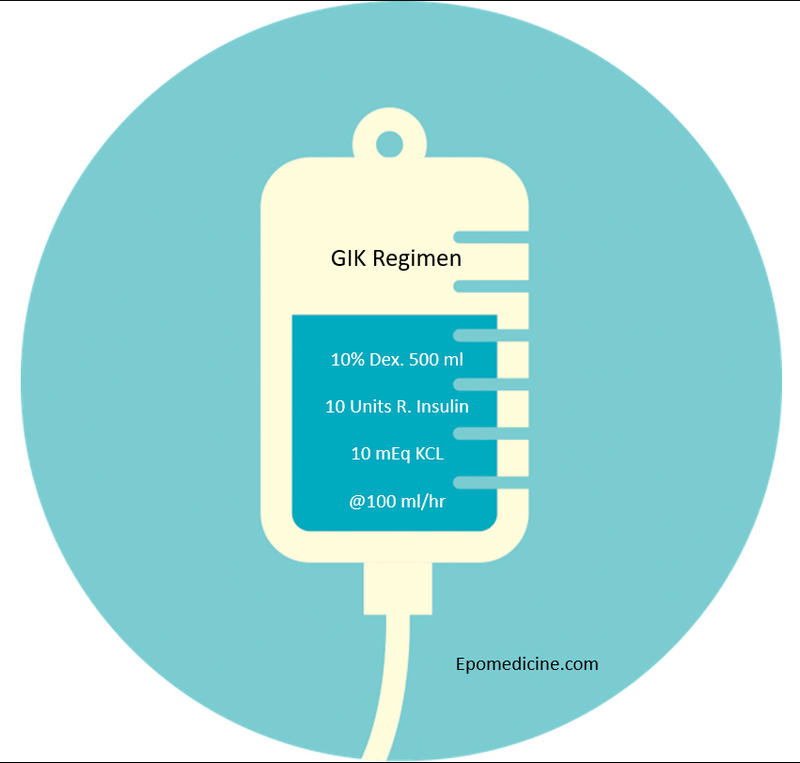
gik regimen

Points to remember:

1. A 70 kg person would require 5-10 gm of dextrose per hour
2. 1 Unit of Insulin is expected to lower blood glucose by 25-30 mg/dl
3. Insulin leads to influx of potassium into the cells
4. 1 mmol glucose = 18 mg/dl
5. Target blood sugar is 80-110 mg/dl.
6. Monitor potassium levels every 6 hours.

We can remember the original Alberti’s regimen for GIK with the rule of 10 (mnemonic). The GIK regimen is composed of:

1. 10% Dextrose 500 ml

2. 10 Units Short acting (Regular) Insulin

3. 10 mEq KCl

This is started at the rate of 100 ml/hour (i.e. 2 Units/hr of Insulin and 10 grams of Dextrose).

This regimen is for blood glucose level upto 10 mmol (180 mg/dl).

Our target blood glucose is ~ 100 mg/dl.

Capillary blood glucose must be monitored every 1-2 hours on GIK regimen and the concentraltion of insulin must be changed accordingly. For an infusion of separate insulin concentration, a separate bag of GIK regimen must be made.

  • For blood glucose between 120-180 mg/dl: Use the same regimen
  • For blood glucose below 120 mg/dl: Reduce Insulin by 5 Units (total 5 Units)
  • For blood glucose below 80 mg/dl: Stop infusion and administer IV bolus of 50% dextrose in water (25 ml)
  • For blood glucose above 180 mg/dl: Add Insulin by 5 Units (total 15 Units)

References:

1. RSSDI Textbook of Diabetes Mellitus By Bb Tripathy, Hemraj B Chandalia

2. Comprehensive Hospital Medicine By Mark Williams, Scott A. Flanders, Winthrop F. Whitcomb, Steven L. Cohn

3. http://medind.nic.in/jac/t00/i3/jact00i3p285.pd
1 shares
  • Facebook1
  • Twitter
Emergency Medicine AnesthesiaEndocrine systemNursing

Post navigation

Previous post
Next post

Related Posts

Emergency Medicine

Conus Medullaris Syndrome vs Cauda Equina Syndrome : Anatomical basis and Mnemonic

May 8, 2022May 8, 2022

Definitions Condition Vertebral level of injury Neurological level of injury ISNCI level of injury Conus Medullaris Syndrome (CMS) T12-L2 T12-S5 T11 Cauda Equina Syndrome (CES) L3-L5 L3-S5 L2 Anatomy The spinal cord ends as a tapered structure called the conus medullaris at the level of L2–L3 disc in the neonate…

Read More
Case Reports eclamptic fits

Postpartum Eclampsia : Case Discussion

Jun 8, 2016Jun 12, 2016

History 23yrs/F non-diabetic, non-hypertensive, non-smoker, non-alcoholic primigravida was admitted to Obstetric ward on with the chief complaints of: Cessation of menstruation X 9 months Decreased fetal movement X 6 hours LMP 2072/04/12 EDD 2073/01/19 GA 41 WOG Examination Dr. Sulabh Kumar Shrestha, MS Orthopedics He is the section editor of…

Read More
Emergency Medicine nstemi algorithm

NSTEMI : Early Medical Management Pearls

Jan 6, 2017Jan 7, 2017

Antiplatelet therapy Aspirin 2-4 non-enteric coated chewable baby aspirins (81 mg each) – buccal absorption is the fastest for platelet inhibition. Initial dose: 150 mg – 325 mg Daily dose: <150 mg For patients unable to take oral medications: Rectal suppository 325 mg Avoid in acute MI: Enteric coated preparations…

Read More

Comment

  1. Olawepo says:
    Feb 3, 2022 at 12:09 pm

    Succinct.
    Well written.
    Adequate information
    Clear picture.
    Great job

    Reply

Leave a Reply to Olawepo Cancel reply

Your email address will not be published. Required fields are marked *

This site uses Akismet to reduce spam. Learn how your comment data is processed.

Pre-clinical (Basic Sciences)

Anatomy

Biochemistry

Community medicine (PSM)

Embryology

Microbiology

Pathology

Pharmacology

Physiology

Clinical Sciences

Anesthesia

Dermatology

Emergency medicine

Forensic

Internal medicine

Gynecology & Obstetrics

Oncology

Ophthalmology

Orthopedics

Otorhinolaryngology (ENT)

Pediatrics

Psychiatry

Radiology

Surgery

RSS Ask Epomedicine

  • What to study for Clinical examination in Orthopedics?
  • What is the mechanism of AVNRT?

Epomedicine weekly

  • About Epomedicine
  • Contact Us
  • Author Guidelines
  • Submit Article
  • Editorial Board
  • USMLE
  • MRCS
  • Thesis
©2026 Epomedicine | WordPress Theme by SuperbThemes