Skip to content
Epomedicine

Mnemonics, Simplified Concepts & Thoughts

Epomedicine

Mnemonics, Simplified Concepts & Thoughts

Differential Diagnoses of Older patient’s fall : Mnemonic

Epomedicine, Aug 18, 2021Aug 18, 2021

Mnemonic: CATASTROPHE

1. Caregiver and housing (information on the circumstances of present fall and falls history)

2. Alcohol (including withdrawal)

3. Treatment (medications, recently added or stopped, compliance)

4. Affect (depression or lack of initiative)

5. Syncope (any episode of fainting)

6. Teetering (dizziness)

7. Recent illness

8. Ocular problems

9. Pain with mobility (as the reason for falls in chronic joint pain or as the result and proof of repeated falls)

10. Hearing (necessary to avoid hazards)

11. Environmental hazards (rags, steps, etc.)

Source: Samaras N, Chevalley T, Samaras D, Gold G. Older patients in the emergency department: a review. Ann Emerg Med. 2010 Sep;56(3):261-9. doi: 10.1016/j.annemergmed.2010.04.015. PMID: 20619500.
  • Facebook
  • Twitter
Emergency Medicine Emergency medicine

Post navigation

Previous post
Next post

Related Posts

Emergency Medicine

Respiratory Emergencies

Apr 11, 2020Apr 11, 2020

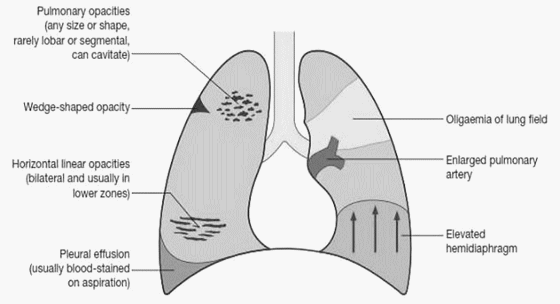
Contains concise management of following conditions with flowcharts, tables and figures. This handbook can be helpful for medical students posted in Emergency room or Internal medicine and also for medical officers working in Emergency department. Acute Pulmonary Embolism Acute Exacerbation of COPD     Community Acquired Pneumonia (CAP) Healthcare Associated Pneumonia (HAP)/Ventilator…

Read More
Emergency Medicine severe malaria

Severe Malaria : Quick revision

Apr 15, 2017

Criteria for Severe and Complicated Malaria Positive peripheral blood smear for P.falciparum + ≥1 of the CHAPLINS (Mnemonic) Convulsions: >2 in 24 hour Cerebral edema (Consciousness impaired) Hypoglycemia (glucose <40 mg/dl) Hemorrhage (DIC) Hemoglobinuria (Black water fever) Anemia (hemoglobin <5 gm/dl or PCV <15% in children; hemoglobin <7 gm/dl or…

Read More
Emergency Medicine hypothermia ecg

ECG changes in Hypothermia

Nov 10, 2013Jun 12, 2016

Synonyms: Accidental hypothermia, Neurotensin-induced hypothermia, Endogenous cryogen-induced hypothermia, Hypoxia-induced hypothermia, Primary hypothermia, Secondary hypothermia Definition: The normal body temperature is around 37 c or 98.6 F. Hypothermia is defined as the lowering of core body temperature below 35°C or 95°F. Classification (Grading): Mild: 32°C to 35°C (90°F to 95°F) Moderate: 28°C…

Read More

Leave a Reply Cancel reply

Your email address will not be published. Required fields are marked *

This site uses Akismet to reduce spam. Learn how your comment data is processed.

Epomedicine. Differential Diagnoses of Older patient’s fall : Mnemonic [Internet]. Epomedicine; 2021 Aug 18 [cited 2026 May 15]. Available from: https://epomedicine.com/emergency-medicine/differential-diagnoses-older-patients-fall-mnemonic/.

Pre-clinical (Basic Sciences)

Anatomy

Biochemistry

Community medicine (PSM)

Embryology

Microbiology

Pathology

Pharmacology

Physiology

Clinical Sciences

Anesthesia

Dermatology

Emergency medicine

Forensic

Internal medicine

Gynecology & Obstetrics

Oncology

Ophthalmology

Orthopedics

Otorhinolaryngology (ENT)

Pediatrics

Psychiatry

Radiology

Surgery

RSS Ask Epomedicine

  • What to study for Clinical examination in Orthopedics?
  • What is the mechanism of AVNRT?

Epomedicine weekly

  • About Epomedicine
  • Contact Us
  • Author Guidelines
  • Submit Article
  • Editorial Board
  • USMLE
  • MRCS
  • Thesis
©2026 Epomedicine | WordPress Theme by SuperbThemes