Skip to content
Epomedicine

Mnemonics, Simplified Concepts & Thoughts

Epomedicine

Mnemonics, Simplified Concepts & Thoughts

Tanner stages : Simplified with Mnemonics

Epomedicine, Jun 19, 2022Jun 19, 2022

Breast Development

Mnemonic: ABCDE

  1. Stage 1 – Absent development
  2. Stage 2 – Breast bud
  3. Stage 3 – Common Contour (not separated)
  4. Stage 4 – Double mound (contour separated)
  5. Stage 5 – End stage development (Adult type)
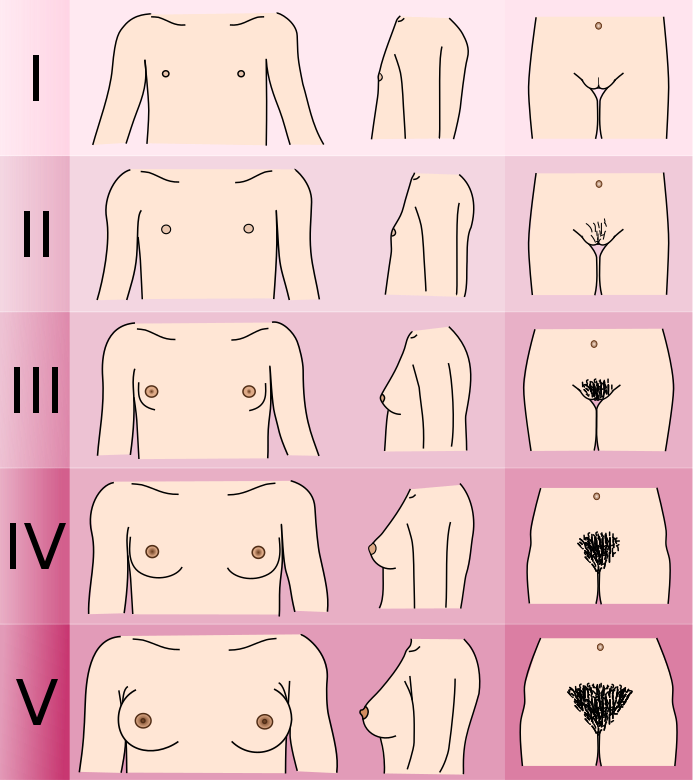
female tanner stage
M.Komorniczak, polish wikipedist.Illustration by : Michał KomorniczakThis file has been released into the Creative Commons 3.0. Attribution-ShareAlike (CC BY-SA 3.0)If you use on your website or in your publication my images (either original or modified), you are requested to give me details: Michał Komorniczak (Poland) or Michal Komorniczak (Poland).For more information, write to my e-mail address: [email protected], CC BY-SA 3.0, via Wikimedia Commons

Male Genitalia Development

Mnemonic: ABCDE

  1. Stage 1 – Absent development
  2. Stage 2 – Bulky testes and scrotum
  3. Stage 3 – Cock lengthens
  4. Stage 4 – Darkening of scrotum
  5. Stage 5 – End stage development (Adult type)
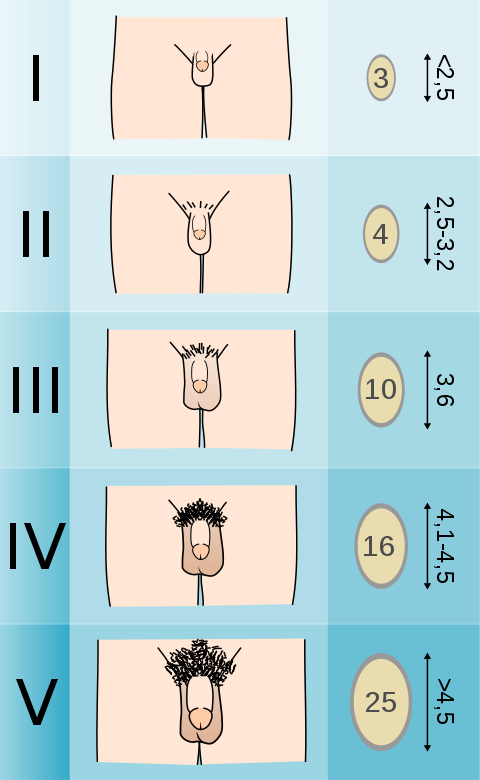
male tanner stage
M.Komorniczak, polish wikipedist.Illustration by : Michał KomorniczakThis file has been released into the Creative Commons 3.0. Attribution-ShareAlike (CC BY-SA 3.0)If you use on your website or in your publication my images (either original or modified), you are requested to give me details: Michał Komorniczak (Poland) or Michal Komorniczak (Poland).For more information, write to my e-mail address: [email protected], CC BY-SA 3.0, via Wikimedia Commons

Pubic Hair Development

Mnemonic: A Small CAT

  1. Stage 1 – Absent
  2. Stage 2 – Straight
  3. Stage 3 – Curling
  4. Stage 4 – Adult
  5. Stage 5 – Thighs
FemaleBothMale
StageBreastPubic HairGenitalia
1PreadolescentNoneChildhood size
2Breast budSparse, straightEnlargement of scrotum, testes
3Areolar diameter enlargesDarker, curlingPenis grows in length; testes continue to enlarge
4Secondary mound; separation of contoursCoarse, curly, adult typePenis grow in length/breadth; scrotum darkens, testes enlarge
5Mature femaleAdult, extends to thighAdult shape/size
  • Facebook
  • Twitter
Clinical Skills and Approaches Clinical examinationPediatrics

Post navigation

Previous post
Next post

Related Posts

Clinical Skills and Approaches

Diet Assessment in Pediatrics: History taking skill

Jan 7, 2023Jan 7, 2023

As a part of history taking, Dietary assessment becomes an important part of pediatric history. As childhood is the age of rapid growth and development, any lag in diet and nutrition will manifest with long-term effects if not addressed in time. One of the common nutritional manifestations is Stunting, which…

Read More
Clinical Skills and Approaches Dix hallpike maneuver

Vestibular examination : Dix-Hallpike Maneuver for BPPV

May 26, 2014Aug 27, 2014

Benign Paroxysmal Positional Vertigo (BPPV) is the commonest cause of episodic vertigo and is characterized by acute attacks of transient vertigo initiated by certain head positions, lasting seconds to minutes, accompanied by nystagmus that fatigues on repeated testing. Important terminologies linked with pathogenesis of BPPV: Otoconia: Calcium carbonate crystals released…

Read More
Clinical Skills and Approaches

Eliciting Primitive Neonatal Reflexes

Mar 8, 2023Mar 8, 2023

Neonatal reflexes are the reflexes which are present at birth and have a predictable course of appearance and disappearance. A normally developing newborn should respond to certain stimuli with these reflexes, which eventually become inhibited as the child matures. The list of reflexes that can be elicited in normal newborn…

Read More

Comment

  1. Rabindranath Das says:
    Sep 10, 2022 at 4:50 am

    Excellent

    Reply

Leave a Reply Cancel reply

Your email address will not be published. Required fields are marked *

This site uses Akismet to reduce spam. Learn how your comment data is processed.

Pre-clinical (Basic Sciences)

Anatomy

Biochemistry

Community medicine (PSM)

Embryology

Microbiology

Pathology

Pharmacology

Physiology

Clinical Sciences

Anesthesia

Dermatology

Emergency medicine

Forensic

Internal medicine

Gynecology & Obstetrics

Oncology

Ophthalmology

Orthopedics

Otorhinolaryngology (ENT)

Pediatrics

Psychiatry

Radiology

Surgery

RSS Ask Epomedicine

  • What to study for Clinical examination in Orthopedics?
  • What is the mechanism of AVNRT?

Epomedicine weekly

  • About Epomedicine
  • Contact Us
  • Author Guidelines
  • Submit Article
  • Editorial Board
  • USMLE
  • MRCS
  • Thesis
©2026 Epomedicine | WordPress Theme by SuperbThemes