Skip to content
Epomedicine

Mnemonics, Simplified Concepts & Thoughts

Epomedicine

Mnemonics, Simplified Concepts & Thoughts

Dermatomyositis skin

Skin signs of Dermatomyositis: Heliotrope rash, Grotton papules and Shawl sign

Epomedicine, Jun 19, 2015

Dermatomyositis is a connective tissue disorder characterized by chronic inflammation of voluntary muscles and skin. It is more common in women and the age of onset is 50-70 years.
Dermatomyositis skin
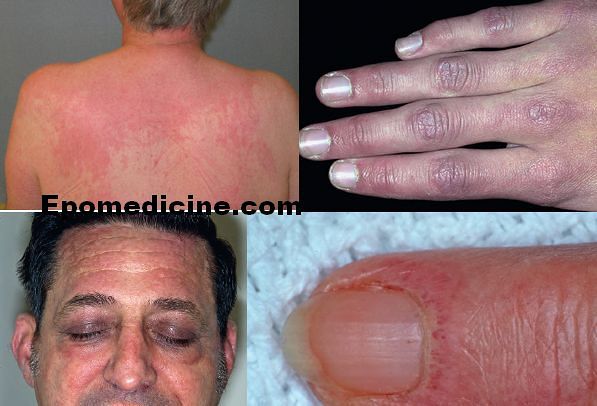
A. Shawl sign B. Grotton’s papules C. Heliotrope rash D. Telangiectasia

A) Heliotrope Rash:

  • It is a macular, confluent, purple or purple/red rash over both eyelids and periorbital tissue present with or without edema.
  • Mechanism: Unclear; probably indicates inflammation of underlying striated orbicularis oculi rather than the overlying skin
  • Resembles  Heliotropium peruvianum flower, which has small purple petals.

B) Gottron’s Papules:

  • Violaceous (violet-coloured) papules on the dorsal aspect of the interphalangeal joints.
  • Mechanism: Unclear
  • Pathognomic sign

C) Shawl sign:

  • Confluent, violaceous, macular (i.e. flat with violet/purple colouring) rash over the posterior shoulders and neck.
  • Mechanism: microvascular injury by complement deposition

D) Other skin signs:

  1. Photosensitivity
  2. Pruritus
  3. Nail fold telangiectasia
  4. Scaly scalp
17 shares
  • Facebook17
  • Twitter
Clinical Skills and Approaches DermatologyInternal medicinePediatrics

Post navigation

Previous post
Next post

Related Posts

Clinical Skills and Approaches ascitic paracentesis site

Ascitic Paracentesis : Practical Essentials

Jan 16, 2017

Absolute contraindications to Ascitic Tapping (Paracentesis) While some authors have claimed ascitic paracentesis to be free from absolute contraindications, others have listed following as absolute contraindications: Clinically evident fibrinolysis Disseminated Intravascular Coagulation (DIC) Clinically apparent oozing from needle sticks Acute abdomen requiring surgery Relative contraindications to Blind Paracentesis Ultrasound guided…

Read More
Clinical Skills and Approaches spleen percussion

Percussion of Spleen

Jan 31, 2017

Traube’s semilunar space Borders: Superiorly: Left 6th rib superiorly Laterally: Left midaxillary line or Left anterior axillary line Inferiorly: Left costal margin Method: Patient’s position: supine with left arm slightly abducted. Percuss: from medial to lateral Interpretation: Resonance (Normal) and Dullness (Splenomegaly) Also: Pleural effusion or mass in stomach may…

Read More
Clinical Skills and Approaches diuretics mechanism

Approach to a Child with Edema

Aug 10, 2014

Before beginning the clinical approach to a child with edema, it is necessary to understand the basics of fluid compartments, starling forces and technique of eliciting edema. Life threatening causes of Edema: Generalized: Cardiac disease Congestive Heart Failure Pericardial effusion Renal disease Nephrosis Nephritis Hepatic failure Localized: Allergic reaction with…

Read More

Leave a Reply Cancel reply

Your email address will not be published. Required fields are marked *

This site uses Akismet to reduce spam. Learn how your comment data is processed.

Epomedicine. Skin signs of Dermatomyositis: Heliotrope rash, Grotton papules and Shawl sign [Internet]. Epomedicine; 2015 Jun 19 [cited 2026 Sep 16]. Available from: https://epomedicine.com/clinical-medicine/skin-signs-of-dermatomyositis-heliotrope-rash-grotton-papules-and-shawl-sign/.

Pre-clinical (Basic Sciences)

Anatomy

Biochemistry

Community medicine (PSM)

Embryology

Microbiology

Pathology

Pharmacology

Physiology

Clinical Sciences

Anesthesia

Dermatology

Emergency medicine

Forensic

Internal medicine

Gynecology & Obstetrics

Oncology

Ophthalmology

Orthopedics

Otorhinolaryngology (ENT)

Pediatrics

Psychiatry

Radiology

Surgery

RSS feed: Ask Epomedicine Ask Epomedicine

  • What to study for Clinical examination in Orthopedics?
  • What is the mechanism of AVNRT?

Epomedicine weekly

  • About Epomedicine
  • Contact Us
  • Author Guidelines
  • Submit Article
  • Editorial Board
  • USMLE
  • MRCS
  • Thesis
©2026 Epomedicine | WordPress Theme by SuperbThemes